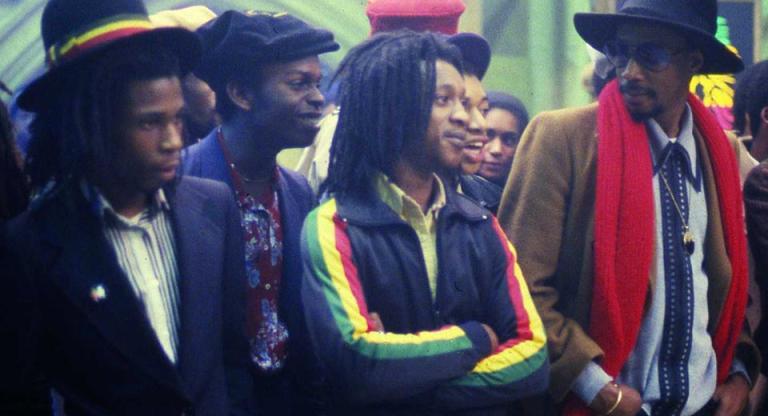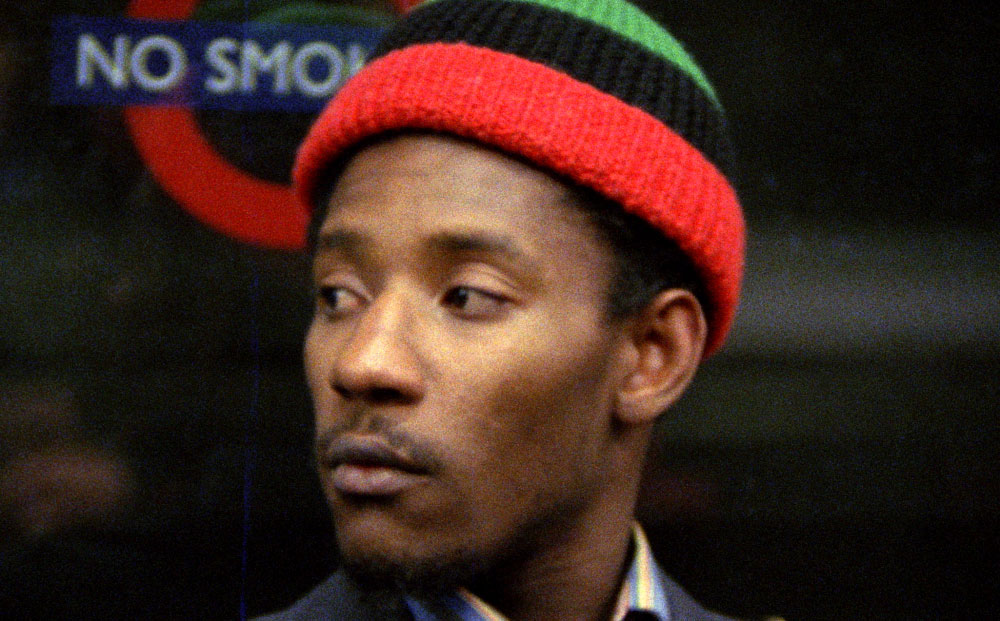
In the newly restored Dread Beat an Blood (1979), Franco Rosso (director of cult classic Babylon) portrays the life of the Jamaican-born dub poet and recording artist Linton Kwesi Johnson, whose voice has been fundamental to interpreting and presenting the political consciousness and vernacular of the 20th central Black freedom movement in the United Kingdom. As in Rosso’s Babylon (1980), a portrait of sound system artists amidst incendiary racial tension and police brutality in Brixton, Dread Beat an Blood is built on the historical framework of the political struggle that underwrites Black bass culture. Set to the poetry and score of Johnson’s 1975 book of poetry-made-album, Dread Beat an Blood, the film meditates on the insurgent spirit of Johnson’s music and poetry as inseparable from the everyday spaces in which struggle for liberation takes shape. Toward the start of the film, in an interview with a British news outlet, Johnson speaks about the stakes of sonic language in terms of a greater struggle for justice: “People are not just blood and flesh, but they have within them histories, knowledge, through centuries of time.”
The film opens with a close-up view of Johnson in his recording studio, seen in mood-rich hues of red. His lyrics, like the film’s opening phrase (“music bleeding out”) prod at the relationship between musical language and the physical body. This is clear in shots of Johnson framed by the physical and material presence of his artistry: at his desk, stacks of books and folders of drafted materials overhead seem as if they are about to spill onto him; or, tucked in the back of a wide-open moving van with his friends, he lounges atop bulky sound system equipment, toes jutting off the edge of the vehicle. Shots like these make it clear that music inhabits and transforms the spaces it occupies.
A committed reader of Frantz Fanon, Johnson creates music and poetry to document Black political consciousness and language shaped by racial violence and alienation. In the film, Rosso documents Johnson’s eulogy of David Oluwale, a Black man who was killed by British Police officers in 1969, as well as Johnson’s participation in marching against the wrongful imprisonment of Black Briton George Lindo. Rosso also uses footage of Black youth pushing back against police officers, of Johnson meeting with students and recording his music, of him playing dominoes and record shopping, and of Johnson participating in the community’s organized responses to racial violence. While Johnson is often in frame and his charisma anchors Dread Beat an Blood, Rosso makes it clear that Johnson is both a leader and a listener who takes part in conversations with young people whose voices may not have otherwise entered the record. In one scene, where Johnson is seen visiting a classroom, his endearment toward the youth becomes especially evident. A sweet, open smile emerges across his face, crowning the sonic elegy with yet another rhythmic tension that’s a part of Johnson’s life: the richness of his internal and political life. Johnson and Rosso express a dynamic language in which joining the crowd, rather than observing, is requisite and implied. As Johnson states clearly in his poetry, white "fratnicidal" violence will be transformed for other means: toward liberation.
Dread Beat an Blood screens this afternoon, July 25, and throughout next week, at Film Forum. It will be accompanied by Roger Thomas’s Linton Kwesi Johnson In Concert.
See Also