Such was the surreality of the American social fabric in 1970 that six weeks before the Weather Underground accidentally leveled one of its own Greenwich Village hideouts with a nail bomb, Brian De Palma released his fourth feature, Hi, Mom!, which concluded with Robert De Niro’s urban-guerrilla planting dynamite in the laundry room of his co-op while his pregnant wife naps a dozen floors up. In 2026, De Palma’s manic romp cuts through the fog of boomer sanctimony, slowly suffocating us all by satirizing both the war-mongering establishment and the ridiculous sybarites shaking their puny fists at it. Like the ‘40s gumshoe whose cynicism was merely the scar that formed over a wounded idealism, De Palma hilariously dunks on revolutionary art and activism without ever siding with The Man. The film “is too unintegrated [and]... doesn’t work,” he later told film critic David Bartholomew, but the vibrancy of its loose strands make it a fitting portrait of the waning ‘60s.
True to form, De Palma serves a Hitchcockian opening with De Niro’s Jon Rubin pointing an 8mm camera at the wall of apartment windows opposite his own. Through his viewfinder he captures a society in thrall to both the sexual revolution and consumer gadgets. Nearly everyone he spies on spends their time fiddling with A/V equipment of one sort or another. A father records audio of his sons fumbling through “This Land Is Your Land”; a sex worker lets a John take nude pictures of her; a mother watches TV while vacuuming; a tenant makes a documentary about her life in the co-op. Rubin approaches a porn producer with a semi-earnest (De Niro’s smirk makes it hard to tell) pitch for a sleazy, vaguely Warholian documentary smut project: “It’s what I call ‘Peep Art’.... these are real activities. The only compromise in this is when people close the blinds.”
The setup stems from Hitchcock’s Rear Window (1954), but the film’s guiding light is Jean-Luc Godard, in both his early romantic and late ‘60s essayist incarnations. In the film’s first third, De Palma and a handheld camera jumpcut through seemingly improvised two-hand scenes, such as a slumlord’s hysterical tour of a hovel whose price keeps going up. An hour later, Rubin is reading revolutionary paperbacks aloud directly into the camera. While pitching the porn producer, he apes Godard’s look with tussled hair, dangling cigarette, sunglasses indoors, and blazer. The Cahiers crowd shaped the concept and iconography of the auteur in the 1950s, but by the 1960s they were themselves part of the image that De Palma and his peers had lapped up and were eager to regurgitate in their own films. Hi, Mom! has an impressive list of things on its mind, but principally among them is the figure of the film director. Rubin is an unscrupulous hustler who neurotically rehearses his seductions and obsesses over his gear, while De Palma gluttonously riffs on Tati, Antonioni, Truffaut, and cinéma vérité, oscillating between reverence and mockery.
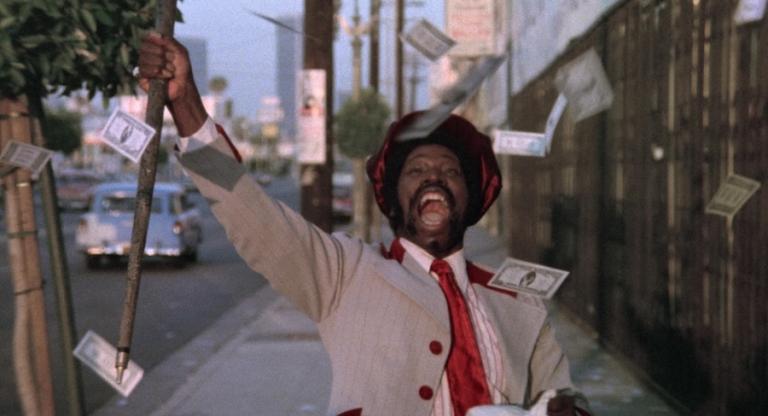
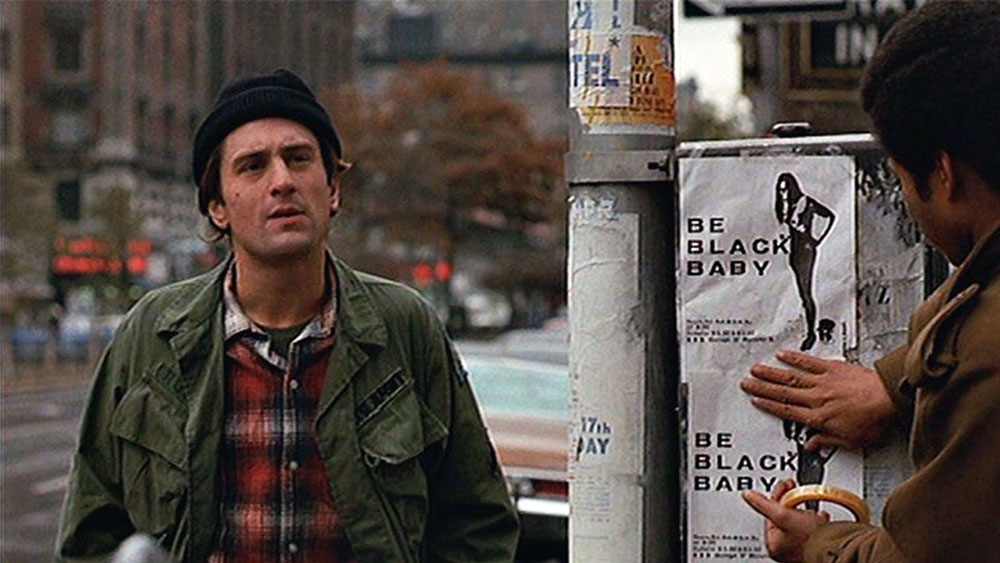
Rubin trades in his camera for a television after a technical mishap blows his budget, but he stumbles into auditions for an experimental theater piece that shapes the film’s final third. A troupe of Black actors in whiteface put a mostly white audience in blackface to give the well-meaning liberals in the latter category a sense of the Black experience. Rubin plays one of the cops who arrives to abuse the blackfaced audience members after they’ve been robbed and sexually assaulted by the “white” actors. His audition scene is a hilarious but no less disturbing dry-run of Travis Bickle’s mirror selftalk in Taxi Driver a few years later. This taste of revolutionary art inspires Rubin to study urban guerrilla warfare. He marries one of the subjects of his failed peep film and adopts the role of pipe-smoking, slipper-wearing square while plotting to blow up his own apartment building.
Hi, Mom! somehow takes the war on the establishment seriously while painting its combatants in buffoonish broadstrokes. No amount of dynamite in a washing machine can begin to reach the self-evident insanity of Henry Kissinger and Robert McNamara.
Hi, Mom! screens this evening, July 24, at the Museum of the Moving Image on 35mm as part of the series “De Palma: Summer of Suspense.”