It was maybe the fifth or sixth bridge into James Benning’s latest feature that I noticed the skies just kept being cloudy. That’s not an accidental detail for a filmmaker who (among much else) is one of the great landscape artists, here adding EIGHT BRIDGES (2026) to a serial practice perfected on 16mm in the 2000s with 13 Lakes (2004), Ten Skies (2004), and RR (2007). As if merging elements from all three, Benning now invites our contemplation of the American built landscape through a human-made structure that, at once practical and promissory, is as freighted with meaning and metaphor as the great American road.
The series of static 10-minute fixed digital shots begins with a star, the Golden Gate Bridge in San Francisco, as glorious and monumental as ever in evoking the hues of dawn and hence transition and new beginnings. Benning’s variations in angle, horizon level, and color start with this foreshortened perspective from the Sausalito side, marveling at the span’s scale and range yet including a human viewpoint through people picking their way along (in the bottom left corner) and the hum of cars—or is that the sea. The Golden Gate is a work of art (and the first bridge that Benning filmed, on a sort of trial run) but doesn’t define this project, as the film’s journey will do more than send postcards back from across the country.
With bridge #2—the Rio Grande Gorge Bridge—we become increasingly aware of not just the strength of these support structures but their contingency and hence fragility. These cantilevered arches impress, but the ant-farm stream of cars evoke more a ribbon or a tightrope; the bridge allows passage but isn’t mightily bestriding the Earth in this flatter image. A decision was made to engineer and build this public work—a bridge tends to solve a problem and provide a way—and to maintain it. But as bridge #3 reminds us in a closer shot, none of these exist in a vacuum: the hopeful high arc of the Edmund Pettus Bridge from Selma, Alabama—the site of the Bloody Sunday 1965 attacks on civil rights marchers by police—shows history lives in every landscape. Even as EIGHT BRIDGES continues to other, less iconic sites, Benning taps into the tension inherent to these spanning structures as they hold up, or, perhaps someday, don’t.
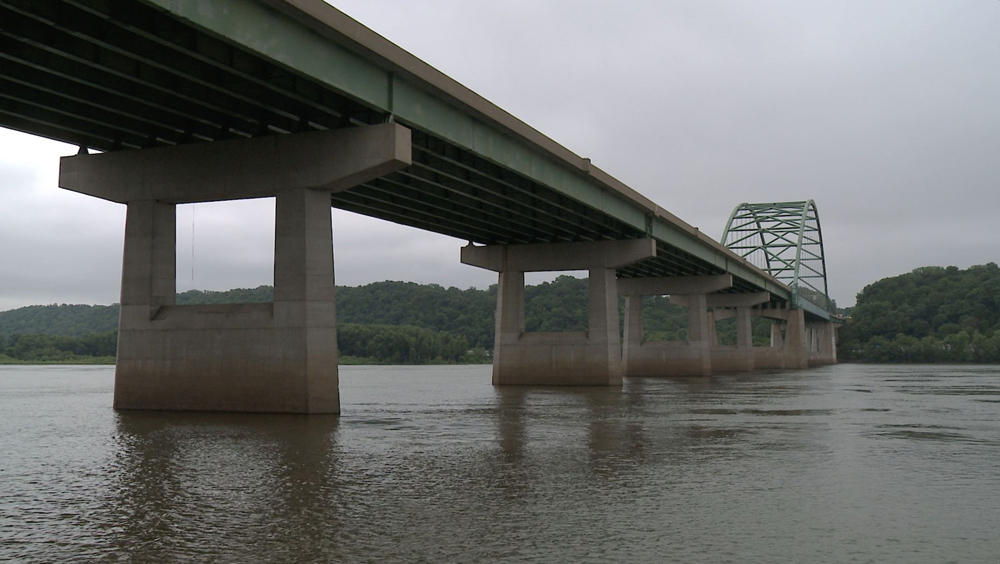
And I kept coming back to the clouds (which, to be fair, don’t grace every image, but most). Feeling the clogging roar of the GWB, or piqued by the minty green of the Dubuque-Wisconsin Bridge (fondly shot by Milwaukee-born Benning), or tracking the voluptuous crawl of a ship past the Astoria-Megler Bridge, I would still ruminate, in these calamitous times, whenever there was a lull in activity or an absence of cars or people. Will these bridges be used, abandoned, sold, destroyed? Are these in media res portraits or memorials for the future? Do we make it across?
EIGHT BRIDGES screens this afternoon, March 8, and on March 11, at the Museum of Modern Art as part of the series “Doc Fortnight 2026: MoMA’s Festival of International Nonfiction Film and Media.” James Benning will be in attendance for a Q&A.