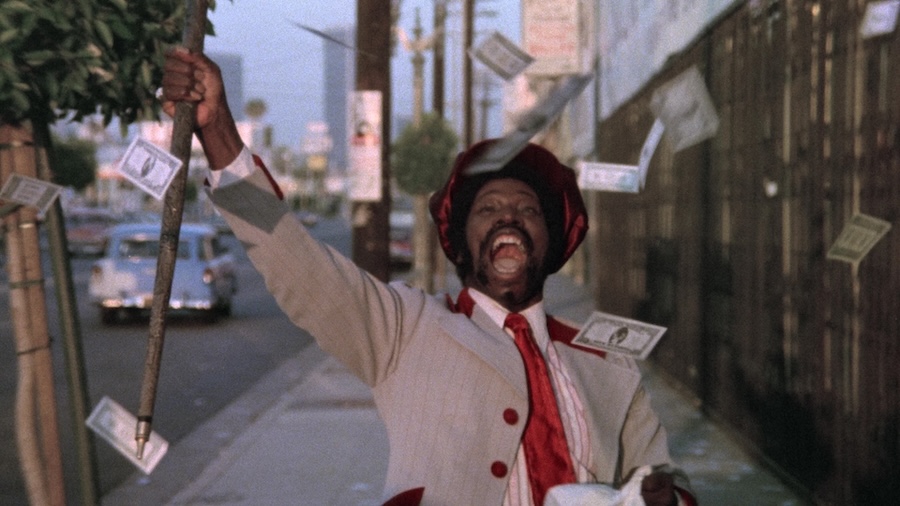
Though best known for playing the deliriously dripped, karate-kicking hustler Dolemite (1975), actor/producer Rudy Ray Moore had several other equally outrageous cinematic alter egos on his roster. Case in point: Petey Wheatstraw. Written and directed by Cliff Roquemore, though based in part on material from Moore's pre-cinematic "party records," the eponymous 1977 film is ostensibly a riff on Moore's earlier, career-defining film work. Unlike Dolemite, though, Petey Wheatstraw is given both an onscreen infancy and, most significantly, an interdimensional conflict.
Born a fully grown boy, Petey Wheatstraw is bullied mercilessly until a mysterious old man takes him under his wing and offers him mentorship in the martial arts (cue training montage). Adult Petey is, much like Dolemite, an impresario whose "revue" touches down in Los Angeles, much to the chagrin of rival promoters Leroy (Leroy Daniels) and Skillet (Ernest Mayhand), who manage to land Wheatstraw in the underworld, where the eccentric antihero makes a deal with the devil to become "the high sheriff of hell." What follows is as unpredictable as it is entertaining.
Moore and Roquemore push Blaxploitation to the far edge of absurdity as Petey Wheatstraw veers from raucous physical comedy, including a chase scene straight out of a one-reeler, to startling moments of painful realism. Some deaths are cartoonish, others deeply felt. From visual gags to turns of phrase, Moore and Roquemore appear to improvise their way through the film's wildly irreverent hour-and-a-half-plus runtime. The story plays less as an arc than as a series of stylistic zigzags; it's rich in non sequiturs and found-dadaism. Though sold as a horror movie, Petey Wheatstraw doesn't offer much in the way of chills, gore, or scares; although, it gleefully riffs on the genre's tropes as much as it does on those of kung fu and Blaxploitation. Combine all three and you have Lou Cipher (a scene-stealing G. Tito Shaw, in his one and only film role) sporting a flared, open-chest jumpsuit belted in glitter, his henchmen red-horned, silk-caped kareteka with melted faces. Add Petey's jewel-capped magic cane and Moore/Roquemore's outlandish skewering of racist tropes, and Petey Wheatstraw is the kind of film that could truly be regarded as a cult classic. Seen through the lens of the 2020s, this unapologetically independent film lands somewhere between Wiseauan abandon and Coffin Joe's no-budget atmospherics—and it’s all set to a requisite soul/funk score.
Petey Wheatsraw screens Saturday September 12 at 9pm at the Orinda Theater.