Guillermo del Toro has cited a rather unorthodox inspiration for the supernatural horror in his debut feature Cronos (1992): his relationship with his grandmother. The film takes the traditional vampire narrative and wraps it around a tale of alchemy and addiction. It is as concerned with the natural, human body as it is with technology, however crude it may be. By now, it’s abundantly clear through his ongoing body of work and decades of on-camera interviews and audio commentaries that del Toro is infatuated with monsters but, more so than most filmmakers, he finds an inherent empathy alongside their requisite terror. The vampire in Cronos isn’t a caped, fanged harbinger of evil but, rather, an old family man who longs to be young.
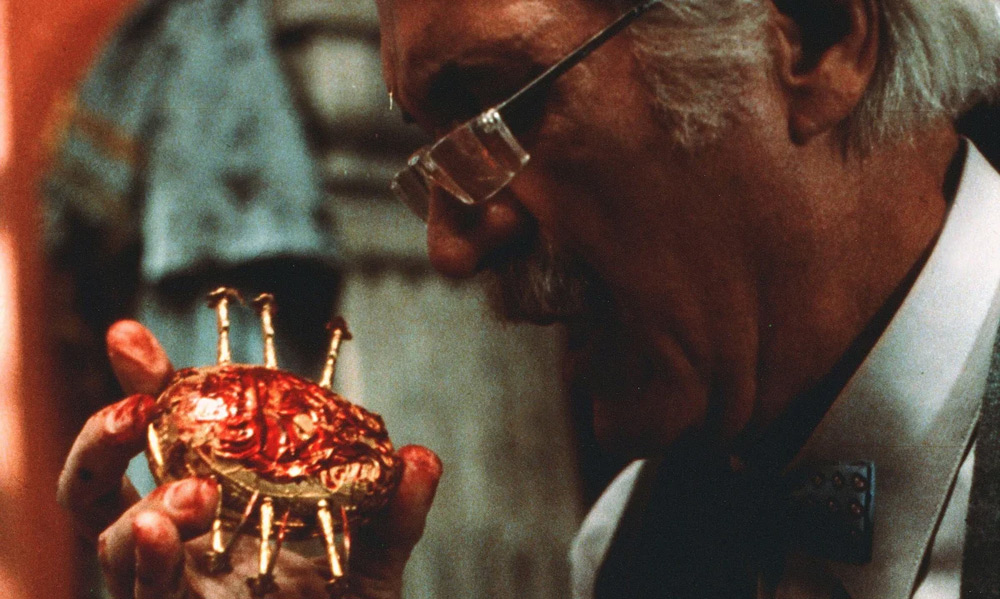
The crux of Cronos’s admittedly eccentric narrative finds an elderly antiques dealer discovering a strange golden contraption inside of a statue. When he accidentally triggers it, the device attaches to his flesh. It turns out that the ornate piece of machinery is actually the work of a 16th century alchemist who sought to live forever and using it has dire consequences. Naturally, a dying, wealthy businessman has been looking for it and will stop at nothing to possess it.
Cronos is tonally offbeat in a manner that few horror films manage to be. It mashes up the conventions of monster movies, folk horror, melodrama, and film noir—it even has a dash of Hellraiser (1987) in there too. It’s clearly a passion project for del Toro, and his comments about its autobiographical nature ring true because of his affection for the characters on screen, most notably the central grandfather who becomes addicted to the titular device and its youthful pleasures. Despite his increasingly monstrous appearance, del Toro never renders the grandfather as a (or the) villain of the film; if anything, he is a victim to the circumstances, and unfortunate reality, of life. In del Toro’s vampire film, the vampire in question is a sympathetic figure and the real enemy is time itself. That and the rich businessman and his violent nephew who would happily kill to get their hands on what they want.
It’s easy to see the pieces of del Toro’s career to follow in the DNA of Cronos: insects become the focal point of his follow-up film, and Hollywood debut, Mimic (1997); the haunted past is rendered more explicitly in The Devil’s Backbone (2001) and Pan’s Labyrinth (2006); his wily approach to vampirism becomes even more so in Blade II (2002); and his affection toward monsters eventually garnered him Oscar wins with The Shape of Water (2017). But the del Toro film that Cronos feels most tethered to now is his long gestating and finally realized adaptation of Frankenstein (2025), which again marries alchemy with technology and melodrama with terror. It’s a reverential adaptation, for sure, but it’s also reliant on del Toro’s palpable empathy for that story’s monster—something that we can see the genesis of back in 1992, when an unknown filmmaker from Mexico wanted to tell a vampire story unlike anything he had ever seen before, and we hadn’t either.
Cronos screens this evening, January 5, and throughout the week, at IFC Center.