The Guangdong-Hong Kong-Macau Greater Bay Area is a container. The idea of the Greater Bay Area first emerged in Chinese state policy relating to the Belt and Road Initiative, as planners stressed its importance to overland economic corridors. The cities within its purview encase the silty waters of the Pearl River Delta (an older, more established name for the region), which itself contains myriad islands and tributaries in an urbanizing mosaic of loess. Place names contain, integrate, and occlude other place names in a bid for administrative primacy. And in these places live millions of individuals with their own relationships to the water.
This sense of scale is what the artist Zhou Tao plays with. The images in his new film, The Rib of the Greater Bay Area (2026), like those in his previous film The Periphery of the Base (2024), are the product of shooting and slowly panning across the environment with a telephoto zoom lens. This technique flattens the landscapes he films into abstraction. In The Periphery of the Base, it heightens the strange marginality of the human figures in the frame, workers pacing the outskirts of a vast megastructure (which is never clarified, but implied to be some sort of pipeline) in the Gobi Desert. At their rudimentary work camps, they look like nesting birds, furnishing their surroundings with styrofoam, plastic, tarps, and other engineered detritus.
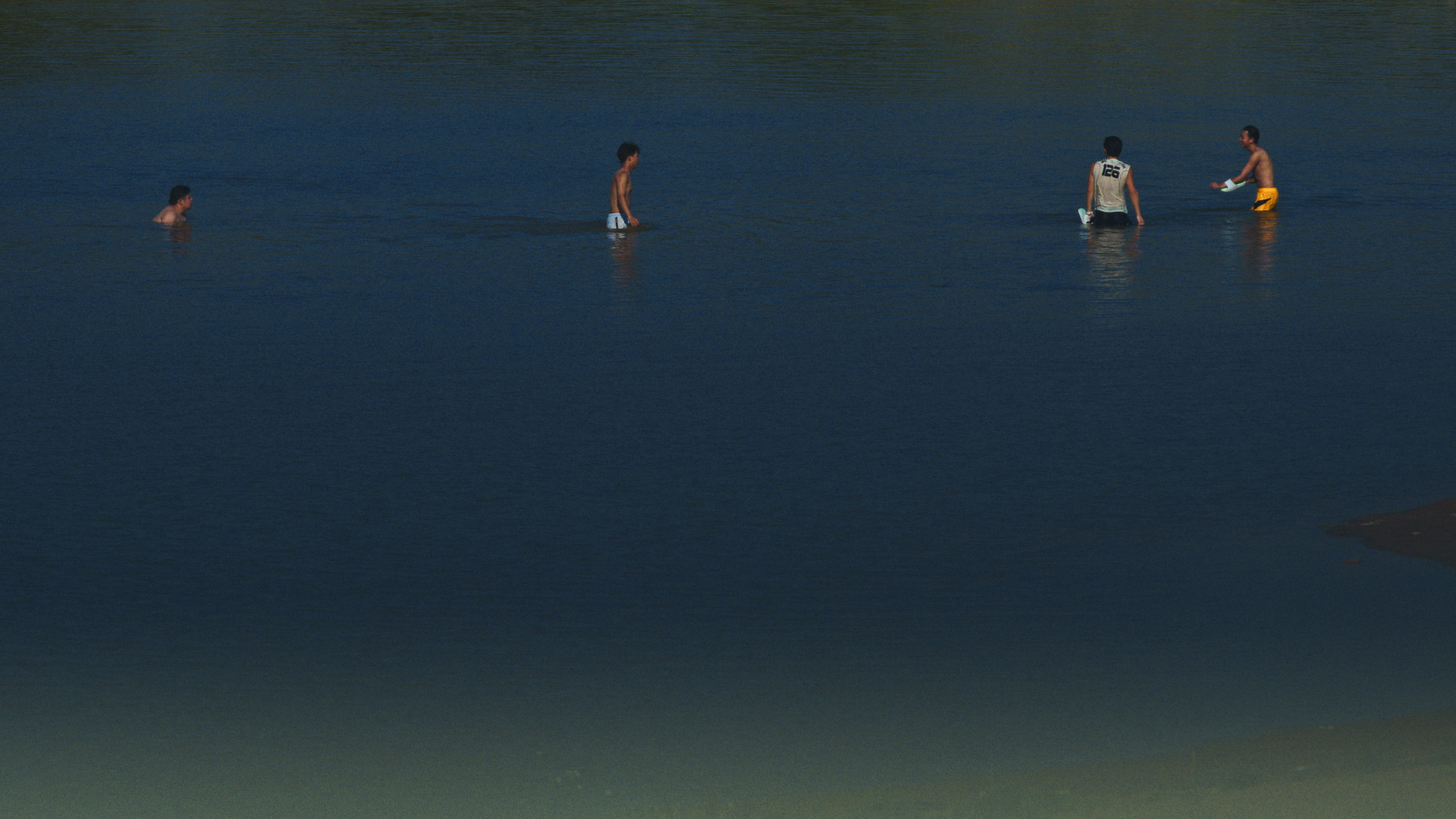
The Rib of the Greater Bay Area is similarly disorienting, but in a different way. This is a film of leisure, not toil. Zhou films locations around the Greater Bay Area which have gone viral amongst tourists as photo-op spots on Xiaohongshu, a Chinese social media network akin to Instagram. People glide down rivers in boats, splash around, go fishing, and snap wedding photos. The scenery is manicured, even charmingly rural at times. Zhou films the water as opposed to the land, often framing it so that no shorelines or promenades are visible. He catches the waves and ripples, the colors of the water, the sunlight dancing off of it. As the camera pans across the water, foreground objects, smeared into fields and particles of translucent bokeh, drift into and out of view, alternately filtering, distorting, and obstructing the image—a procession of visual marvels recalling Stan Brakhage’s Commingled Containers (1997).
The film unfolds as a seemingly unbroken sequence, though it's easy to guess when Zhou makes a cut by zooming into a darkened area or wiping the frame with something in the foreground. The effect is that of a continuous scroll stitching together different times and places, like a Yun-Fei Ji shanshui (mountains-and-waters) painting. But I was surprised to learn that Zhou doesn't seem to think of his films as being scroll-like. In an interview from 2019, he states:
I don’t think my films can be compared to a long scroll that unfolds on one side. Instead, as one side unfolds, the other side closes. You hardly get the whole picture, as the landscape is not represented [as] a panorama.
This film might be another kind of scroll—not that of a painting, but of social media, where images enter from one side of the screen and exit through the other. To scroll is to accede to an experience of the world mediated by an algorithm that links disparate moments through the logic of capital. To scroll is to reinforce the ways that capital connects and makes sensible geographies like the Greater Bay Area, thereby completing its conceptual transformation from a messy estuarine ecology into a navigable and economically integrated arm of the Chinese mainland. Perhaps this is why Zhou concludes the film by showing a gaggle of tourists with their phones out, filming islands scattered across the horizon. The scene before them multiplies across dozens of screens, but will be reconstituted in the social media networks they will presumably upload their videos to.
The Rib of the Greater Bay Area observes the hidden politics and infrastructures shaping our perceptions of place. But I question whether it adequately depicts a region that has seen so much restriction under the dictates of Article 23 and the National Security Law, which curtailed freedoms in Hong Kong after the 2020 protests. The film began as a commission for the LED façade of Hong Kong’s M+ Museum, an enormous 200-foot tall screen forming part of the city’s skyline. Naturally, there is only so much one can say on such a visible platform. Though it focuses on liminal spaces at the water’s edge, the film omits a key liminal zone: the border. Borders evaporate as the film seamlessly floats between territories. It conveys nothing of what Tiffany Sia describes as the “hellish” scroll of state violence required to secure this seamlessness:
Anticipating the inevitable, I would flip through my phone, liking pictures of dogs on Instagram to calm myself down. These minutes were marked by an endless confluence of simultaneous boredom and terror. […] Flaming barricades, umbrellas open against teargas, the stream of blue from a water cannon against small cowering bodies, and green lasers shooting across the foreground of the Hong Kong skyline made for sensational pictures… This is how the city will be consumed.
Indeed, social media is one of the main ways we consume death, destruction, pain, and conflict, immediately adjacent to aspirational images of wealth and comfort. One can hardly be a tourist without being reminded that the streets sanitized for our pleasure were once covered in blood. Yet this violence remains latent in Zhou’s film, which only vaguely hints at the underside of its glittering scenes.
The Rib of the Greater Bay Area screens this evening, March 5, at the Museum of Modern Art as part of the series “Doc Fortnight 2026: MoMA’s Festival of International Nonfiction Film and Media.”