It was 1966: the Information Age was dawning, the champagne optimism of the early decade was waning, and the New York art world had become a vast archipelago of overlapping disciplines, ranging from Pop to Minimalism to Conceptual art and beyond. Pluralism was the name of the game; paranoia was around the corner. At this fraught juncture, the trailblazing artist Robert Rauschenberg helped organize 9 Evenings: Theatre & Engineering, a mutli-night performance extravaganza that paired avant-garde artists with a cadre of Bell Labs engineers to produce large-scale performances at the 69th Regiment Armory in New York. The series is the subject of a number of documentary films by Barbro Schultz Lundestam and Julie Martin, screening at Anthology Film Archives February 6-8. The final two films in the program, on Rauschenberg’s Open Score and Yvonne Rainer’s Carriage Discreteness, convey most cogently the project’s synthesis of utopian totality with big-budget bombast.
The footage in these films is decidedly straightforward in tone: there’s little of the arty flash of, say, Andy Warhol’s films of his own 1966 multimedia event, The Exploding Plastic Inevitable, and there’s a fair amount of talking-head interviews. 9 Evenings shares some DNA with Warhol’s event and earlier ‘60s “happenings,” like those of Allan Kaprow, but was overall a bigger and glossier affair. What really comes across in these films is the scale that this technology allowed artists to work in. This was stadium-level art, and as a consequence it is often shot like a primetime event.
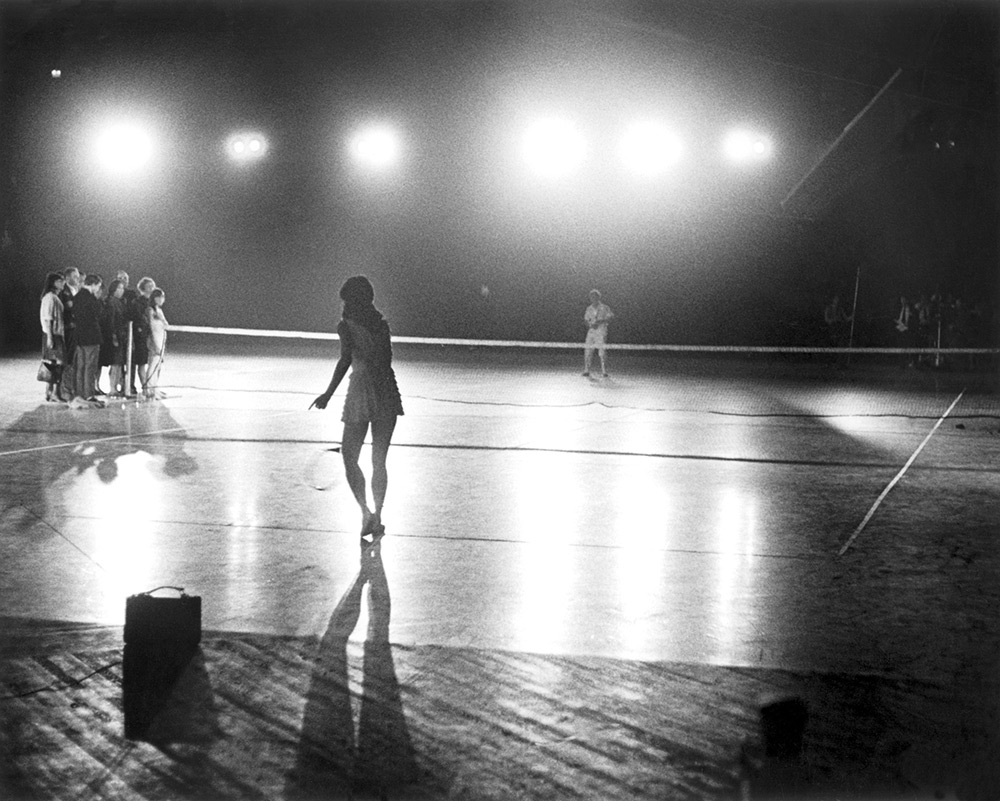
Take Open Score, for example, which opens with a tennis match staged inside the cavernous Armory. With every volley, a massive electronic chime rings out in the hall, and one of the venue’s overhead lights switch off. As the match progresses, the hall gets darker and darker; when the final light goes out, hundreds of performers descend onto the court, following strange, pre-planned movement instructions like “touch someone who is not touching you” or “women brush hair.” Ghostly infrared imagery of this throng is projected on screens suspended from the ceiling for the remaining audience to watch. High-minded performance has become entertainment spectacle: a séance and a sporting event, forged into one with the help of the brand-new surveillance technology.
Rainer’s Carriage Discreteness feels similarly huge, though it is less sportlike and more firmly rooted in the decade’s New Dance ethos. The work features a tableau of dancers standing amid a landscape of slats and cubes made by the artist Carl Andre; behind them, screens play films by W.C. Fields. We see Rainer, on a catwalk far above the Armory floor, giving directions via wireless FM receiver, and watch the performers on-stage fulfill her directions, moving objects around in a rote, machine-like manner, while various stage elements collapse in pre-programmed routines. There’s a prevailing sense of automation—Rainer’s “task performance” choreography transformed into a post-human assembly line.
There’s a definite prescience here. The high-production performance art of Matthew Barney, the directionless stage-craft of Vanessa Beecroft, and the reflexive stadium environments of Anne Imhof all come to mind. There’s also a certain wistfulness: these artists, working in a utopian ‘60s vein, seem enamored of the emerging technological regime, not yet jaded or suspicious.
Robert Rauschenberg: Open Score and Yvonne Rainer: Carriage Discreteness screen this evening, February 8, at Anthology Film Archives as part of the series “9 Evenings: Theatre & Engineering.” Artists Morgan Griffin, Julie Martin, Wendy Perron, Mimi Gross and Yvonne Rainer will be in attendance for a post-screening discussion.