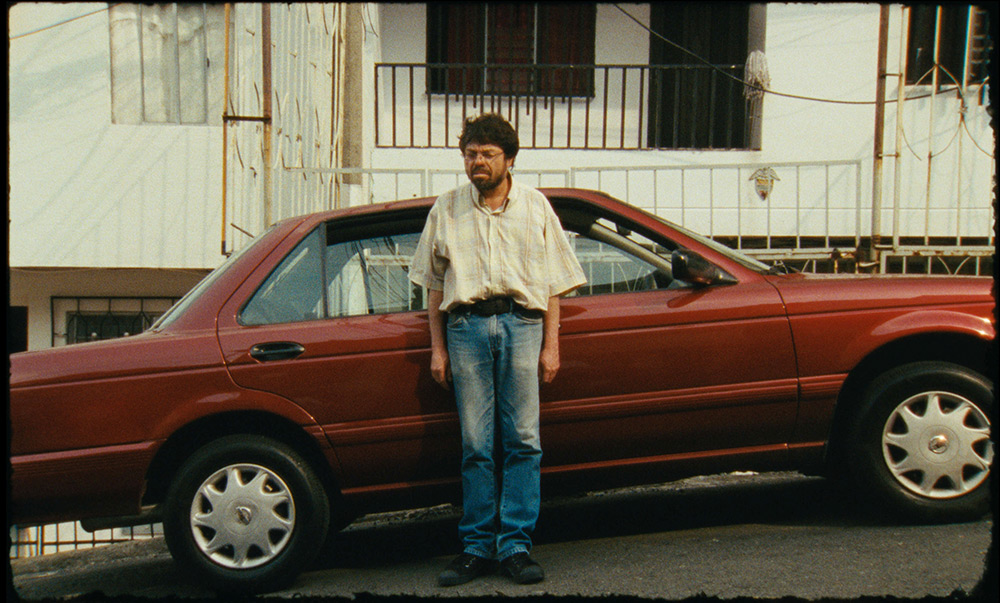
“I’m a poet,” Oscar Restrepo—middle-aged, depressed, alcoholic, and living with his sick mother—declares to his older sister. She quickly cuts back, “You’re unemployed.” It’s one of the funniest lines in Simón Mesa Soto’s riotous and raw new comedy A Poet, but also its most biting.
Oscar, phenomenally played by the nonprofessional actor Ubeimar Ríos, published two books of poetry in his youth, but after nearly 10 years of career and artistic failure, his close ones can only see him as a broke deadbeat. Now living the cliché of the tortured artist, he drinks chelas under the yellow streetlights of Medellín, singing drunken praises to the forgotten Colombian poet Jose Asunción Silva, and wildly denouncing the widely read—and easily exported—Gabriel García Márquez. Oscar likens himself to Silva—forgotten about, pained, and misunderstood—and goes so far as to hang a portrait of the forlorn 19th century poet on his bedroom wall.
Unable to pay for his daughter’s college tuition, Oscar agrees to take a teaching job at the local public school. There, he meets a soft-spoken and lower-classed prodigy, Yurlady (impressively played by nonactor Rebeca Andrade). Oscar sees potential in her poetry and she becomes his beacon of light. While flipping through her notebook of drawings and verse, he becomes illusioned with helping her become the kind of poet he never was: a successful one. “Do you also live in a profound sadness?” he asks her. Yurlady is unsure, but she goes along with Oscar’s seemingly well-intentioned pursuit. He introduces her to a poetry club, and what follows is a series of misfortunes and misunderstandings of which Oscar, inevitably and hilariously, bears the brunt of.
Frenetically shot on handheld 16mm with a gritty and documentary feel, A Poet won the Un Certain Regard Grand Jury prize at Cannes last year. It refreshingly blends comedy, sharp class critique, and a tender, heartwarming story the likes of which you seldom see coming from Latin American cinema. I spoke with Soto on the day of the film’s premiere at the IFC, during his first ever visit to New York.
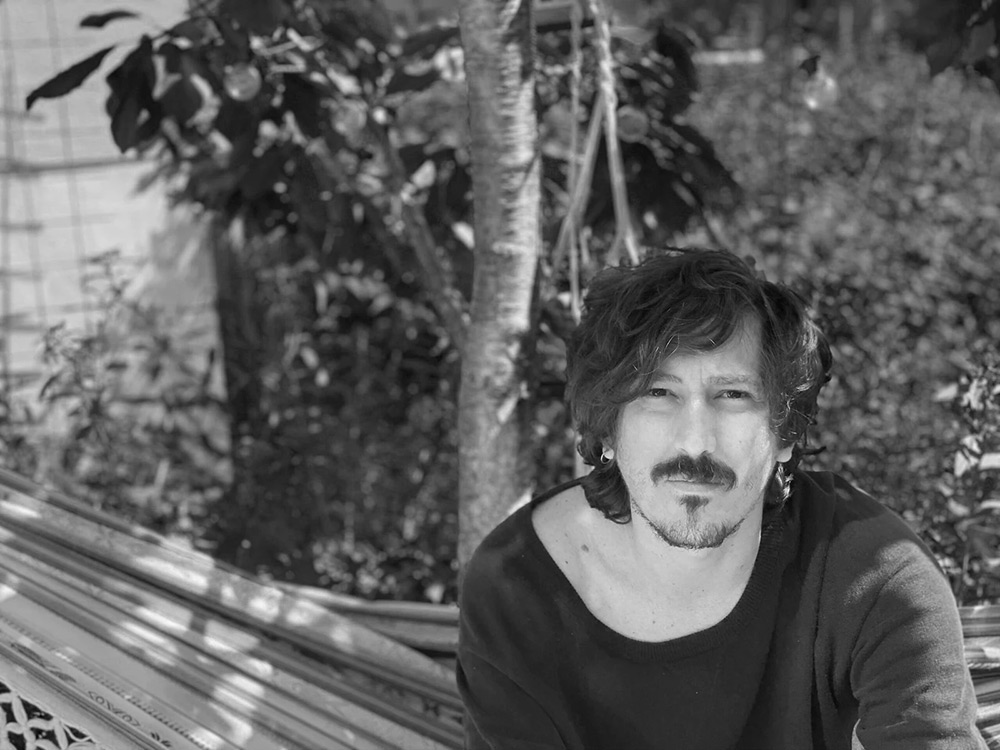
Samuel Brodsky: This is your first time in New York?
Simón Mesa Soto: Yes.
SB: That’s surprising. I was telling someone how the film has a New York sensibility to it. There’s even something a bit Woody Allen-like to Oscar Restrepo.
SMS: Woody Allen maybe isn’t as frustrated as Oscar, but there’s something neurotic or even hypochondriac about him, sure. I actually feel it’s closer to Alexander Payne’s Sideways [2004]. I find Payne to be a very, very interesting filmmaker, especially because he has a very analytical vision of the spaces and the characters, [and] the culture of the spaces where he films. That makes something very interesting. I remember when I saw Sideways for the first time, I loved it and I laughed so much.
SB: Tell me about this impressive balancing act: of making a movie about depression that feels hilarious, of a character who is pathetic but you grow to love.
SMS: I wanted to make a very saturated film: the frenetic energy, the emotions. My challenge was to make a strange film, to play with cinematic language, to free myself from restrictions and predefined forms, to look for strangeness by playing with the language of cinema. That’s also part of the film’s concept: what kind of art we make and for what purpose. We sell art as a product, as a commodity, and it loses some of its essence along the way. I was really searching for that strangeness and for emotion.
Originally, the main character wasn’t quite as pathetic. He was childish, immature, clumsy, erratic—he did stupid things—but he was more serious and less empathetic. There was a meanness to Oscar in the origin of the film.
SB: I imagine that Ubeimar Rios, who plays Oscar, brought out the humor and humanity in the character. How did you cast him?
SMS: Finding Ubeimar was a kind of magical accident. I was looking for a professional actor because the script was very dense: many characters, lots of dialogue, complex situations, physical actions. I also wanted to move away from working with non-actors, because the challenge for me was to do something radically different from what I had done before.
We ran two casting processes: one with professional actors, and another with poets, writers, and intellectuals from Medellín, partly to give the film a documentary texture. That’s where Ubeimar came from. After his first audition, that little video stayed with me. There was something very particular about the way he spoke and expressed himself. I kept looking for professional actors, but that audition opened a door to something very specific.
It was a risk. He was someone who had never acted before, and very particular to himself, to his personality. At that point the film didn’t exist yet and the risk was discovering whether he really was the character. But freedom was a constant in the making of the film. Risk became part of the film itself.
Ubeimar helped me understand the character. He also helped me understand that the film needed even more comedy. Comedy is very difficult, and at first you’re conservative about how much you allow in. But little by little, I loosened up. In the end, it was beautiful how he fit the role. He brings empathy, pathos, but also nobility and dignity to Oscar. As a person, Ubeimar has a very strong empathy toward people.
SB: You portray, with poignant and self-deprecating humor, the difficulty of being a writer or artist while staying financially above water. Art and work. It’s something that I struggle with on an everyday basis. Is that a tension that you were personally thinking about while writing the script?
SMS: Absolutely. The film was therapy for me. It was a way of analyzing myself, of reflecting on my life. I’ve been a teacher for many years…
SB: Teaching cinema?
SMS: Yes, to kids in school. And many of my colleagues in Colombia, we often go through the same situation when we make this kind of independent cinema. We’re always on the edge of unemployment, and economic stability is fragile.
That was the origin of the film. I was at a stage of life—before fully entering adulthood—where I started to realize that cinema is a huge risk. When you’re very young, you don’t think much about what will happen later. But as you grow older and responsibilities appear—stability, having a home, a family—that dream starts to tremble. I wanted to exorcize those dilemmas, of life pulling us in other directions, dealing with frustration and failure. The challenge is how to live with failure without letting it consume you, accepting it as part of the process. Making peace with failure means letting go of obsession. Artists are obsessive; we’re narcissistic; we seek validation. Sometimes that can consume you.
This film was my attempt to find calm in everyday life. The character of Yurlady represents something I aspire to: tranquility, enjoyment, making art because you’re genuinely interested in it. That’s also why it’s a comedy. I wanted to break away from the paradigm of suffering, the tortured artist, and open myself to light, to life, to enjoyment, before the process consumes you with that pessimistic cliché.
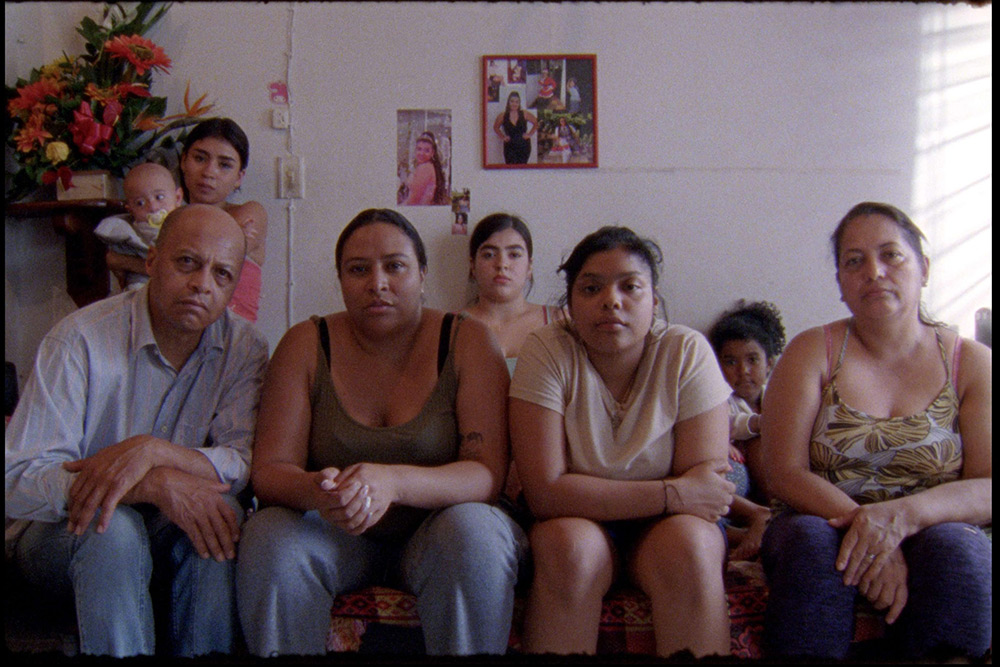
SB: Oscar presents Yurlady a path where she could, perhaps, make a living with her poetry in a way that Oscar himself is unable to. But there’s a compromise: she has to write poetry that will please “the Dutch embassy,” who is funding the poetry festival that she’s reading at, and therefore, write about her poverty, her race, and exploit a certain stereotype. There’s a critique there. I wonder if you feel this way as a Latin American filmmaker: that in order to get funding from certain grants or contributions from certain donors you have to “write a poem that has social value,” as one of the Poetry Festival organizers tells Yurlady.
SMS: Without a doubt. I’ve written those poems. And, that’s not to say that those are inherently bad or that I think those poems—or films with social values—should not be written. But, as a filmmaker, I wanted to question how much utilitarianism is involved. For instance, there are recurring themes in Colombia, or in Chile as well, where you had a dictatorship, that feel inescapable or never-ending…
SB: There’s a movie about the dictatorship from Chile every year without fail.
SMS: Sure, and those films matter, right? But there are projects that are easier to sell in their financing than others, for many reasons. The question is, “How do you approach making art from a place of something you genuinely want to do, and not from a place of wanting validation from certain circles or institutions?” I wanted to poke fun at that a little bit, of ridiculing that paradox of artistic liberty, or lack thereof. There are times where I’m writing a script, and I think, well, what do I need to put in here to get this certain grant…?
Financing this film, for instance, was fairly difficult. A comedy about a poet in Medellín, it’s not something you usually see. I had an investor ask me once after a pitch, “Where is Colombia? I don’t see Colombia.” And that was surprising, because I mean, what is Colombia? Drugs and violence?
SB: And now, thanks to you, failed artists.
SMS: [Laughs] I think one should have the freedom to talk about any subject, whether social or not. It just comes down to that question of utilitarianism and of freedom, of course. For example, now I'm interested in making films about things that start from something very personal, and not necessarily be like hooks that can generate interest in certain markets.
SB: Irony of ironies, in Colombia you have Gabriel García Márquez on the 10,000 peso and Jose Asuncíon Silva, the poet Oscar cherishes, on the 5,000 peso; in Chile, we have Gabriela Mistral on our 5,000 peso and once had Pablo Neruda on our 20,000 peso. I don’t know if putting writers on currency is a uniquely Latin American thing…
SMS: Actually, in Sweden, they have Bergman on the bill.
SB: Wow, I had no idea. In any case, you make a point of these bills in your film. There are a couple of close-ups of them. In our collective imagination in Latin America, poets are national heroes… And yet, Oscar couldn’t be treated further from it. Is there a certain hypocrisy there?
SMS: Everyone knows García Márquez, you know, which is why he’s on the 50. But not everyone knows Jose Asunción Silva, and I thought that was interesting. Silva is a giant in modernist poetry, who’s recognized in more intellectual circles, but not many people know or have read him. And, if you read about Silva’s life, it’s really interesting and deeply touching. There was darkness, which he is often associated with, but he also had a very special and loving relationship with his sister, which I found very beautiful. It was interesting to think of Oscar as having this parallel with Jose Asunción, or him having this idea that he was a reflection of him. Of what he lives…
SB: But this notion kind of traps Oscar, right? This romanticized idea of him being a tortured artist, as Silva once was…
SMS: Right. And, I wasn’t interested in idealizing poetry in this way, or making the film about romanticizing poetry. I was interested in the poet as an object of analysis—the poet as an anthropological case. That’s why I avoided seeing any of his poetry until the very end. I wanted to make it ambiguous if he was actually a good poet or not. Oscar always says he’s writing something, but you’re not sure if it’s good or bad. It’s more like the situation is what makes him pick up writing again.
SB: But you wrote the last poem, the one that we finally hear.
SMS: Yes, and I can’t tell if it’s a good poem or not. What I can say is that it’s what I wanted. It’s what I wanted the poem to say. And, I like it, because it encapsulates the end. It resonates with what I feel as an artist, which is that in the end I am searching for the light, that happy poem.
A Poet screens this evening, February 6, and throughout next week at IFC Center.