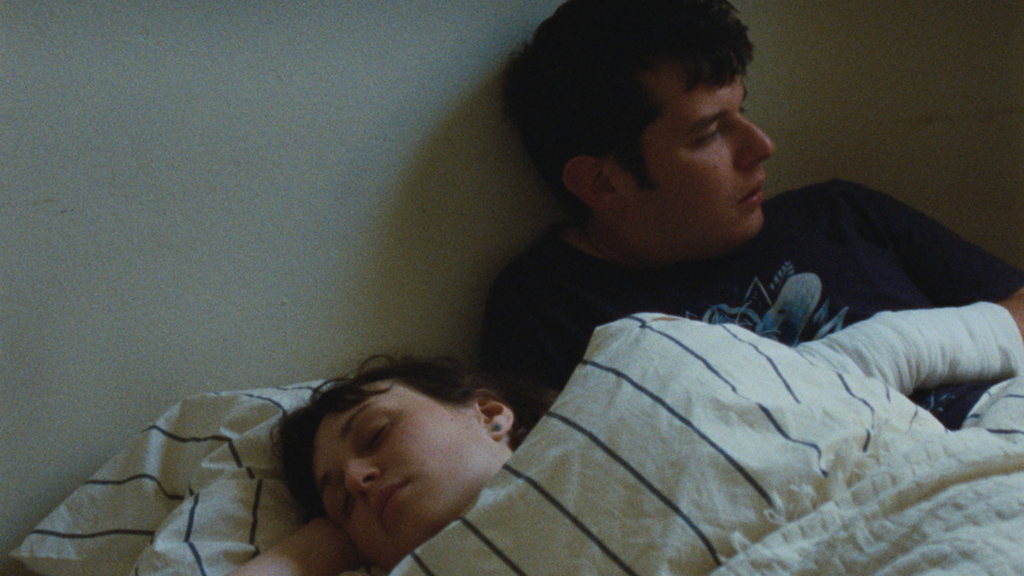
It would be deceptive to describe William Wrubel’s directorial debut, When We Saw Each Other More Often (2025), according to the foundations of its light plot—the film, like so many independent features from beginner filmmakers, follows the intersecting lives of young people—because it risks misrepresenting its lackadaisical form (more Angela Schanelec than Joe Swanberg), and more importantly because Wrubel is less interested in narrative fulfillment than he is in what can be dug up from underneath the superficialities of interaction. The film starts with a Slacker-ish conceit, as one character’s story leads to the next before turning it over to another; a couple separates, a new woman moves into the apartment, she brings a man home, he goes to an acting class with another woman, and so on. But soon, their individual picaresques become orbits around the same space: a collegiate corner of an unnamed German city—a place that, in itself, is not unique because there exist innumerable spots like it all around the world, suggesting an experience more universal than particular.
Eschewing conventional plot at every turn, Wrubel’s film is about how people say things to one another, how their bodies move, and how they look at each other. From fixed positions, cinematographer Owen Smith-Clark’s camera swivels with the characters as they whir around each other. While maintaining a naturalistic flow of dialogue, Wrubel defines relationships visually rather than through explicit conversation—what characters mean to each other is stated by their separation between shots, or how their faces fall into dusky shadow as their tension boils over.
There is a scene early in the film that, when paralleled later, is flooring. It happens when one of its main characters, Elit (Elit İşcan), sits by herself at a bar until she is the only customer left. She then reveals to the bartender that it is her 27th birthday or, more precisely, that it was. The bartender proceeds to pour her and himself two shots. Later, another character, Caro (Caroline Hellwig), sits at the same bar, in nearly the same spot. The camera sits at a slightly different angle, emphasizing the mirror behind Caro. The bartender, a different one than the one who talked to Elit, tells her that the lease is up on the space. A man then comes up asking for a knife to cut a birthday cake, and Caro watches and smiles at the singing people off-screen. As understated as it is, this scene can only be described as the emotional climax of the film—it’s not devastating, but it does capture a moment of loneliness that two of its characters aren’t even aware they’ve shared. By the time it ends, When We Saw Each Other More Often reveals itself as a portrait of people on the cusp of realizing that their lives and the world around them are changing. Wrubel concludes the film with one character photographing another, capturing, like the film itself, a fleeting moment of youth before it's gone. It immediately invokes the disappearance of those bars his characters used to drink at, the apartments they used to live in, and the relationships they used to be in. Wrubel’s film, in its commitment to duration, feels incredibly present as it unfolds, and thus, resonates as a work concerned with life on the verge of becoming memory.
When We Saw Each Other More Often screens this evening, August 30, at the Roxy. Director William Wrubel will be in attendance for a Q&A.