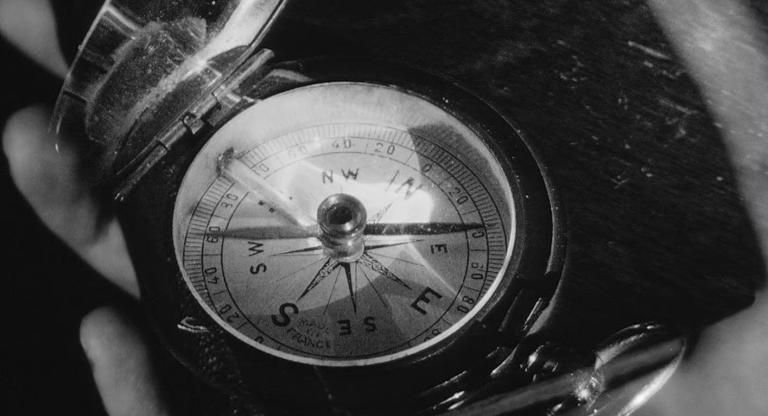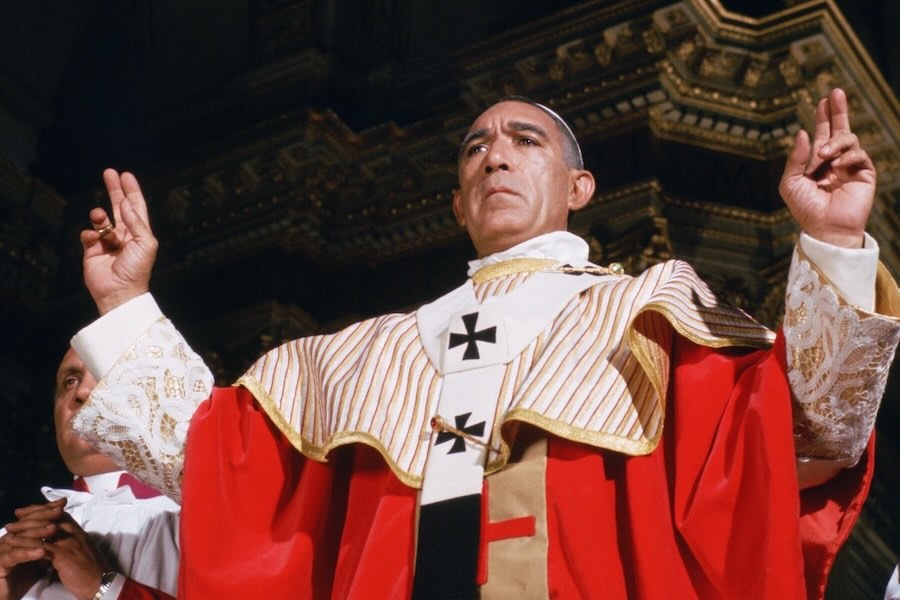
Recent years have seen fresh, imaginative depictions of the leader of the Catholic Church. Paolo Sorrentino’s HBO series gave us a Young Pope, while Edward Berger’s Conclave teased a Vaping Pope and ultimately delivered an Intersex Pope. But did you know that once upon a time, at the height of the Cold War, we had… a Communist Pope?
The Shoes of the Fisherman (1968) opens on a Siberian labor camp where Kiril Pavlovich Lakota (Anthony Quinn), the former archbishop of Lviv, has been held as a political prisoner for 20 years. With no warning, he is summoned to an audience with Piotr Ilyich Kamanev (Sir Laurence Olivier)—the Soviet Premier, and Kiril’s former jailer, with whom he shares an adversarial respect. Kemenev, it would seem, has a mission for Kiril. The world sits on the brink of war: Western trade blockades have cut China off from the rice bowl of Southeast Asia, and following a spate of crop failures, the nation faces a catastrophic famine. In response, Chairman Peng prepares for invasions of Burma, Thailand, North Vietnam, and even his Soviet allies. Kemenev remands Kiril to the Vatican, where he is restored to the rank of Cardinal. As the pontiff weighs in on growing global tensions, Kemenev hopes Kiril will advise him with his unique “East meets West” perspective. Kiril objects, but the matter is out of his hands. And go with God he does, for shortly after arriving in Rome, the pope dies unexpectedly, and Kiril is elected to the papacy. From his position as the first non-Italian leader of the church since the 16th century, Kiril must intervene to stop a world war and resolve some humbler matters along the way.
With a nearly three-hour runtime featuring both an overture and an intermission, Shoes of the Fisherman presents itself with enough pomp and circumstance for a papal coronation. Yet there’s less grandiosity here than there is a genteel regard for material that feels at once precisely of its time and perennial. While the idea that the Vatican might prevent nuclear war by donating the entirety of the Catholic Church’s financial holdings to feed the poor strains credulity in any historical context, the suggestion that world leaders might take the words of a spiritual figurehead to heart feels quaintly of a bygone era.
These tensions, of a world and faith caught between tradition and the perilous speed of a modernity on the brink, are the heart of the film. They are also best realized in its most affecting subplot: that of the friendship between Kiril and Vatican anthropologist Father Telemond (Oskar Werner), whose research on evolution and Christian philosophy verges on mysticism and threatens church orthodoxy. For his part, Quinn (who, in his self-disparaging autobiography The Original Sin, claims to have once considered joining the priesthood) brings a felt sense of internal conflict to the role, striving to embody the Christian ideals of moral certitude and humility. Anderson, a journeyman director whose 50-year career spanned the science-fiction, adventure, political thriller, and fantasy genres, went on to direct two more papal-inspired films (let’s call them “pontifictions”): Pope Joan (1972), based on the legend of a young woman who, disguised as a man, became pope; and The Jeweller’s Shop (1988), a moral tale adapted from a play written by Karol Józef Wojtyła, the man more widely known as Pope John Paul II. With Shoes of the Fisherman, Anderson displays a technical aptitude for framing the cavernous, ornately detailed recreations of the Vatican and brutalist Soviet headquarters in such a way that draws out the similarities and contradictions of their respective ideologies and the images they project to the world. His mise-en-scène doesn’t merely relativize the two as power structures so much as it suggests, equally, the faithful’s recourse to bureaucracy and politicking, as well as the politician’s recourse, in times of great uncertainty, to faith. In Shoes of the Fisherman, there is no great man of history, only the appropriate sense that every man is the same man, and that to wield power and to hold faith must either be corresponding acts, or otherwise empty gestures.
The Shoes of the Fisherman screens this Sunday, April 12, at the Orinda Theatre as part of their Wide Screen Roadshow Series.