At one point in Sarah Halpern and Tim Geraghty’s hybrid doc Monument (2026), geologist Jan Tullis, professor emerita at Brown University, describes what she sees when she looks at rocks: visible evidence of metamorphic deformation and ductile shearing as an animation unfolding in extreme slow motion. “The earth is a movie that’s still going on,” she says, a piece of slow cinema with a runtime of 4.6 billion years and counting.
Monument is also a movie that is still going on—a formally adventurous foray into untangling the rich history of the state of Rhode Island. Even after sitting through its magisterial 270 minutes, we’re left feeling like we’ve only scratched the surface of this complex material. It’s a cliffhanger, leaving us thirsting for what comes next in this parade of tectonic movement, colonial violence, industrialization, urban renewal, and real estate enshittification. Divided into six chapters that blend archival material, interviews, historical reenactment, and lots of maps, Monument is both a critical dissection of the Ocean State’s troubled past and an earnestly awed tribute to its natural and cultural beauty.
There’s a moment we’re led into Slater Mill, the first water-powered cotton spinning mill in the United States, where a National Park Service tour guide leads a group to an impressive scale model of the mill and deadpans, “This was made by a Lego artist. I didn’t know that was a thing until we met this guy.” The artist, Andrew Grover, became obsessed with the state’s historic public school buildings and started recreating them as an act of preservationist activism, later expanding his repertoire to include other historic sites. (Impressively, his model of Slater Mill features an operational drive train.) A different kind of preservation is advocated by members of the Narragansett and Wampanoag tribes, whose burial grounds, among other sacred sites, were casually excavated by successive generations of European settlers, their contents divvied up as spoils.
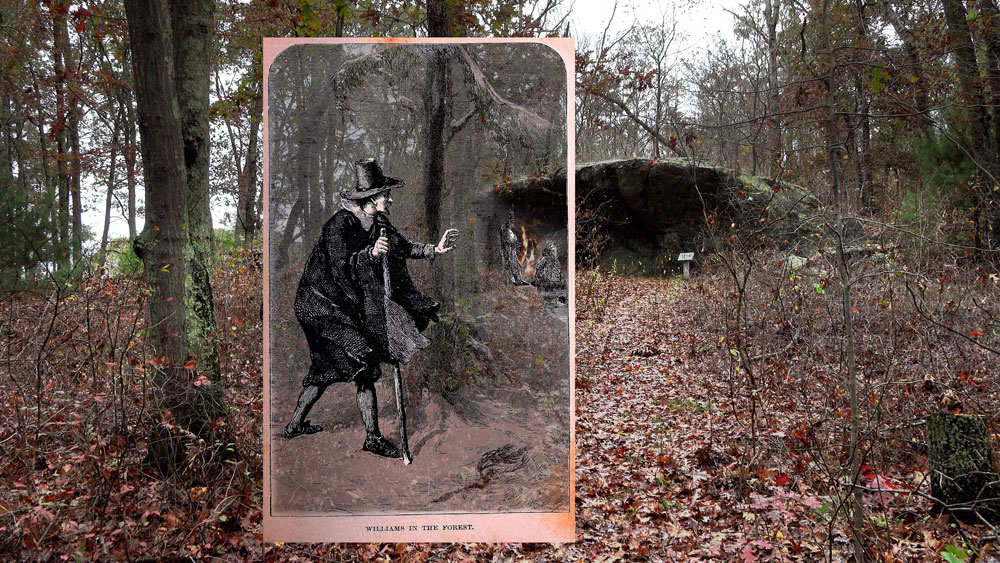
Architecture and housing are a huge theme in Monument. Geraghty’s mother, Sue—who, as a young girl, attended Catholic school in Providence’s Federal Hill neighborhood—recounts the moment she learned that people are judged based on where they live: “The good nuns used to blame everything on the ‘project kids,’” a label she soon learned applied to her. The West Elmwood and Lippitt Hill neighborhoods fell victim to the Providence Redevelopment Agency’s urban renewal plans in the late 1950s and early 1960s, and we’re treated to heartbreaking testimony from their expropriated denizens in warbly black-and-white archival footage. Tying these threads together, Halpern and Geraghty mine hundreds of local “luxury” real estate listings and synthesize them into a glitzy ad for the fictional Roger Williams Realty, named after the legendary founder of Rhode Island. The agency’s flagship properties are praised by an onscreen broker in 17th-century garb who spouts promotional copy only marginally more preposterous than the real thing: “Live-work loft life… a unique event in a preplanned community-networking space reserved for private parties. There's an unprecedented opportunity to eat-in, an in-unit urban living experience. To soak-in the water rights, flowing quietly to the center island overhang in this creative community gathering hub.”
In a move as poetic as it is sobering, the filmmakers end with Jan Tullis waxing existential about sedimentary strata: “It’s comforting to me as a geologist that man’s creations are transient. Geology will take over, and life too.” She passed away two years ago; continental drift continues in her absence.
Monument runs May 21-28 at Anthology Film Archives. Directors Sarah Halpern and Tim Geraghty will be in attendance for a series of Q&As.