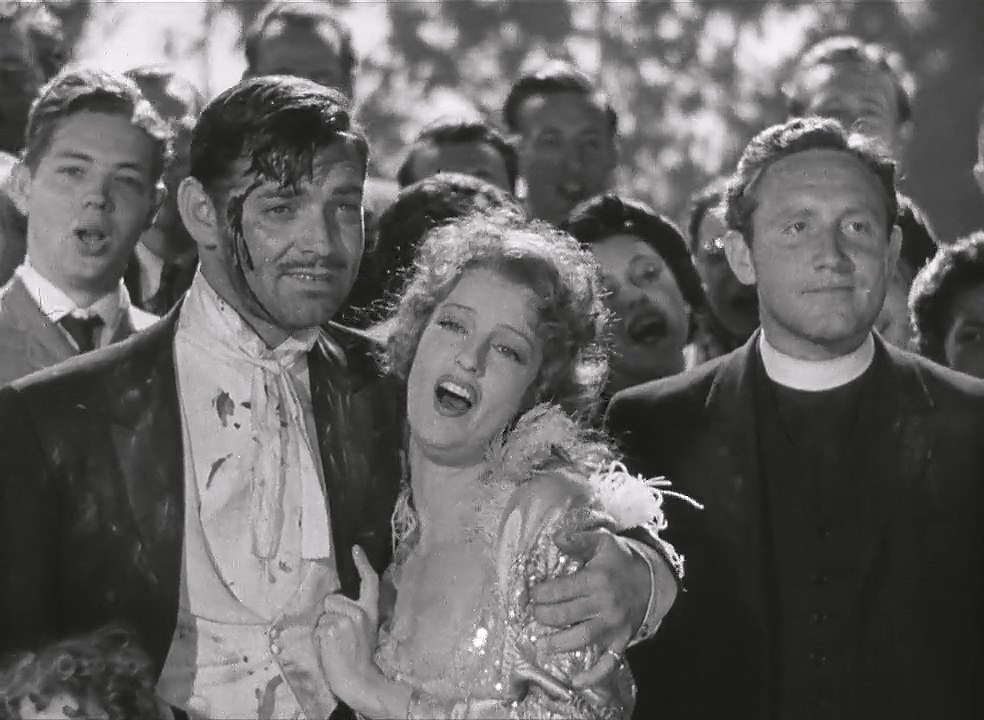
There is the city, and then there's the movie, and then there's the song. The latter two emerged together in 1936 by way of an MGM Best Picture nominee. It stars Clark Gable as a scoundrel with a code, and therefore a contender for redemption or at least for city supervisor; Jeanette MacDonald as a singer caught between low and high cultures of nightclub and opera house, that one spirited tune seeming at times like her only belonging. As for the former, it's still here, if also still prone to self-destruction.
The 1906 earthquake, says San Francisco the movie, is what propelled the city's transition from "splendid and sensuous, vulgar and magnificent" to "industrious, mature, respectable." Well. We may safely say "San Francisco" the song, arguably most familiar today as a beloved finale in Castro Theatre organist David Hegarty's repertoire of audience warm-ups, wouldn't be here without the movie.
With its sprinkle of poignant hindsight atop a heap of melodrama, San Francisco also initiated the casually historical disaster film, with 1997's Titanic being possibly our grandest and final example, in which knowing how it ends is almost the opposite of a spoiler, and the disaster itself proves insincerely cathartic but a stirring payoff nonetheless: an impressively managed choreography of then-state-of-the-art model work and other special effects. This also was from before movies had the Golden Gate Bridge to smash, so it had to work harder.
Seeing it now in any Bay Area theater tends to stoke local pride with endearing outbursts of audience approval, as when Spencer Tracy's priest proclaims San Francisco "probably the wickedest, most corrupt, most godless city in America," or when one rough customer gets bounced from a club with an extra punch in the face just for being from Los Angeles.
Still, against a real-life 2026 landscape of junior broligarchs swaggering indifferently among the destitute, and fresh daily headlines of industrialized misogyny, you might also say nowadays that San Francisco the movie hits different. It's nontrivially unnerving to see MacDonald's character treated like property by rapscallion and aristocrat alike, with little relief from their rivalry later being obviated by an act of God. And it brings to mind how, decades after the movie, there also was a great Judy Garland version of the song, with a tonally evolving, increasingly dark introductory tribute: "I never will forget Jeanette MacDonald, just to think of her it gives my heart a pang; I never will forget how that brave Jeanette just stood there in the ruins and sang."
San Francisco screens this February 28-March 1 at the Stanford Theatre on a double bill with 42nd Street.