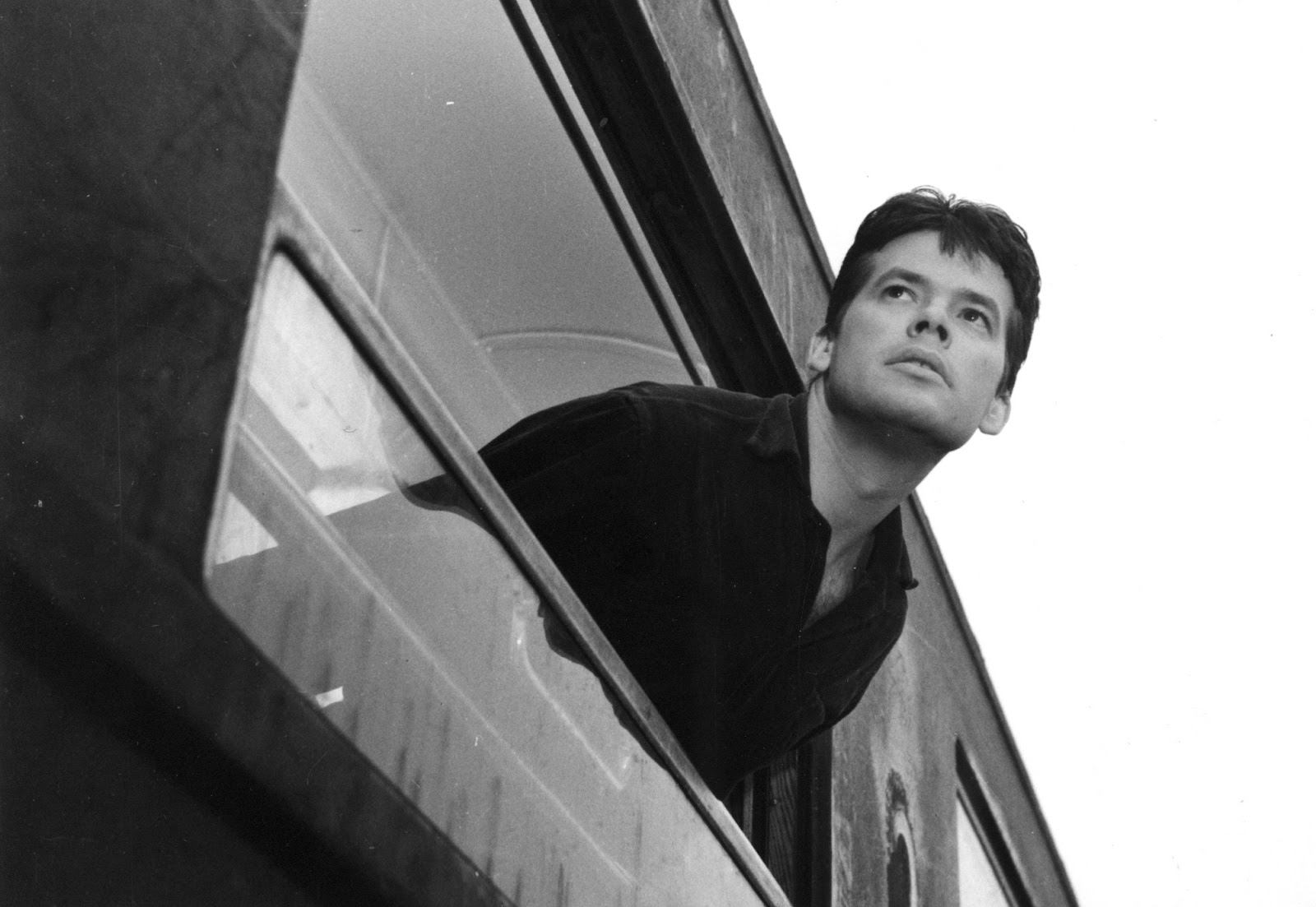
About halfway through Jerzy Kawalerowicz’s Night Train (1959), the anhedonic Marta (Lucyna Winnicka) quotes her spurned lover: “Anonymity is the disease of our times.” That sentiment is preempted by Night Train’s logline, which promises a Hitchcockian case of mistaken identity and foul play, and it’s further anticipated by opening credits that play out over a wide shot of faceless masses marching up and down the grand staircase of a train station. It’s by the time the night train reaches its unspecified final destination somewhere on the Baltic coast, and we realize we never learned the name of the male lead played by Leon Niemczyk, that such a sentiment becomes something of a key to unlocking the film’s seeming lack of political and historical specificity.
By 1959, Poland was deep in the thaw of de-Stalinization. The Soviet Union was liberalizing, and films from Kawalerowicz’s contemporaries, like Andrzejs Munk and Wajda, were speaking to Poland’s experiences under the regime. However, it would still be a few decades before Poland would entirely shake off communism, and state censorship remained an obstacle in need of creative circumvention. Unable to address recent events directly, Kawalerowicz offers Night Train as something of a temperature check: a read on the national mood through the allegory of a few strangers on a train. The one thing everybody knows about trains is that they go somewhere, and Night Train leans on this general knowledge to emphasize the pervasive mood of ennui that afflicts his ensemble of (mostly nameless) passengers. Everybody has a ticket, but nobody seems to know where they’re going.
This would-be prosaic metaphor is delivered from cliché by Kawalerowicz’s commitment to the spatial restrictions of its premise. Like any good movie set primarily on a train, Night Train is an entrancing work of light, shadow, and perspective. It’s in these qualities that Kawalerowicz is most apt to let his knack for expressive staging and clever camera placement narrate the turmoil of his ensemble’s inner lives. Their frustrated ambitions and unfulfilled desires are allotted far more screen time than the promised thrills, which are granted only 20 of the film’s 100 minutes. Yet it is in these 20 minutes, and their climax in the film’s most extended break from the narrow confines of the train cars, that the weight of so much dissatisfaction is given its only release.
In this regard, Night Train is a decidedly modernist film: its characters are seers more than actors. Agency is granted to the infrastructure and bureaucracy that surrounds them, the desires that drive them, and they are only along for the ride. Yet Night Train is nowhere near as mordant as that sounds. While the threat of a murderer on the lam is swiftly raised in the opening scenes, Kawalerowicz’s seemingly effortless direction is entirely unconcerned with the fulfillment of genre conventions, imbuing the thriller premise with a cool sense of apathy. No less a figure than Martin Scorsese, who includes Night Train among his “Masterpieces of Polish Cinema,” has observed that Polish cinema marks a rather ambivalent distinction between humor and tragedy. Night Train is indeed possessed of a blithe, unbothered attitude that emerges from its pleasingly languid treatment of material that other hands, other national cinemas, might overbear.
Night Train screens tomorrow, February 28, at the Paris Theater as part of the series “All My Memories Are Movies: Cinema That Inspired JAY KELLY.”