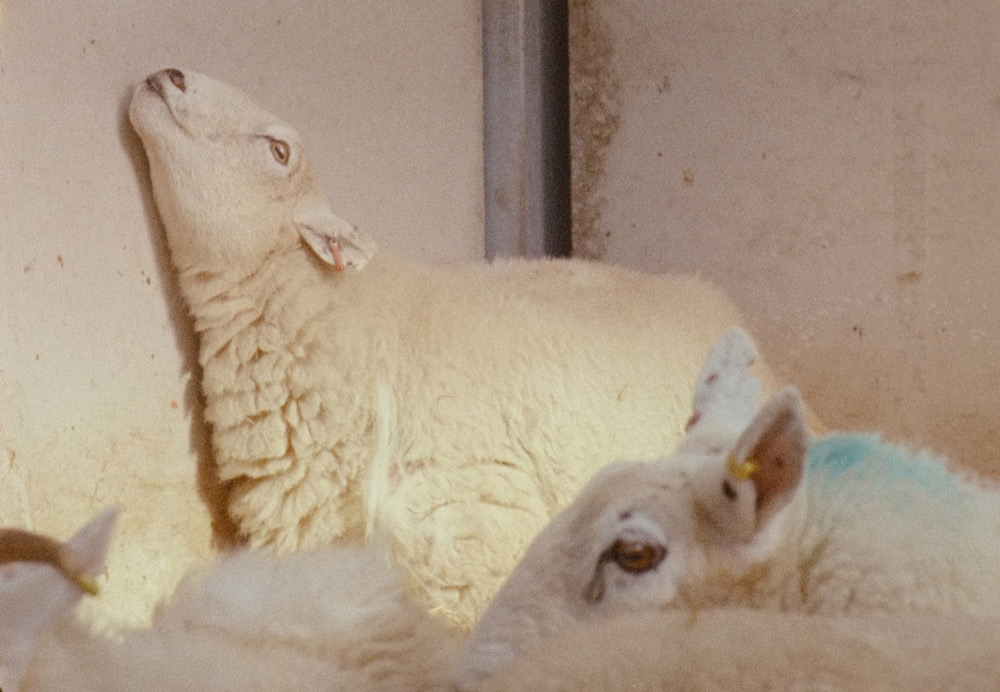
Walking into Peter Freeman, Inc. in SoHo, visitors are greeted by four editions of a silkscreen depicting a lamb in profile with the word "film" scrawled beneath. The number of prints points to the four 16mm films on view in the exhibition, one of which, Lamb (2019), is projected on the obverse side of the wall. Capturing ewes giving birth in the warm morning sun of a lambing shed on the Scottish Isle of Lewis, Lamb emphasizes the word of its title as a verb and as a noun; shots of expectant sheep panting and straining as they transform from heavily pregnant to postpartum before our eyes are intercut with their newborns' first moments in the world as a wordless soundtrack of drumbeats and high-pitched vocals adds a mythic tone to what is ultimately a common, but no less miraculous, pastoral event.
Artist collaborators Rosalind Nashashibi and Lucy Skaer, who have produced work under the moniker Nashashibi/Skaer since 2005, shot Lamb just before the pandemic. Their companion piece, Bear (2021), which was filmed during the lockdown, is also on view. The latter captures the same action as Lamb, but the artists have modified the filmstrip with brushstrokes of ink rendered in a style similar to the silkscreens at the entrance, painting over the bodies of the sheep with simplified figures of bears. As the film progresses, the ink brush is replaced with more refined, digitally added linework drawings by Regina Ohak, which describe a mama bear and her cubs, their movements mirroring that of the sheep. While some might be inclined to read a predator-prey relationship between bear and sheep, the film's focus on the tender interactions between mother and child across species are more suggestive of maternal care and companionship’s universality, a theme reinforced by the shadow of the pandemic in which it was created.
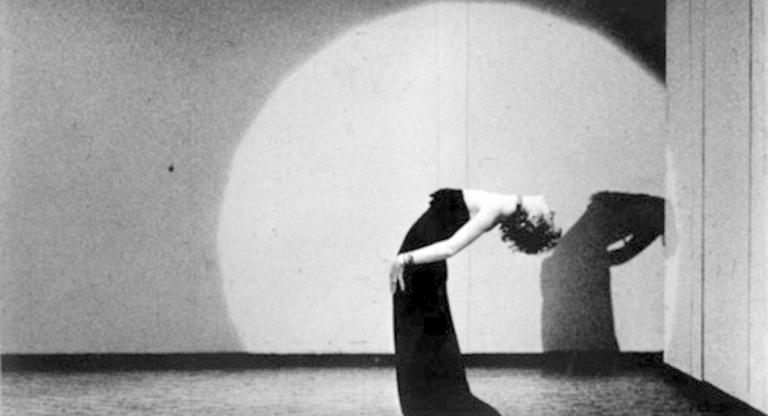
Nashashibi/Skaer's films are best read as a set of symbolic associations reinforced by formal harmonies, with elements that often echo across the artists' non-filmic works. This is exemplified in Pygmalion Workshop (2008/2025), a series of chromogenic prints that document spreads from an unnamed art book, the body text of which has been redacted by white boxes. Left only with the images and their captions, we observe the transmission of a specific motif across time and cultures, namely the "half-moon" shape used by artists to suggest life in the eyes of animals in Greek mosaics from the 3rd century BC, bronze horses of Saint Mark's from the 2nd–3rd century AD, and Michelangelo's David (1501–04). This photo series shares a wall with the film Pygmalion Event (2008), a silent, two-reel diptych—a format similar to an open book—juxtaposing footage of a priest donning vestments designed by Henri Matisse for the Chapel of the Rosary in Vence with shots of a coffee cup, a courtyard or park inhabited by three young men, and upside-down shots of a sailboat on the open sea. Best known from Ovid's Metamorphoses, Pygmalion was a sculptor who fell in love with one of his creations, which, or perhaps who, was then blessed with life by the goddess Aphrodite. The legend's invocation in the title of these works prompts us to consider the artists' transference of a subject from one format to another in such a way that new meanings arise through their transmutation—an act presumably undertaken as a labor of love.
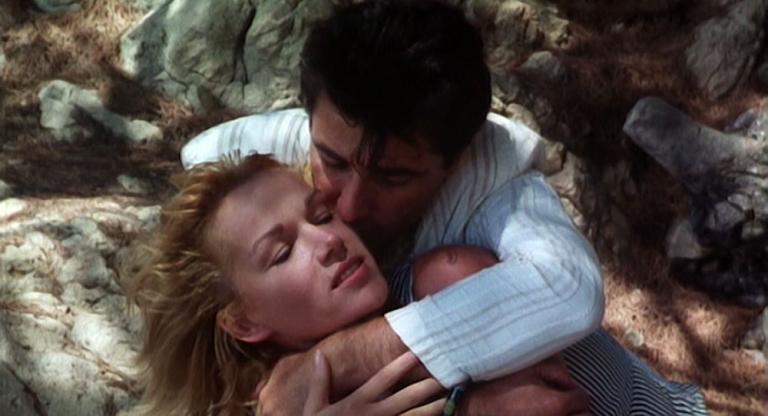
Our Magnolia (2009) likewise takes an extant work of art as a framing device, opening with a shot of wartime painter Paul Nash's Flight of the Magnolia (1944) before proceeding on to footage of real magnolia trees in bloom, followed by shots comparing waves rolling onto a beach to the shape of a cetacean ribcage half buried in the sand. Then, jarringly, the film cuts to an interior office setting where headshots of Margaret Thatcher are strewn across a desk. Judging by the age of the nearby computer and phones, this footage belongs to the era of the First Gulf War, a reference that segues into the next sequence, which follows a woman wailing as she surveys the damage wrought by looters at the National Museum of Iraq in 2003, a pillaging enabled by the Anglo-American interference in the region. The warmongering parallels between Reagan-Thatcher and Bush-Blair are clearly established before we return to shots of Nash's surrealist painting, which positions an ear surrounded by magnolia blossoms hovering in a cloudlike formation over a landscape. Does the ear of his painting hear the cries of the woman in Baghdad? The vertical scratches that reiterate across the final frames of the film return us to the space of the exhibition, where traces of humans and animals intermingle across time and space, revealing the presumed boundaries between object and image, art and life, birth and death, to be far more porous than we assume.
Nashashibi/Skaer: Pygmalion Margaret Ursus Uan is on view through February 14 at Peter Freeman, Inc.