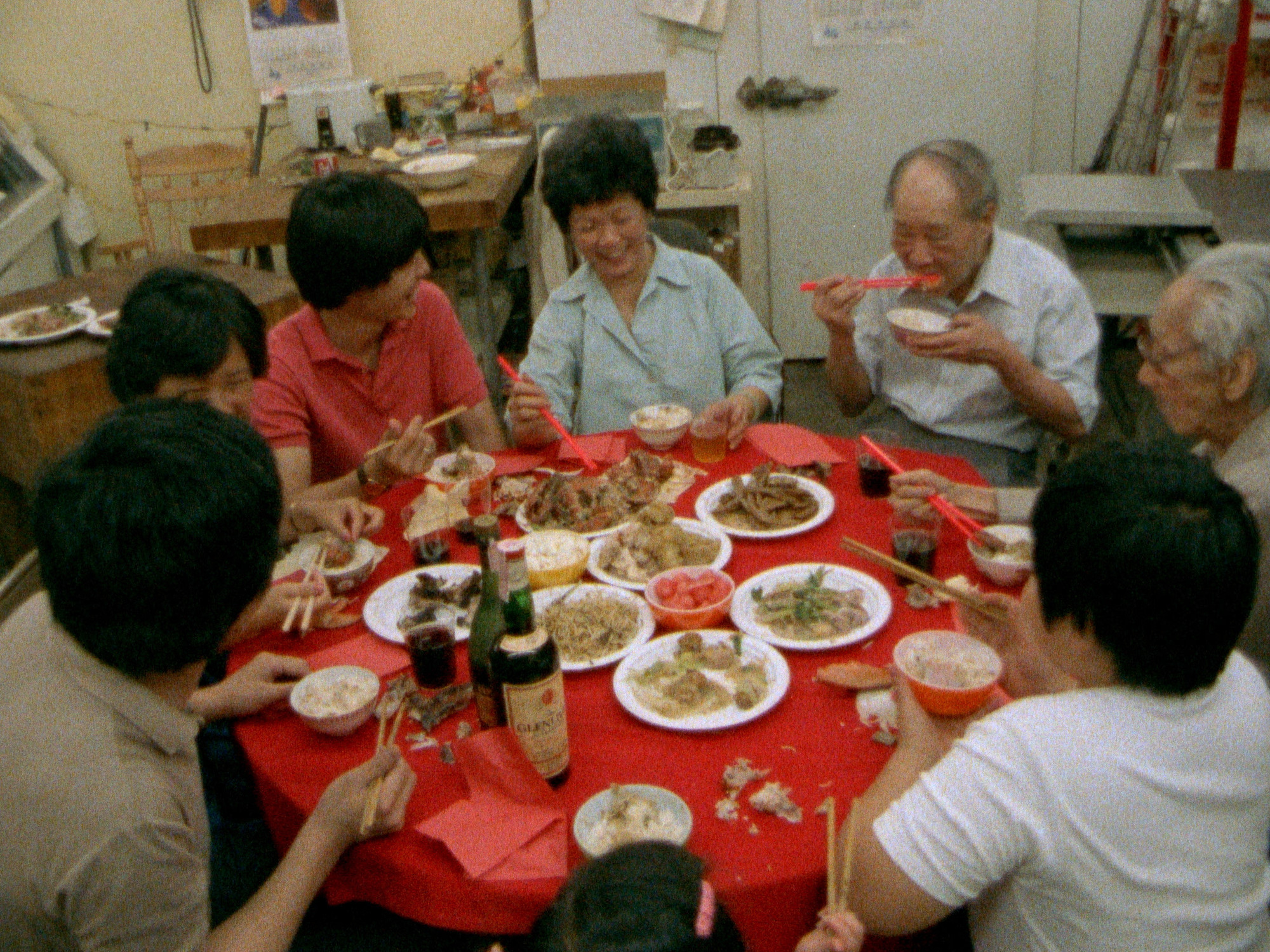
It would be easy to discuss Christine Choy, Worth Long, and Allan Siegel’s documentary Mississippi Triangle (1984) from a strictly sociological standpoint. It was inspired by the sociologist James Loewen’s influential 1972 study on race relations, The Mississippi Chinese: Between Black and White, and is built around interviews with the white, Black, and Chinese communities in the Mississippi River Delta. The Delta Chinese, perhaps most famously (and recently) represented on screen in Ryan Coogler’s Sinners (2025), have occupied a liminal space—this “between” that Loewen invokes—in academic discourses of race in the United States. Their racial identity has been characterized by their ability to reposition themselves in relation to a dominant white/Black color line. According to Loewen, the Delta Chinese (many of whom worked alongside Black laborers on cotton plantations after the Civil War before becoming minority grocers and shopowners) transitioned away from being grouped with Black people and successfully became, essentially, white.
In narrating their own family histories, the film’s interviewees cover more than just race relations. Their words equally reveal class distinctions and labor issues in a cotton economy facing an uncertain future under Reagan-era industrial policies. The filmmakers also capture shifting attitudes across generations—adults who lived through the Civil Rights Movement and the end of Jim Crow, and young people born into a desegregated society. And while all of this is a fine description of the film’s content, it hardly captures the richness of the stories on display. For example, when the Chinese interviewees speak about fighting to send their children to white-only schools, they are not speaking as case studies for racial mobility. They are speaking, as individuals, of the pain and passion involved in making a home and of making a life.
Mississippi Triangle opens with a blues rendition of “Swing Low, Sweet Chariot” and closes with a funeral. By interweaving past and present, it evokes a Delta poetics of life, land, and loss. In an early scene at a Chinese cemetery, an elderly man speaks of the land filling with graves, and of securing a plot for himself and his family. The film then jumps to a scene of petroleum barges traversing the Lower Mississippi, intercut with archival footage of devastating floods and levee camps filled with Black prisoners. The question of what it means to transform and be transformed by the land over a lifetime is as fundamental to the film as its focus on race. The Chinese are not exceptional, the film implies, because the Delta they live in is a profoundly liminal place in its own right—always changing amidst shifting waters, containing landscapes that seem suspended between this world and the next.
In her book Partly Colored: Asian Americans and Racial Anomaly in the Segregated South, the scholar Leslie Bow points out that while Mississippi Triangle may have been inspired by Loewen’s study, it also troubles its neat conclusions—did the Chinese really succeed in becoming white? We meet Chinese elders who bear the stigma of being mixed-race (such as Arlee Hen, the daughter of a Chinese railroad worker and Black sharecropper) or having married outside their race (such as Henry Goon, a Chinese shopkeeper who married a Black woman), and who were ostracized from the Chinese community because of this. Their presence complicates Loewen’s thesis; although the film depicts the uplift the Chinese community experienced in aspiring toward and allying with whiteness, it also shatters the community’s presumed unity and homogeneity.
It is startling to see people so heavily burdened with the stigma of miscegenation living alongside the children and teenagers in the film, who mention that race doesn’t matter to them, and that they wish to be friends with and date whoever they want. However, these seemingly colorblind statements betray a self-consciousness about how race affects perceptions of social status. These young people yearn to be seen as detached from the binary logic of institutionalized segregation that defined their parents’ lives, but they also seem to care about not being seen, in the eyes of their parents and peers, as too Black, or too ethnically marked based on who they associate with and how they behave. White supremacy manifests itself as the constant anxiety to be properly post-racial. Herein lies another complication in Loewen’s thesis: there is a normativity to whiteness that seems to be forever out of grasp for the Chinese.
One interviewed Chinese shopkeeper offers a resigned, haunting reflection on his life near the end of the film: “It seem like I don’t have a future no more. The only one with a future is the bright young people… The people don’t get old, just fade away, that’s all.” It’s a subversive ending to a film that is, supposedly, about illustrating the “success” of one racial group elevating themselves above others. The glories of this world are fleeting. And Arlee Hen, frail and near-death, gets the film’s last word: “I’m mixed with negro, you know. And I couldn’t be buried in a Chinese cemetery.” The pain of her exclusion closes Mississippi Triangle, a film which shows, to paraphrase a great Southern writer, that the past really isn’t past.
Mississippi Triangle screens this afternoon, July 28, at the Museum of Modern Art as part of the series “Immigrant Nation: People in Transit.”