The first glimmers of an oasis in the Nevada desert began to burble in 1931, a scant 20 years after municipal incorporation, when the dusty berg enjoyed a one-two punch of uniquely American happenstance. Construction had begun on the nearby Hoover Dam, bringing thousands of workers and their families to the Silver State. Sensing opportunity, and already overseeing a well-established haven for would-be divorcees, the desert fathers conferred yet another benediction: legalized commercial gambling. While it would be another decade until Thomas Hull opened his El Rancho hotel and casino, heretofore the largest in the state, by then the die had surely been cast.
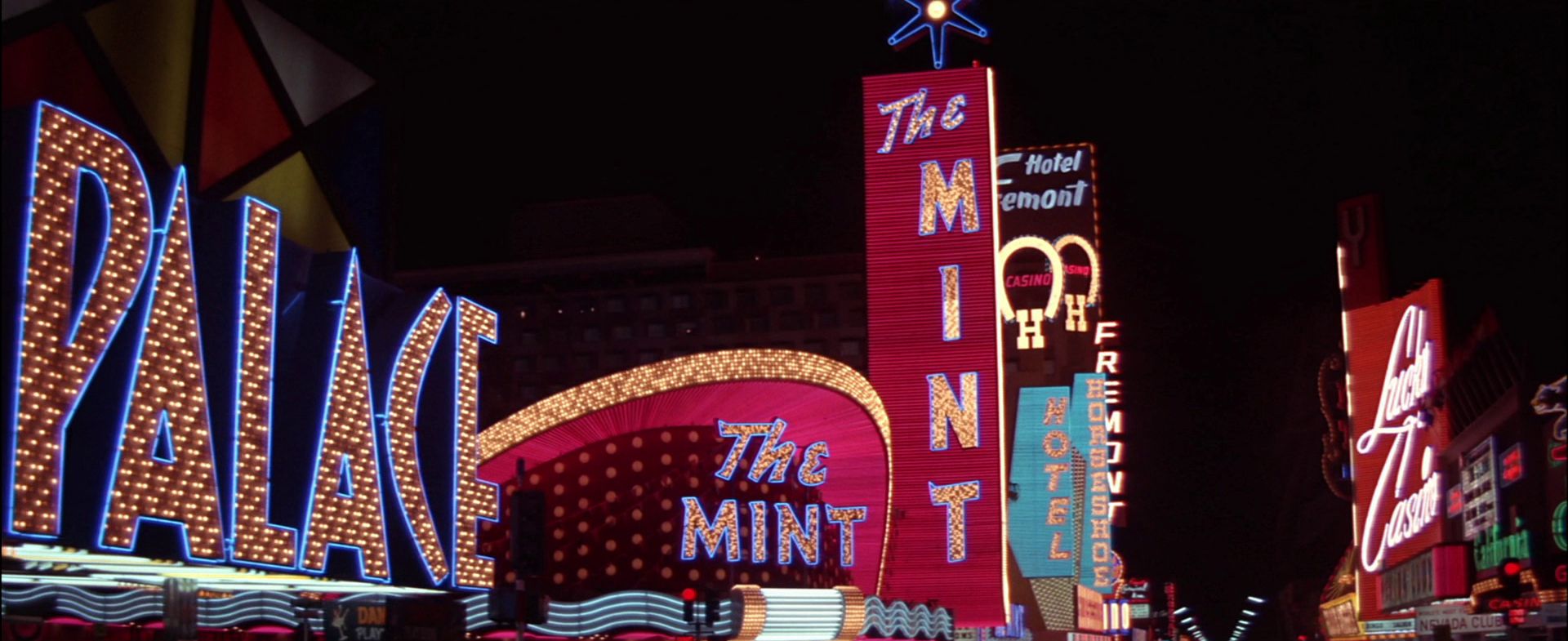
In 1946, New York-born mobster Bugsy Siegal, now operating from nearby Los Angeles, took over William R. Wilkerson's Flamingo Hotel, expanding his footprint just in time to rake in the postwar wages of returning veterans. The subsequent boom is well-documented, as were the glittering results. New casinos cropped up on a fresh 4-mile stretch, drawing business away from venerable Fremont Street toward the now-iconic Las Vegas Strip. This placement was no accident: visitors cruising through the desert on Interstate 15 get their first glimpse of Sin City just a few miles outside of town. Make the drive at night and the effect is awe-inspiring: one final hill before the descent, toward a lake of neon lights shimmering in the darkness.
Like moths to a flame, Americans began arriving in droves to a newly-built playground, one that wantonly advertised itself as a safe space for casual degeneracy. Wary of the city’s disreputable reputation, Vegas business owners made sure to tout the more wholesome aspects of their vacation destination. As much a cornerstone of Las Vegas culture as the whirring slots and turning cards, nightclub acts, dance revues, and A-list stars provided sufficient cover for the less-savory aspects of the gambling mecca. This uneasy negotiation—between American middle-class values and commercial decadence, desert landscapes and urban expansion—inspired scholarship from the outset, drawing intellectuals from the fields of economics, anthropology, and especially architecture. For architect and city planner Denise Scott Brown, Las Vegas—long considered a “non city” by academic standards—stood apart as an untamed wilderness of forms, styles, and tendencies ripe for organization and analysis.
Learning from Las Vegas, written by Brown with co-authors Robert Venturi and Steven Izenour, sent shockwaves through the field of American architecture upon its publication in 1972. Among the first texts of its kind to elevate vernacular architecture into the halls of academia, Brown and his collaborators’ assessment of the Las Vegas Strip and its surrounding environs rearranged the parameters of taste and expanded the field’s understanding of architectural form. In their new film, Learning from Learning from Las Vegas (2025), directors Sam Taffel and Gillian Waldo take Brown’s work as a point of departure to create a supplemental experimental survey of Vegas architecture both past and present. Blending archival footage and interviews from Brown and Venturi’s trips to the Strip with Waldo and Taffel’s own 16mm footage, shot in 2024, the filmmakers lay before us a fleet, sometimes funny, and often stirring 18-minute synecdoche of their source material. “The first feeling I had was a shiver,” Brown’s voiceover intones in the opening scene. “Do I love it, do I hate it? Which is it? I’m not sure, but I’m very, very attracted.”
“This project was our introduction to the text,” Waldo explained, via correspondence. “As an outsider from South Africa, Brown brings a very keen understanding to American landscapes that architects weren't always thinking critically about in the twentieth century. Her commitment to seeing the beauty in things that are overlooked really resonated with me.” For Taffel, the parallels between his collaboration with Waldo and the collaboration of Brown and Venturi paved a fated path to the Strip as subject. “The experience of reading and rereading the book together while figuring out what to make mirrored the genesis and nature of Venturi and Brown’s collaboration,” writes Taffel. “They met as work colleagues at the University of Pennsylvania, we met as work colleagues at the University of Wisconsin - Milwaukee. They loved the architecture of diners and cathedrals, we love the architecture of diners and cathedrals.”
Taffel and Waldo have chosen George Sidney’s 1964 Elvis Presley vehicle Viva Las Vegas to screen alongside their film at the Roxy this evening. According to Waldo, it represents “a time capsule of the place Brown and Venturi encountered in the 1960s.” If Las Vegas had a patron saint, it would surely be Presley, whose acolytes and impersonators continue to make pilgrimages to the Strip a half-century after his death. “The film is full of camp and kitsch,” Waldo added, “qualities Denise and Bob were interested in taking seriously and understanding as design principles.” Blending shot-on-location splendor with toe-tapping musical numbers, Viva Las Vegas is undeniably a portrait of the city at its pop cultural acme, one that forever wed Presley and Las Vegas in the minds of American consumers. “It's genuinely the closest any contemporary audience will get to seeing the city that [Brown and Venturi] saw, the city that inspired their book,” added Taffel. “So much of it takes place on the newly developed Strip, and certain shots look nearly identical to the portraits Venturi and Scott Brown took of each other—the ones that appear and are recreated in Learning from Learning from Las Vegas.”
In a filmography of hits and misses, Viva Las Vegas remains one of Elvis’s finest moments. Presley brings more than his hip-swiveling swagger to the role of racecar driver Lucky Jackson. He is, like Presley, the child of modest means, armed only with charm and know-how against his wealthier competitors in the Las Vegas Grand Prix. Casting the most recognizable entertainer in the world may be good for box office, but it's Presley’s own relatability and charm that bring us into the fold of this latter-day David and Goliath story. His hunger for success is as big and true as life itself, fleshing out the contours of a character that would offer little more than “gee whiz!” ambition and naïveté in the hands of a lesser performer. In Viva Las Vegas, the wheel of fortune isn’t one you spin at a roulette table, but one of four tires on souped-up little racecar Jackson built with his own hands, echoing the pioneering spirit of entrepreneurs who saw a vast expanse of unmolested desert and thought, “This could use some neon.”
If, as Venturi says, “all cities communicate messages,” the message of Las Vegas is one of constant flux. What can you expect from a city that turns building demolitions into must-see TV? From the outset, destruction and rebirth has always been a feature of the city: for every historic hotel razed to the ground, three more spring forth, hydra-like, to take its place. Countless films and stories have made light or dark of sudden fortune and ruinous forfeiture, of Lady Luck’s fickle affections and seemingly random success among the gathered and gambling. Undergirding this dance is a uniquely American mania, masquerading as optimism—an almost religious belief in the power of luck as a cure for hunger and obscurity. “A fortune won and lost on every deal,” as the King croons in the opening number. “All you need's a strong heart and a nerve of steel.”
Learning from Learning from Las Vegas and Viva Las Vegas screen this evening, September 12, and on September 19, at the Roxy. The latter will be presented on 35mm and directors Sam Taffel and Gillian Waldo will be in attendance for a Q&A.