In Martin Scorsese’s documentary No Direction Home (2005), Joan Baez says of her onetime paramour Bob Dylan, “Thirty some years, whenever I go to a march, sit-in, or lie-in, or jail-in, people always say ‘Is Bob coming?’ I say, ‘He never comes, you moron. When are you going to get it?’” She was right, of course, that the so-called “Voice of a Generation” rejected that label almost the second he was given it, and left the ‘60s protest movement without looking back. But in the decades since, every now and then, Dylan has let his political opinions be known, and even occasionally dipped a toe into activism. It just has never come in the form that many of his early fans expected or wanted.
In the ‘70s, there was his fierce advocacy for the wrongfully imprisoned middleweight champ Rubin Carter. A few years later, there was that odd period of Christian proselytizing, and then, once he had re-embraced Judaism, his love affair with Israel (listen to “Neighborhood Bully”). There was that abrasive performance of “Masters of War” at the Grammys during the First Gulf War, and the election-night concert in 2008 where he played “The Times They Are A-Changin’.” More recently, he contributed a single to the soundtrack for Reagan (2024). In other words, you can never predict what the Voice of a Generation is going to say.
Political confusion is the subject of Masked and Anonymous (2003), the last and arguably strangest of Dylan’s occasional forays into feature filmmaking. Conceived in collaboration with director and co-writer Larry Charles, the story takes place in a dystopian near-future where North America has been ravaged by a revolutionary war that may just be a false-flag for shadowy corporate and government interests. The terms of the conflict are never explained. “I don’t know what they’re fighting about,” says Jessica Lange, playing a producer. “I mean, do the Hindus, Arabs, Jews, Irish, Muslims, Buddhists know what they’re fighting about? The last person who actually knew that was killed a long time ago.”
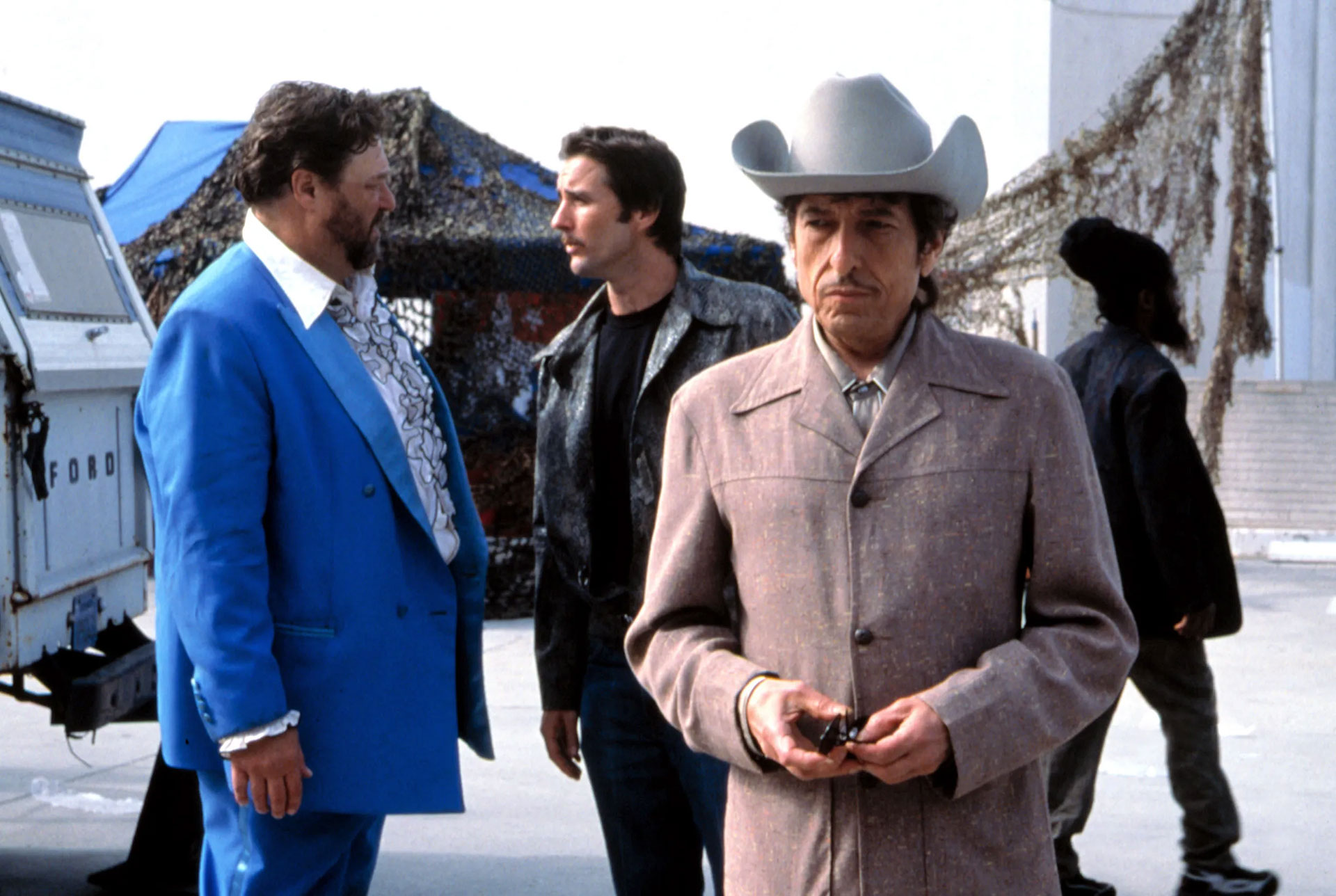
Sleazy promoter Uncle Sweetheart (John Goodman) sees an opportunity to cash in and plans a phony benefit concert. To headline, he secures “Jack Fate” (Dylan), a half-forgotten icon vaguely associated with a radical past (the concert’s funders are disappointed they couldn’t land Springsteen). This plot almost certainly draws inspiration from one of the unlikelier moments in Dylan’s career: his awkward participation in the 1985 “We Are the World” single. Allegedly a fundraiser for famine relief in Ethiopia, the initiative is best remembered for the star-power of its music video, in which Dylan looked acutely uncomfortable amidst the theatre-kid hamming of more than 40 other superstars. “You do this show, this benefit, you’ll be seen all over the world,” Uncle Sweetheart tells Jack. You can almost hear Lionel Richie telling the same thing to Dylan in his fallow ‘80s period.
For fans, Masked and Anonymous offers the curiosity value of seeing Dylan act. His performance is fascinating, if only for its sheer badness. The same monotone expressionlessness that has fostered Dylan’s mystique in other spheres translates to a stiff, uncharismatic performance when surrounded by real actors. Goodman, Lange, Jeff Bridges (as a pushy journalist), and the rest of the 40-Karat cast work hard to compensate, but they just end up emphasizing the void at the center. Dylan is not much helped by Charles, who doesn’t know what to do with the star’s diminutive physical presence and allows him to contort his little body in some truly bizarre ways.
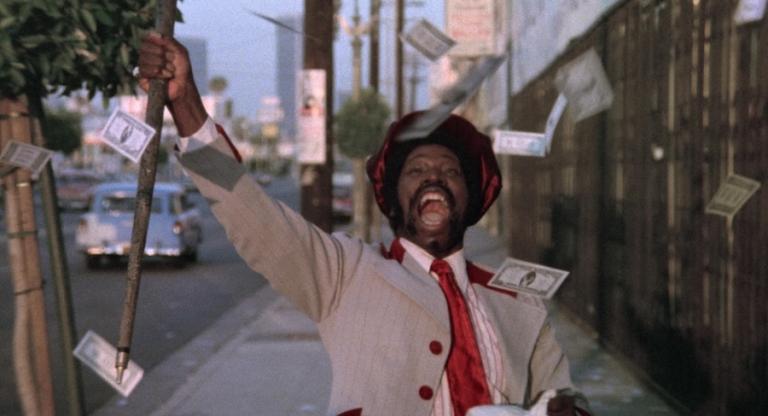
But there are also plenty of genuine pleasures for the amateur Dylanologist, including the chance to observe sixtysomething Dylan ruminate on becoming an icon. In the lead-up to a concert that never comes, Fate/Dylan drifts through a landscape full of decontextualized icons, like Abraham Lincoln, the Pope, and a blackface minstrel (a literal ghost of showbiz past) played by Ed Harris. Adding to the postmodern atmosphere, the soundtrack features a Japanese cover of “My Back Pages,” an Italian hip-hop remix of “Like a Rolling Stone,” and a sickly-sweet rendition of “The Times They Are A-Changin’” performed by a little girl as if at an American Idol audition (hilariously, the only part of the movie Roger Ebert liked). For all his discomfort in the dialogue scenes, Dylan’s raspy late-period voice is in fine form during the film’s scorching musical interludes—I’m especially partial to his rendition of “Dixie.”
If there’s anyone who still considers Dylan a Judas for abandoning the folk movement, they might chafe against the film’s streak of “both sides” political resignation. Still, I can find a lot of common ground with Dylan and Charles circa 2003, including their healthy skepticism toward the Philanthropy Industrial Complex, their distaste for celebrity activism, and their general distrust of official narratives. In one early scene, Dylan takes a bus ride with Giovanni Ribisi, playing a disillusioned veteran of the ongoing war. He says he fought for the rebels until he learned they were funded by the government, then fought for the government until he was ordered to destroy a village. “They told us something about the rebels having infiltrated. It was a lie.” Is he talking about a future America, or Gaza today?
Masked and Anonymous screens tonight, July 26, at the Roxy on 35mm.