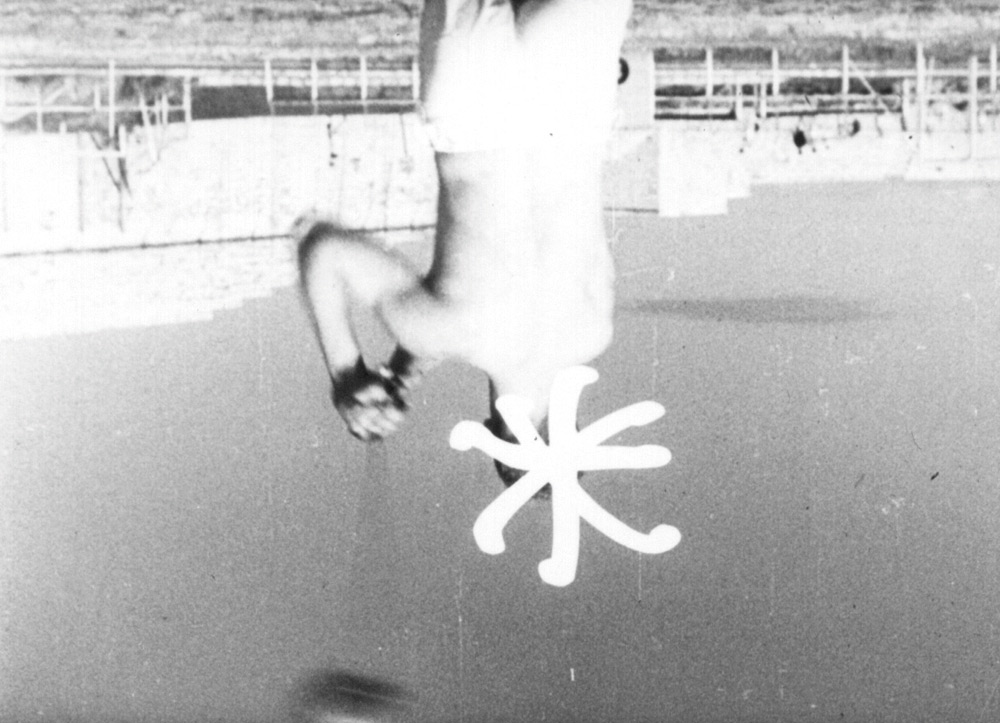
Anthology Film Archives kicks off their “Lettrist Film” series this evening with a rare screening of Gil J. Wolman’s L’Anticoncept (1951). Wolman, who the French film theorist Nicole Brenez described as “one of the great inventors of negative forms after Hegel” in her book Introduction to Lettrist Cinema, has had an outsized impact on postwar intellectual and aesthetic thought. He wrote the landmark essay “Methods of Detournement” with Guy Debord in 1956, and is also said to have inspired Debord to avoid the use of images in his feature debut Howlings in Favour of De Sade (1952). While less known, his contributions to painting and video are also significant. Yet L’Anticoncept remains more or less unknown and little shown. Why? Well, on the one hand, it remains censored in France. And, on the other hand, it has to be projected on a weather balloon.
This mad and precise mode of gimmickry—by which I mean, a bizarre flair for oddball formalism and inventiveness—defines much of Lettrist creation. Wolman’s film was projected on a balloon. François Dufrêne’s Drums of the First Judgement traded the projector for a performance staged inside exhibition halls. Isidore Isou’s Venom and Eternity (1951) attacked audiences with its loud, rambling soundtrack and carved images. The films, much like the poetry, novels, and treatises, created under the Lettrist banner sought the reinvention of the artform. And, like similar utopian art projects, Lettrism chased after the reinvention of all aspects of life. Though long considered a footnote to Situationism, the artistic and political avant-garde most associated with former Lettrist Guy Debord, the fact remains that Lettrism was no mere fad, but a real, clever, scandalous, and over-ambitious art movement that inspired such figures as Debord to revolt and artists like Stan Brakhage to scratch.
Anthology Film Archives’ screenings are tied to a couple of newsworthy pegs: the 101st anniversary of Isou’s birth, Maurice Lemaître’s forthcoming centenary, and an exhibition at the Center for Book Arts dedicated to the Lettrist Book. The latter was organized by Frédéric Acquaviva and Bill Kartalopoulos, who also selected the films in the program. To unpack the contents of their project and the series as a whole, I think it’s worth digging into the aforementioned tie-ins underpinning the film series.
First, there is Isou, the brainchild behind Lettrism. He was a Romanian immigrant who arrived in Paris following World War II and, through tireless writing and performances, managed to make Lettrist poetry a public sensation. In 1955, Orson Welles interviewed him as part of Around the World with Orson Welles. This glimpse of Isou sees the young poet practicing his offbeat poetry, an infectious riddle of sounds that came about from his own frustrations with surrealist poetry. His aim, after all, was to chisel language down to the letter, and letters down to the sound, so that a new language would spring and give voice to a new generation with ideas and ambitions that broke with all previous establishment codes.
His feature debut Venom and Eternity (also known as Slime and Eternity, or A Treatise of Drivel and Eternity) embodies these revolutionary aspirations. In it, Isou walks around Paris while lecturing on the impoverished state of cinema and what could be if Lettrist principles were upheld around the world. As he rambles on and on in his monologue, the images on the screen spin, flicker, and erode—it’s as if Isou has snapped a portrait of cinema-writ-large imploding in real time. As Brakhage put it during one of his famous lectures at the School of the Art Institute of Chicago, Isou “does everything he can think of to spit upon and destroy the film image.” His destructive spirit remains inspiring today and I’m sure his work proved influential on many filmmakers, some of whom, as was the case with Jean-Luc Godard, Isou claimed ripped him off.
Maurice Lemaître was another one of the gleeful pranksters in the Lettrist cohort and his most famous film remains his first: Has the Film Already Started? (1951). He was Isou’s right-hand man, having been an assistant director on Venom and Eternity (whatever that entailed) and also having edited the film. (According to Acquaviva, Lemaître only edited Venom and Eternity because the film’s initial editor quit after Isou instructed her to scratch the film—also worth noting: Lemaître had never edited a film in his life.) What followed was his own extravagant farce of a film. Has the Film Already Started? doesn’t just mock the conventions of filmmaking, but those of filmgoing as well. Throughout, Lemaître incites audience members to revolt, even to shred the screen with a knife. It’s a provocative little wonder, and a hilarious dunk on the ritual seriousness that so often thrives in arthouse cinemas.
In addition to showing a restored 16mm print of Has the Film Already Started?, Anthology Film Archives will also present two rare shorts from Lemaître in their series. I have not had the privilege to watch either of these, but the first of them, The Youth Uprising — May 1968 (1969), evinces the oft-overlooked political dimension of Lettrism. The title is taken from an economic treatise that Isou wrote in 1949, and that inspired Debord to seek the artist out and further develop political ideas that would become cornerstones of Situationist philosophy. With The Youth Uprising — May 1968, Lemaître wanted to make a film about ‘68 like no other—a film of multiple destructions, or “polythanasie” per Lettrist terminology. Considering Lettrism wanted to reinvent the world, it goes without saying that it needed to reinvent politics. After all, art and politics are one in the same, and this little anecdote from Brenez’s book reveals just how the Lettrists wanted to take out the old and institute the new:
In his book The Old World Is Behind You, Jean-Louis Brau, an old Lettrist and one of the most fascinating figures of the French avant-garde, describes in detail this grand political happening [the occupation of the Théâtre de l’Odéon] , and reveals that a previous plan was to occupy the Musée du Louvre, confiscate its most famous paintings and use them as shields against the police. The Mona Lisa, and canvasses by Veronese, Holbein, Goya, and Ingrès had been carefully measured, and the plan was to show them throughout Europe, while threatening governments with their destruction to test their commitment to the Fine Arts. Such an act would indeed have established the artwork as a radical political weapon.
Other Lettrist musings and transgressions are laid bare in Frédéric Acquaviva and Bill Kartalopoulos’ exhibition “Rewriting the World: Isidore Isou and the Lettrist Book.” Spread across several walls and vitrines are an assortment of Lettrist objects: geological novels, hypergraphic novels, doodles, posters, spoons, and soap, among many, many other items. This impressive spread, despite only covering a small area of Lettrist production, reveals much about their method: its tactility, its anarchy, its beauty. Between Anthology Film Archives’ series and Center for Book Arts’ exhibition, an opportunity has presented itself to reconsider this long-marginalized artistic movement and the sad state of our own cinema, which is clamoring, if not begging, to be torn asunder and built anew.
Lettrist Film runs January 29-February 1 at Anthology Film Archives.