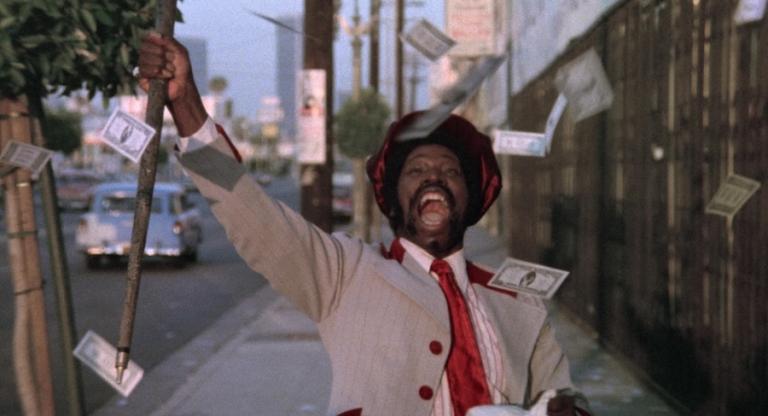
With puckish bravado, the British music impresario/fashion designer/marketing genius Malcolm McLaren whispers to us at the beginning of The Great Rock ‘n’ Roll Swindle (1980) that the documentary fantasia we are watching is about “an invention of mine called punk rock.” Capturing the spectacular rise and fall of the Sex Pistols, the film, produced by and starring McLaren, tells the band’s story through his perspective, portraying them as a triumph of savvy marketing. Loosely structured as a case study in showmanship, it takes us through a series of lessons including “How to Manufacture a Group,” “Establish the Name,” and “How to Sell the Group.” (In this last lesson, the promoter asserts “the enormous potential of a band that can’t play”). Summarizing his cheeky cynicism, McClaren is identified as “The Embezzler,” and Sid Vicious as “The Gimmick.”
Originally intended as a Russ Meyer sextravaganza (scripted by Roger Ebert), the film was instead directed by Julien Temple, who was just 24 when the project started and brought a zany, unabashed spirit worthy of Richard Lester on hallucinogens. Completed in 1980, after Vicious died of a drug overdose, the film was disowned and banned by the group’s management company, which saw McLaren’s approach as self-aggrandizing and degrading rather than irreverent and self-mocking. (I received a cease and desist letter when I programmed it for a 1991 rock movie series at the Museum of the Moving Image. And Temple balanced the scales in 2000 with his documentary The Filth and the Fury, which told the Sex Pistols’ story from the band’s point of view).
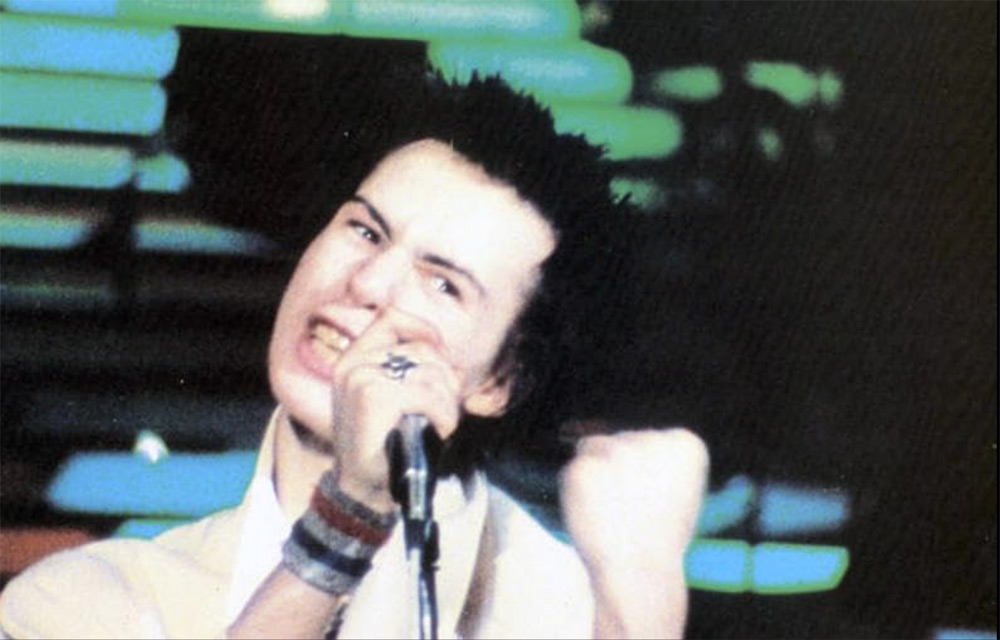
Variety called The Great Rock ‘n’ Roll Swindle the “Citizen Kane of rock ‘n’ roll pictures,” and the spirit of Orson Welles is indeed felt in its endless inventiveness—how it moves fluidly between different cinematic approaches, including documentary, animation, and wildly expressionistic fictional scenes. But I find it is closer in spirit to Welles’s trickster gem F For Fake (1973). Woven throughout the film’s invented passages is a treasure trove of archival footage of Sex Pistols performances. Joseph Lydon, also known as Johnny Rotten, refused to have anything to do with the film’s fictional scenes, but is seen vividly in the archival footage.
As much as the film continuously tries to make the case in its narration, and in man-in-the-street testimony, that the Sex Pistols were without talent, the electrifying performances easily refute the notion. Unlike the glut of authorized biopics and hagiographic documentary series about famous musicians that are flooding the theatrical and streaming market these days, The Great Rock ‘n’ Roll Swindle film feels unvarnished and unauthorized, ironically making it perfectly faithful to its subject. And, even without Meyer helming it, it has plenty of sex.
The Great Rock ‘n’ Roll Swindle screens this evening, January 22, and on January 28, at Anthology Film Archives on 35mm as part of the series “Malcolm McLaren.”