It should come as no surprise that Ayn Rand's 1943 bestselling paean to unbridled individualism came to Hollywood through the advocacy of an actor. Without a hint of irony, Rand's novel portrays one man's stubborn pursuit of his singular artistic will against all opposing societal forces. What may be unexpected is that it wasn't a male actor who sought the novel's adaptation so he could be cast as the unconquerable architect Howard Roark. Barbara Stanwyck, no stranger to playing steel-spined heroines, was the one who brought the text to Jack Warner's attention. Curiously, Rand, whose literary debut was a book-length tribute to the brooding silent screen star Pola Negri, had hoped for the indomitable Greta Garbo to portray the novel's female lead Dominique Francon. But, after delays in production due to wartime rationing, Warner only returned to the project in 1948 and devoted all the needed extravagance to bring this saga to the screen, albeit with a cast not quite like the one either Stanwyck or Rand had envisioned.
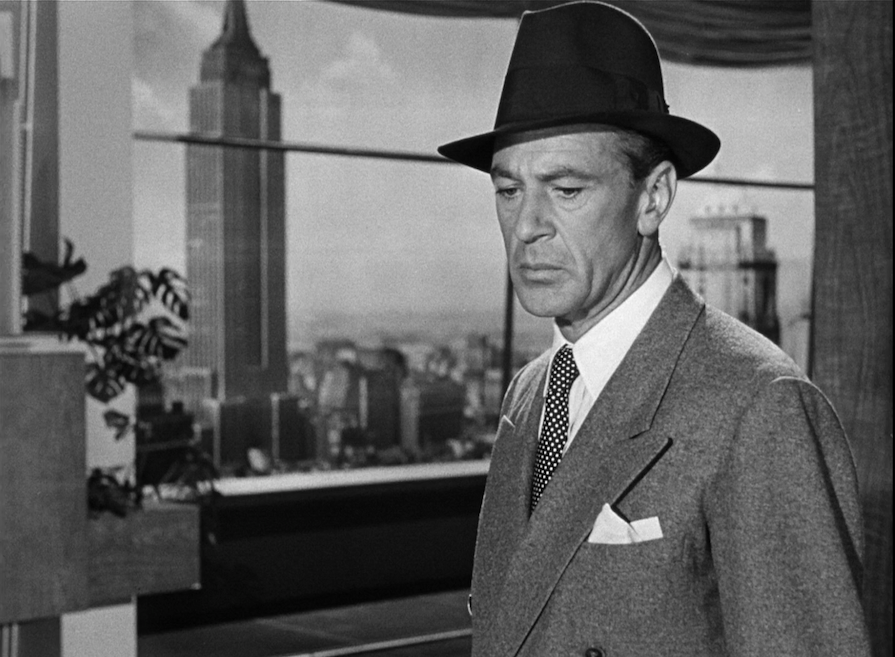
Gary Cooper is improbably cast as Roark—Bogart was originally set to play the part, and one can easily imagine his tight-lipped tenacity as the unwavering Roark. Oddly, Cooper's everyman lankness and deep drawl give the character a dimension of mania fitting his hermetic insularity. In fact, the entire world of The Fountainhead feels airlessly self-contained; even society's two supposed pluralizing forces—the newspaper and the multi-family residence—are the playthings of obsessive sociopaths. Patricia Neal winds up as Francon, and without the gravitas of Garbo or Stanwyck, the character's nihilism is dialed down significantly. Nonetheless, Rand's declarative dialogue and archetypal characterizations lend the film a nearly Brechtian dimension, which only heightens its intoxicating artificiality.
Cinematographer Robert Burks, best known for his decade-plus collaboration with Alfred Hitchcock, lends an epic scope to director King Vidor's vision: faces in close-up resemble granite monuments, and the countless interiors, expansively appointed by Edward Carrere, have a screen-filling grandeur. Even the interplay of shadow and light in dark scenes feels structured by planar considerations. Vidor is perfectly suited to the material's combination of overheated dramatics and monumental imagery. In fact, The Fountainhead often harks back to Vidor's silent masterpiece The Crowd (1928), from its skyscraper-scaling opening to its endless, grid-like bullpen. But besides this shared visual language, both films chronicle one man's attempt to swim against the tide of the masses—though in the case of The Fountainhead, Rand's "fool visionary" plows onward with unwavering egotism and is rewarded by literally ending up above it all.
The Fountainhead screens Tuesday, July 28, at the Orinda Theater as part of their Classic Movie Matinees.