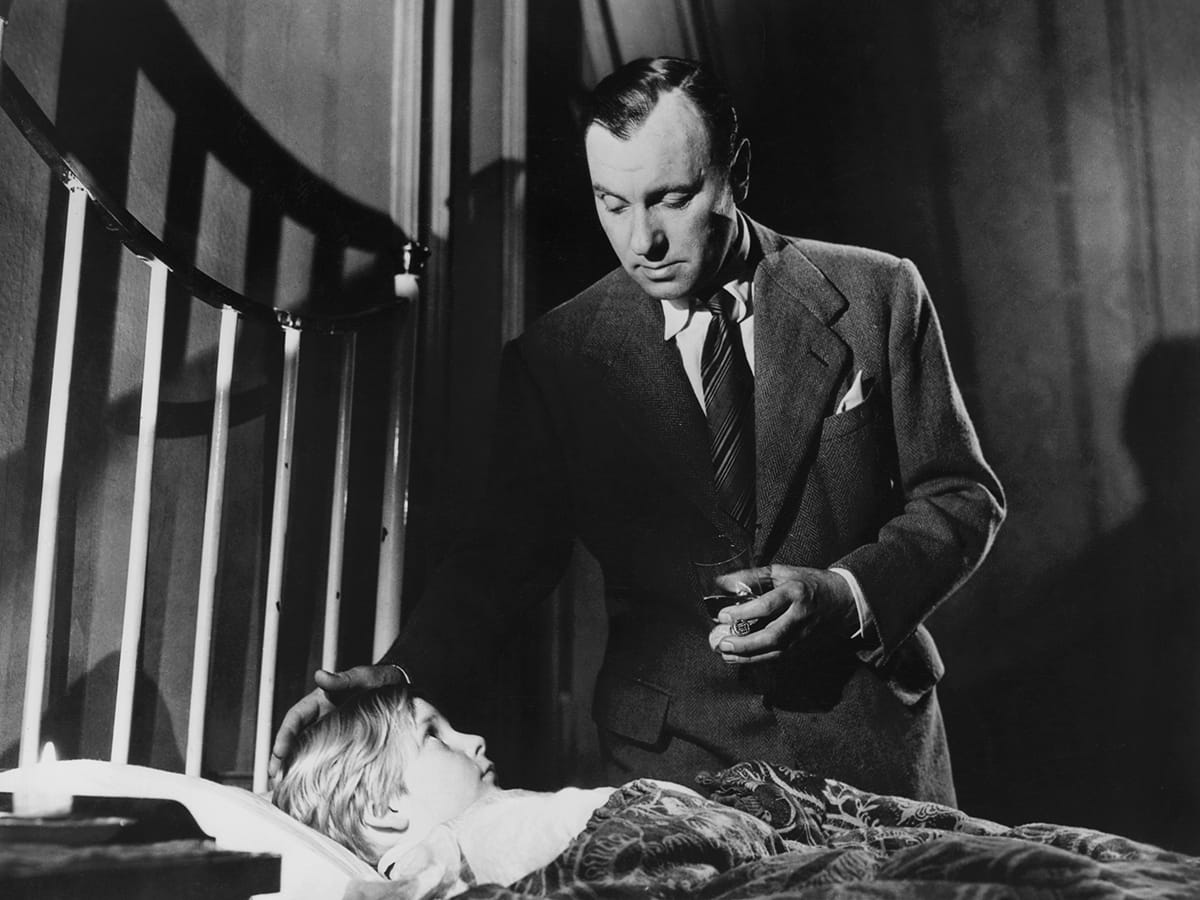
Carol Reed’s The Fallen Idol is bookended by the departure and return of Mr. and Mrs. Ambassador from the French embassy in London. Their pampered ten-year old son Philippe (Bobby Henrey, who will answer questions after the 7 o’clock screening) becomes the spectator of a triangle drama that unfolds between three of the mansion’s employees: Mr. and Mrs. Baines (the butler and the nanny) and Julie (a young translator). All of the household’s class antagonisms are expressed through the tension between the nosey, pampered child and the maritally unhappy butler, who winds up implicated in his wife’s accidental death. Cockney housemaids waxing sardonic over the backbreaking work their poor employer has to perform as ambassador, Baines bragging that he was once the ruthless master of a colonial estate in Africa, Phillip feeling more tenderness toward the help than toward his parents—the theme of class identity runs discreetly beneath the story’s whodunit surface.
At its core, The Fallen Idol is about getting tangled up in abstractions. Philippe thinks there’s only one indisputable Truth, not a multiplicity of particular truths that depend on one’s vantage point. “The truth can’t harm Banes—he’s innocent,” says Julie. Baines himself believes it; when the cops tell him to think his story through carefully, he says, “I don’t have to think! It’s the truth!” The problem is that from where Philippe saw Mrs. Banes fall to her death, it looked like Baines pushed her. Thus the “Truth” is that Baines murdered her—after all, Philippe saw it with his own eyes. Since 1950, the phenomenon of several partial narratives dancing around—but never quite adding up to—some kind of aggregate truth has been known as the “Rashomon effect,” and in 1873 Nietzsche demonstrated that a “correct perception”—an adequate representation of an object for a subject—is a “contradictory impossibility,” that between these two different spheres “there is, at most, an aesthetic relation … a stammering translation into a completely foreign tongue”. In the case of Philippe it is literally a stammering one; he flutters around the Scotland Yard detectives desperately trying to catch their attention and tell them what “really” happened. Philippe has decided to tell the truth because he thinks that Baines will benefit from it, i.e. he has assigned the truth a positive value on ethical grounds. He’ll be in for a surprise when he gets older and discovers that what he regards as the “objective truth”—empirically verifiable, measurable—is not always in the service of the Good.