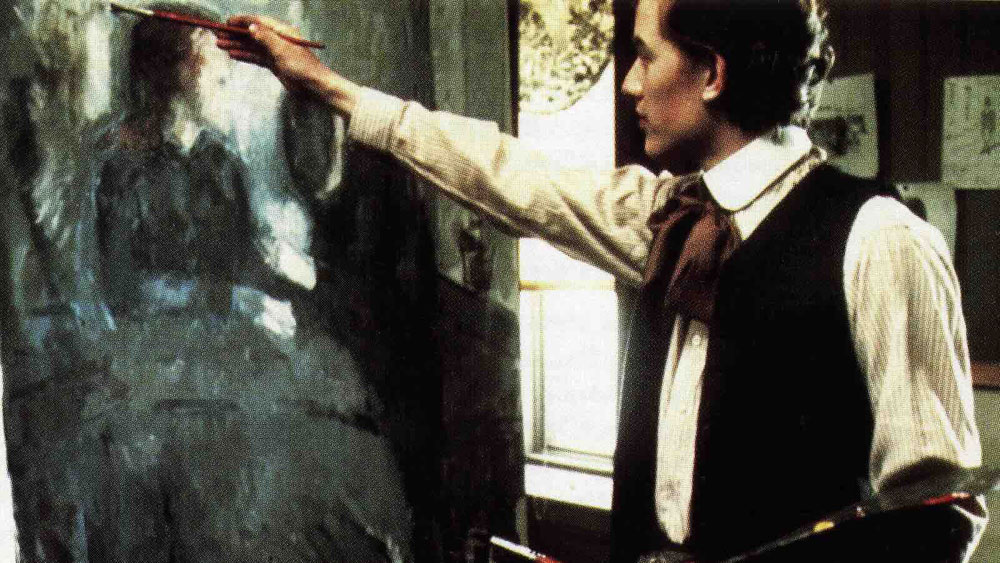
In Edvard Munch (1974), Peter Watkins presents the artist as a miserable bastard. The late director portrays Munch’s early life and career through his intrusive thoughts and obsessive, circuitous ruminations. His epic biopic uses complex, extended montage to constantly return to sequences of illness and death from Munch’s painful childhood in Christiana, Norway (now Oslo), his failed love affairs, and relentless slights and insults from critics who cite insanity more than it’s mentioned in promos for the Gathering of the Juggalos. When Munch nears an artistic breakthrough, or a moment of personal passion, Watkins cuts to sequences of the artist coughing up blood as a child or getting scolded by his conservative father. As he reveals Munch’s biography in a rough chronology, Watkins dramatizes the traumas that haunt the artist’s subconscious—a churning stew of chaotic motion that will eventually be spewed on canvas.
Like Munch, Watkins uses established tools to do something new. In the case of the painter, the pictorial plane became a stage for his personal, almost, insane expression, causing a rupture so intense in representation that it advanced a major new mode of art: expressionism. In his own way, Munch was a documentarian at the site of his own feelings, attempting to capture them with raw immediacy. Watkins uses, and subverts, familiar documentary filmmaking techniques for his own unique purposes as well, imbuing the sometimes dry discursive mode with passion and marshalling the technology of cinema to document a larger truth about Munch and his times. In fact, the filmmaker mirrors the artist’s process to bring us closer to him. Munch was constantly working and reworking the surface of the canvas using oil, pencil, charcoal, and pastels, often at the same time, while also employing a brush, palette knife, and even kitchen blades to scrape mark-making away. Similarly, Watkins layers sound and weaves together dramatizations, staged interviews, narration, and poetic montage. The use of anachronistic documentary modes to depict time periods before they were invented (seen again in his mammoth La Commune (Paris, 1871)) is a hallmark of Watkins’s work and it can be considered his own mind-bending addition to the cinematic art form.
Very early in Edvard Munch, Watkins uses the devices described above to establish the sociopolitical conditions of Christiana in 1884, five years after the young Munch took up painting. Through narration and staged interviews, he examines the conservatism and folly of the bourgeois, as well as the poor conditions of the city’s workers. Class is an essential lens for Watkins and even as he reveals the leftist beliefs of the bohemian subculture Munch was a part of, he makes sure to note that its participants were outcast members of the middle class. In the second half of the film, when Munch leaves Christiana for Berlin, a city that bolsters his fame through controversy, Watkins recreates the milieu at The Black Pig, a beer hall where the recently divorced and exiled Swedish writer August Strindberg holds court. Watkins unflinchingly shows what is now recognized as a form of incel indoctrination, wherein Strindberg's miserable and hateful views toward women are presented as theories that other lonely men too easily interpret as facts. Here, the filmmaker establishes both the background of his genius artistic subject while also presenting a bold alternative history of the avant-garde and its adjacent politics, wherein individual prejudices could poison the seemingly progressive.
I first saw Edvard Munch as a very young writer in 2013. I rented the film on DVD in preparation for an article on a Munch exhibition at the Schirn Kunsthalle Frankfurt and was so enthralled with it that I took off work the next day to watch it several times in a row (I filed late). I was at the ass end of what is now called a situationship; my interest far outweighed the other party’s, and so I was touched by the film’s tragic, bleeding romanticism, and what I interpreted as the generative creative potential of unrequited love. Watching it over a dozen years later, I’m more aware of Watkins’s fascination with moments of political and social rupture, be them in a near future, alternate reality (Punishment Park, The Gladiators), or the past (Colluden, La Commune). While Munch’s work is certainly radical, it’s also highly individualistic and decadent. Watkins, conversely, prioritizes the collective, not just in its political potency, but also its function in artmaking, typically choosing to work with large troops of non-actors in his films. Amidst what is already a deeply layered work, I now see yet another layer, which is that Edvard Munch remains a remarkable and generous treatise on youthful passion that also manages to levy a class critique that is as incisive as it is damning. The film captures the intoxicating power of emotion and its expression, while leaving room to consider its greater revolutionary potential.
Edvard Munch screens tomorrow afternoon, May 24, at Metrograph on 35mm as part of the series “The Lives of the Most Excellent Painters.”