What is a punk filmmaker if not an artist at war with his own medium? In 1987, the 33-year-old English director Alex Cox embodied this contradiction with the production and release of Walker, a $6 million anticolonial psycho-western biopic that, among other things, viewed both its target audience (the United States) and the American studio who backed it (Universal Pictures) with open disdain. Shot on-location in Nicaragua during the Central American nation’s Revolution, the film (which has seen its critical reappraisal) was the kind of storied studio flop that the industry has since selected against with its preference for pre-visualizations and decisions-by-committee. In Cox’s heyday, it was enough to condemn him to the margins. After Walker, he never worked for a major Hollywood studio again, and, with the exception of the internationally, independently co-produced Highway Patrolman (1991), with a budget that exceeded $1 million.
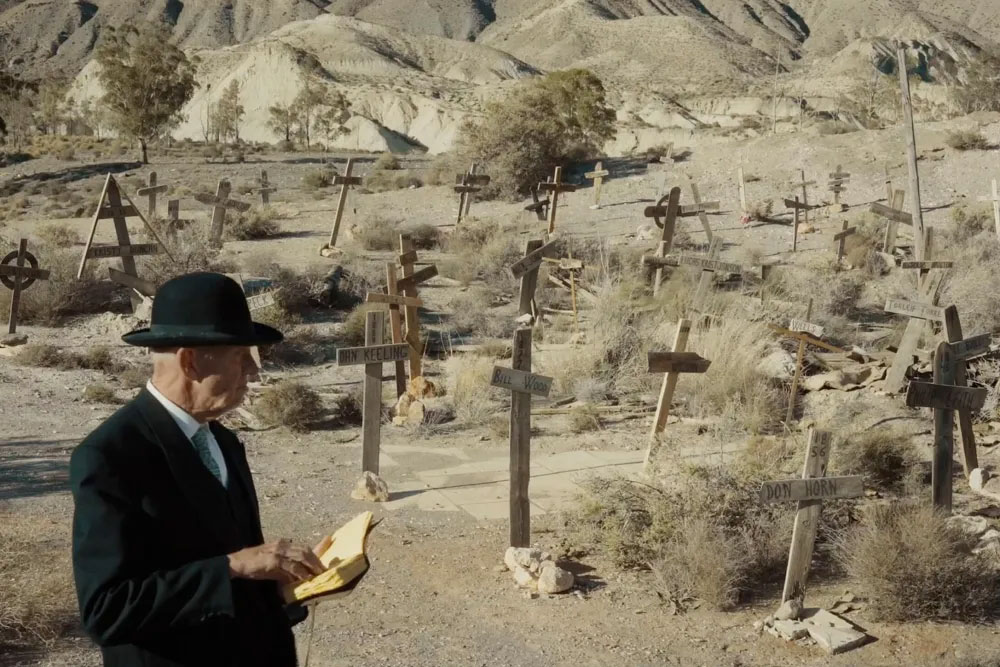
That tension, between what is and what could have been, is at the forefront of Dead Souls (2025), Cox’s latest and potentially final effort (if he is to be believed on the matter). A crowd-funded Western retelling of Nikolai Gogol’s novel of the same name, the film stars Cox himself as Strindler, a bumbling drifter with a bag of doubloons who appears in a Southwestern border town with the curious offer to pay each of its citizens a negotiated fee for the names of each of his or her deceased Mexican employees. It’s a bit of historical revisionism—to which Cox is no stranger—that becomes more interesting in its misalignment. Writing in 19th century tsarist Russia, Gogol’s novel depicts a scheme whereby serfs, who were considered human chattel, could be loaned against. The more serfs one acquired—dead or alive, thanks to the discrepancies of city registers—the bigger the loan. No such analogue existed in the American South, where Mexican laborers were not serfs but something closer to the migrant workers of today who, as Dead Souls’s American characters suggest, find themselves at the mercy of an even more violent and callous ruling class. The imprecise analogy lends a kind of cosmic question to Strindler’s mission: is he merely a swindler, or are his purchases part of an effort to lay these overworked and underpaid “dead souls” to rest?
At 71, Cox appears to be at his most contemplative: his protagonist is neither the thwarted optimist of Roberto Sosa’s Pedro Rojas in Highway Patrolman, the pugilistic provocateur of Gary Oldman’s Sid Vicious in Sid & Nancy (1986), nor the misunderstood rebel of Emilio Estevez’s Otto Maddox in Repo Man (1984). Though still an outsider, what Strindler wants is both material and meta-textual: he wants money (perhaps to make another film?) and he wants his name to be known, even if he is satisfied shouting it into the silence of the desert, like in the film’s final moment. But if he is to end his career with little in the way of either, Cox nevertheless appears to be content staring into the lens, at his cult of followers and the filmmakers in his wake, and affirming the value of human life. Dead Souls is a largely gentle if slight capstone that is lovingly staged and awash in warmth. I hope this isn’t the last we hear from Cox, but if it is, the aging punk has cultivated something far more compelling than attitude. He has cultivated wisdom.
Dead Souls screens tonight, August 15, and throughout next week at the Roxy. Alex Cox will be in attendance for a Q&A.