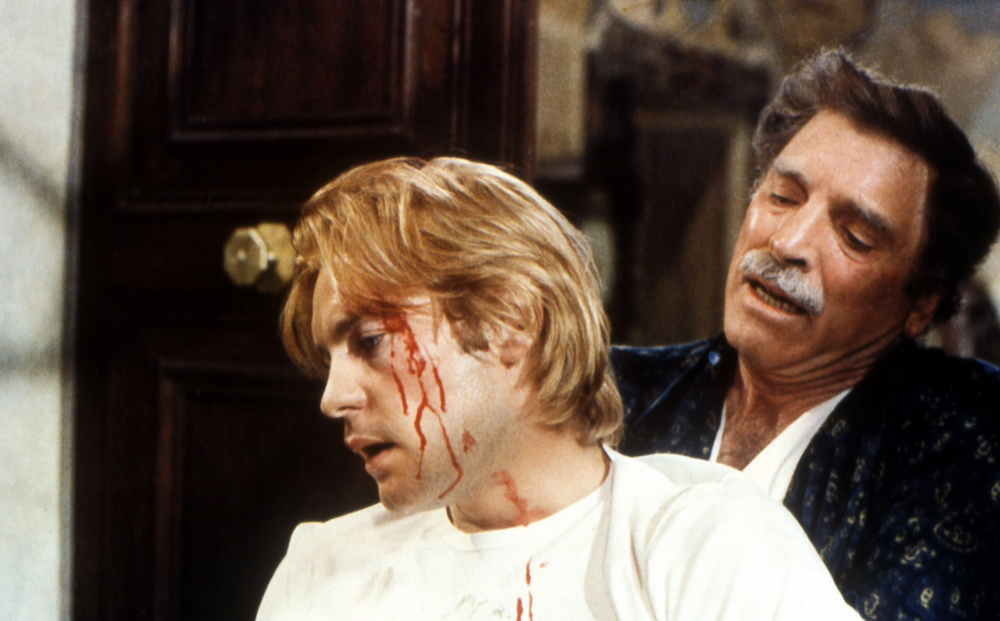
Released two years after director Luchino Visconti suffered a debilitating stroke, Conversation Piece (1974) takes place inside an unnamed Professor’s (Burt Lancaster) Roman palazzo. A retired scholar, the somber intellectual would want nothing more than to hole up in his gilded cave, perched in one of his armchairs, surrounded by stacked books and prized artworks. This meditative existence is disrupted when a wealthy right-wing industrialist’s family manipulates the Professor into leasing out the apartment above his own. A controlling and manic marchesa (Silvana Mangano), her crass younger lover (Helmut Berger), her daughter (Claudia Marsani) and soon-to-be son-in-law (Stefano Patrizi) soon ravage the quiet American’s private life.
Preceded by the sweeping period epics of “The German Trilogy,” Luchino Visconti’s penultimate film has long remained one of his more underseen works. When it opened the 13th New York Film Festival, The New York Times critic Vincent Canby dubbed it “the kind of fatuous film” that Lancaster “would snort at and leave in the middle of.” Though Conversation Piece may not match the grandeur of period melodramas like Senso (1954) and Ludwig (1972), or stoop to the levels of depraved decadence seen in The Damned (1969), Visconti’s late-career chamber drama delivers a disarmingly incisive analysis of hedonistic elites.
In the film’s opening scene, the Professor’s magnifying glass hovers over the 18th century conversation piece John, Fourteenth Lord Willoughby de Broke, and His Family, enhancing delicate expressions framed within the sprawling network of cracks on its oily surface. A niche genre of informal family portraiture, the conversation pieces collected by the Professor look anything but informal. Much like the meticulous camerawork and palatial sets in Visconti’s The Leopard (1963), these carefully composed paintings are oozing with opulence, both capturing and taking part in the ritualized pantomime of noble families. In the wake of fascism and the reactionary crackdown on midcentury student movements, a different set of rituals dominate high society. The ballroom gowns are traded in for Fendi fur coats and polite garden party flirtations supplanted by head-turning polyamorous affairs.
Visconti is considered an anomaly in the Italian film canon, a relic of the 19th century aristocracy caught in the midst of postwar modernity. Despite being a pioneer of the neorealist movement, which focused on the postwar struggles of ordinary people, Visconti’s most memorable films operate in the esoteric circus realm of the ultra-wealthy, whether it be in Risorgimento Italy or Nazi Germany. Conversation Piece conveyed Visconti’s own criticisms with the new breed of self-interested libertines that had come out on top by the midcentury. Yet, the arrival of this latest restoration comes at a historically unparalleled era of inequality, where the debauchery and cruelty of a privileged few is streamed across cyberspace 24/7. Pauline Kael’s characterization of the Professor as a man helplessly “cuckolded by everybody” is a position all too familiar to most viewers today.
Conversation Piece screens January 23-29 at Film Forum.