The college fraternity reads as a quintessentially North American institution, so one of the initial surprises of Mike De Leon’s 1982 Filipino hazing drama Batch ‘81 is learning that the performance of, and submission to, juvenile rites of wanton, irresponsible cruelty for the sake of sublimating individual identity to the horde is an international universal. In any case, the tone is less Animal House than Salò in this fairly explicit parable for Ferdinand Marcos’s dictatorship. Premiering at Cannes, Batch '81 went on to sweep the Philippines’ film awards in the later years of martial law.
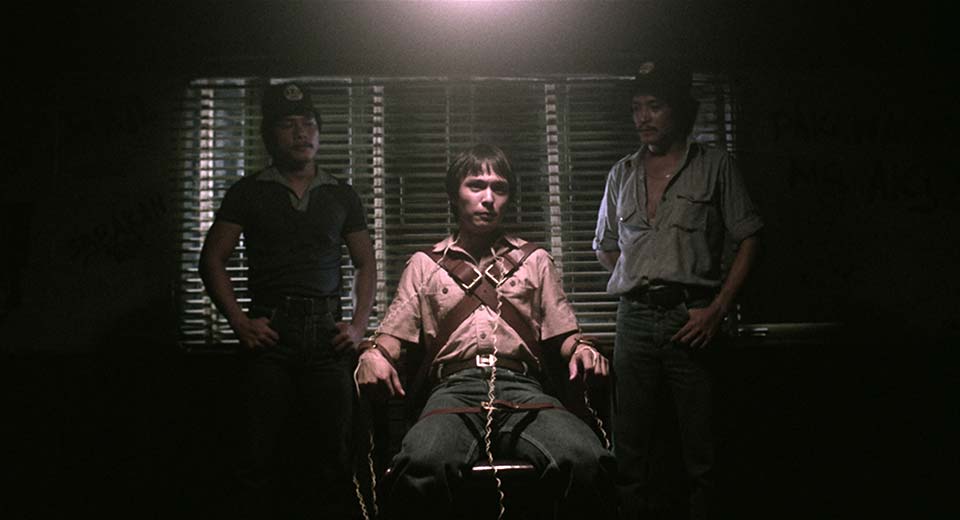
Sid Lucero (Mark Gil) is a pre-med student who pledges to the Alpha Kappa Omega fraternity in order to make new friends. An initial pledge group of more than a dozen is quickly whittled down to eight, and social pressures among the remaining young men intensify alongside increasingly fraught and dangerous initiation rites, which range from paddling and streaking to a perverse enactment of a Milgram-inspired torture experiment. (Ironically, the actor portraying the fraternity founder who supervises the trial was the brother of Marcos’s then-defense minister.) It culminates in a violent gang brawl, at which time its apparent that Lucero’s transformation from reluctant neophyte to pack leader has come full circle.
The tone of Batch ‘81 is resolutely sobering, never veering into leering exploitation despite the trigger-happy hijinks. Its urgency is likely due in part to the personal investment of prolific producer Marichu Maceda, whose own son was seriously injured in a fraternity initiation, and the campus research of screenwriters Clodualdo Del Mundo Jr. and Raquel Villavicencio. The closest the film achieves to a sense of levity are the references to the playful transgressiveness of A Clockwork Orange, including a delightful soundtrack that is a dead ringer for Wendy Carlos’ Switched-On Bach, and a character in droog makeup during a fraternity talent show that includes a Swastika-laden performance of songs from Cabaret. Remarkably, the filmmakers’ only concession to self-imposed censorship was apparently an excised disco rendition of “Don’t Cry for Me, Argentina.”