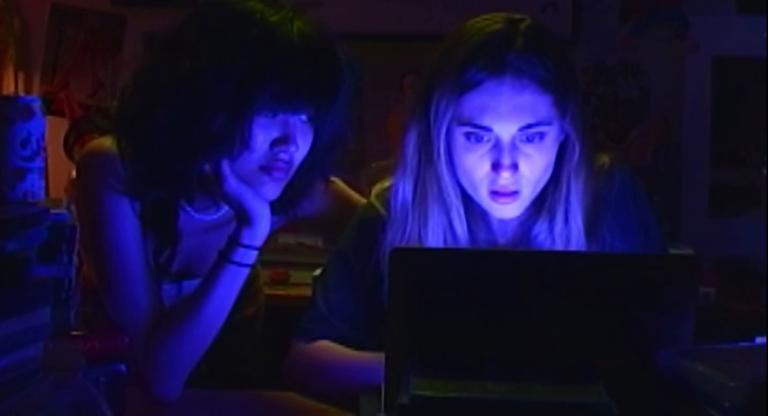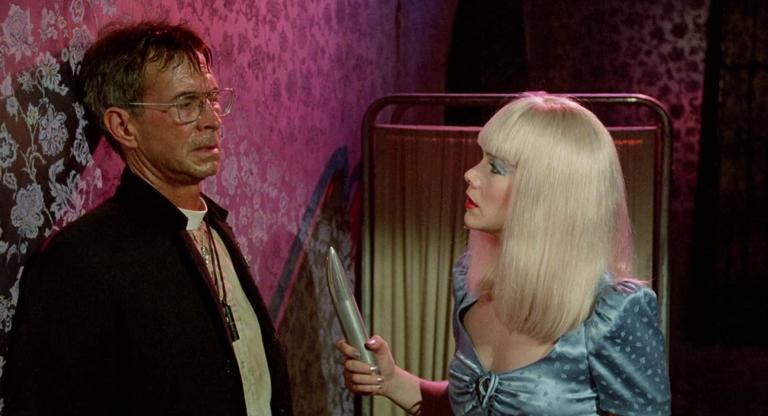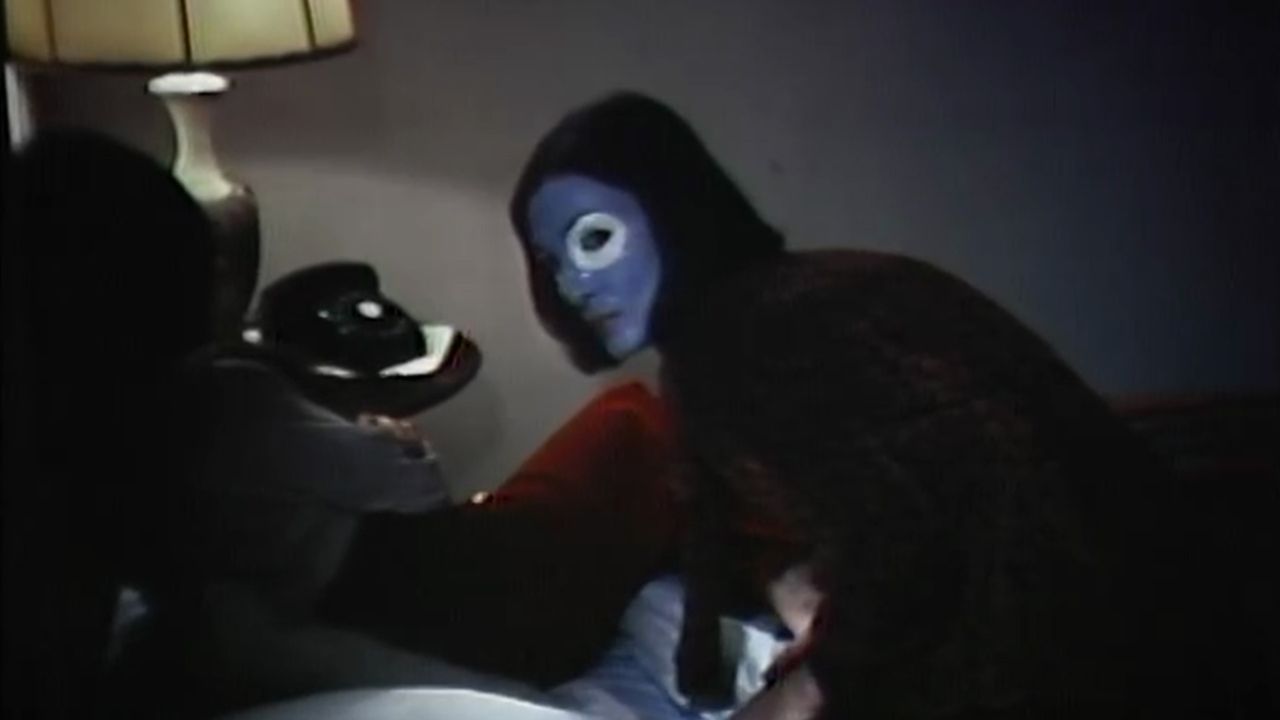
What was happening in The Waiting Room (1973), for those of us watching in a Los Angeles microcinema last Tuesday, was that every time a “good feeling,” a sense of awe or a snare of comfort that a plot might permit, rose toward the heat in our beating chest, it was playfully rebuked by the director, Karen Sperling, and suspended into an exaggerated inactivity. In its place, a blank stare from a group of women and a lab-coated doctor standing in charge of an asylum, suggesting a storyline like that of Lynne Tillman and Sheila McLaughlin’s Committed (1984), an experimental narrative (but a narrative no less) about the maddening treatment of 1930s-era actress Frances Farmer before and after she was unraveled by electroshock therapy. The Waiting Room does not want to organize our good feeling. Instead, the film stalls our understanding, holding it, for example, across a dramatized kitchen-counter conversation drawn from real transcripts of conversation between the director and her mother. If the movie were a radio, this channel would feel chalkboard-scrapingly familiar, but the patter, or image-pattern, talks us into cool coherence. Audience members told Sperling of their emotional transferences after the screening: it was really quite weepy in that room as individuals began to process how this fragmented, “lost” “women’s film” had given them the play blocks with which we may piece together our own dream parts, phantasms, and capital-R Reality (shared and unshared). A psychological Lehrstücke, if I may, that uses straight female friendships and relationships as a surface at a time when it was just beginning to feel outrageous that feminists continued to dwell primarily on the problems of the bourgeois domestic sphere.
One evening before the screening, I am sitting downstream from Karen at an al fresco dinner, and I notice that she takes everyone in with the soft regard of an experienced lucid dreamer. I am told later that this is partly due to the magical conversations she’s been having around the “rediscovery” of her early years as a young filmmaker. “The throughline,” she jokes about her first feature, Make a Face (1971), “was pieces—putting pieces together.” The year following was spent assembling a 35-person crew made up entirely of women, much like Chantal Akerman would do to create the secure space she needed to make Jeanne Dielman, 23 quai du Commerce, 1080 Bruxelles, three years later; and Sperling invited notorious adult-film cinematographer Roberta Findlay to be her DP. Consciously indebted to Maya Deren’s interest in trance, The Waiting Room is wound more tightly by connecting a mundane female fantasy life—similar interiority is almost epic by comparison in Make a Face—with easy-handed, naturalist inner dialogue, externalized for our pleasure. The writing reminds me of the humanist-yet-conceptual plays of Cuban-American playwright and director Maria Irene Fornés, who was contemporaneously writing about women’s subjectivity in works like Fefu and Her Friends (1977) on the East Coast. Where, in Fefu, the audience is a fly on the wall in more than one room at a time, in The Waiting Room, our voyeurism is granted by a kind of seeing “I,” a camera-eyed subjectivity that Babette Mangolte similarly explored in The Cold Eye (My Darling, Be Careful) (1980). It is through Sperling’s unnamed protagonist’s dreamed point of view that we’re granted access to other versions of herself that are physicalized; for instance, seated at a table at a restaurant across from her closest girlfriend, waiting for food. Her friend confides, “I’m so glad to be out. I couldn’t have stayed there another second.” “Since I’ve known you, you’ve never liked being in. You’re always out and on your way. It’s amazing.” The response: “I’m hungry.” She cups her chin in her hands and the camera pans to another woman talking at another table, chiaroscuro vignettes that flood waiting itself with eerie joy.
When I heard that The Waiting Room was coming to San Francisco as part of the Re:Vision Festival, I had to write about this cruelly beautiful thing, the “rediscovery” of a filmmaker who has always been here. It is not the case, as critics are swift to say, that Sperling “Fell off the Map!” (a way of catastrophizing the structural neglect of women directors before their films are even watched) or that Sperling’s two instances of clamoring, clanging, defamiliarizing women’s noir simply disappeared and she was never heard from again. What exactly are we privileging in that scenario—a rescue fantasy, maybe? Sperling, the daughter of Warner Brothers exec Milton Sperling and niece of producer-director Mervyn LeRoy (who made The Wizard of Oz), rejected much of her Hollywood-heavy family’s complicated feelings about her artistry, and continued to work on her own terms, optioning Viva’s Superstar, writing script after script.
Fifty years later, The Waiting Room still mirrors the moves to upend a symbolic order that many feminists of the ‘70s and beyond either contended with, or actively remade—I think of Carla Lonzi in Italy, recombining interviews she conducted with a swath of “genius” male painters so that she might interject her own participation and call it Self-Portrait. Many of Sperling’s shots are styled in medium close-up: hands help button a bride’s neck into wedding-white satin, recalling a Durasian tango scene where Michael Londsdale pulls like taffy the spine of Delphine Seyrig’s colonizer-feminine archetype (India Song, 1976). Romantic? No. There is little romanticizing here, in any sense: setting aside the progression of her characters’ distaste for men and their views of the world, Karen herself threw out the original film stock, figuring no one would want to see it! Seated like vowels surprised that they all occupy one word, or huddled in foyers to embrace, rather than chase, a “wandering woman” (Barbara Loden’s Wanda came out in 1970, and the two directors were featured on panels together), more and more women in The Waiting Room wait for their subject to decide to appear. “I always wanted the world tracking me, and I wanted to track the world,” Karen relayed later when asked about her use of multiple forms of media in these films. I write it down, a positive architecture for women’s internalized surveillance. It’s the radio: I always wanted the world tracking me, and I wanted to track the world.
The Waiting Room screens Sunday afternoon at the Roxie as part of Re:Vision, with director Karen Sperling in person to introduce the film.