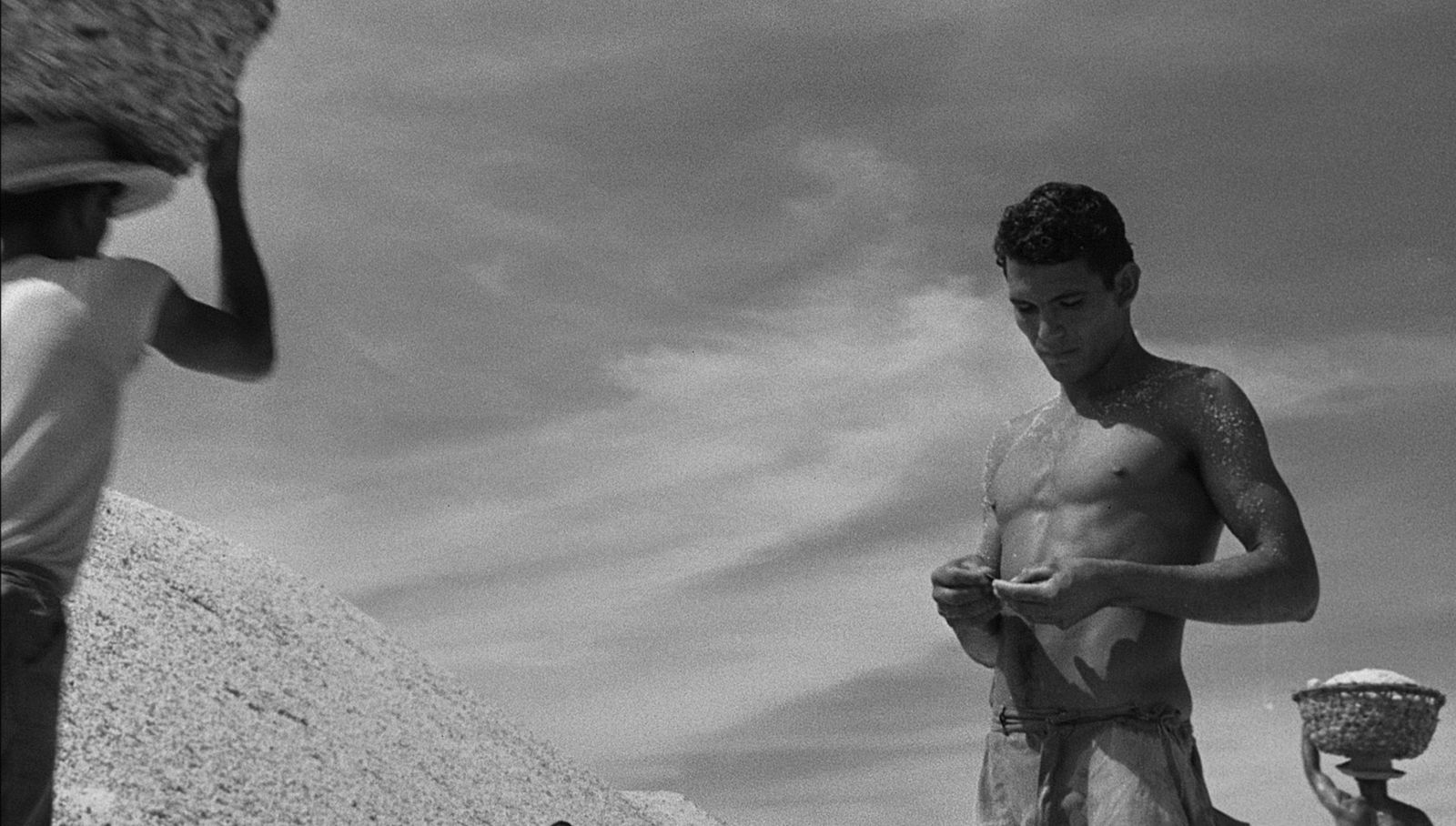
The heavens and sea mirror one another as they enclose a land further defined by its colonial past in the opening shots of Margot Benacerraf’s Araya (1959). These material realities in Venezuela’s Arayan peninsula have combined to produce a society that revolves around salt. The mineral dominates local commerce and largely dictates the life of Arayans, rivaled only by the fisheries made available by the same sea and sun. But salt is a double edged sword in Araya. Although it offers a livelihood and means of preservation, it also makes the land barren and riddles laborers with ulcers, which are further exacerbated by the so-called ”white gold.”
This is the world depicted by the pioneering Venezuelan filmmaker in her striking work of anthropological humanism, and only feature-length film. Filming just before the dawn of sync-sound technology that would soon revolutionize the documentary form, Benacerraf crafts an impressionistic portrait of sustained toil in this isolated community. To be an Arayan is to have some role in the production of salt, or sustaining those that do. Even before they can speak, young Arayans able to walk assist their parents in salting fish.
Benacerraf and her cinematographer, Giuseppe Nisoli, employ expressive 35mm black-and-white to heighten the visual poetry; the gleaming white mounds of salt are all the more domineering against a black sea. While one might think such an abstracted approach to the actuality of the region would be at odds with any kind of materialist representation, Benacerraf’s style creates a contrast against the acute realism to which it’s applied, stressing the accruing incongruities that characterize the lives of Araya’s population. Nisoli often shoots laborers from dramatic low angles, presenting workers with dignity and cinematic grandeur. Yet such respect never gives way to fetishization, as the harshness of life on the peninsula is routinely foregrounded.
Araya eschews the fundamental extraction upon which all the work in the film is predicated, noting simply that the hand-cut, dried, hauled, and packed salt is loaded onto ships and taken away to distant shores. But the film doesn’t need to be explicit about that. The conditions of the villages and their social infrastructure is all the evidence needed to see that the profit generated by the film’s parade of labor resides elsewhere. As Araya reaches questions posed by sudden modernity, hope that the lives to which we’ve been introduced will improve quickly gives way under the weight of the 450-year colonial history invoked in the film’s opening: that’s just not the way these things go.
Araya screens this Saturday, September 26, at the Roxie as part of “Re:Vision.” It will be preceded by Vittorio de Seta’s Surfarara.