The Mexican filmmaker Diego Hernández has become one of his nation’s most exciting (and dependable) new directors in the span of five years. His 2021 feature debut Los Fundadores earned him a Special Mention at FIDMarseille and his third film, El Mirador, earned him a Special Mention at FICUNAM 2024. Between those films, he also churned out 2022’s Agua Caliente, a lovable docu-fiction film set entirely within the confines of his childhood home. Watching any of Hernández’s films entails becoming familiar with his world; not only is his home frequently featured in his work, so are his mom, his girlfriend, his friends, and even himself. His is a humble cinema—imaginative, idiosyncratic and homemade. His latest, A Skyless Roof (winner of the Best Mexican Film Award at FICUNAM 2025), is no different.
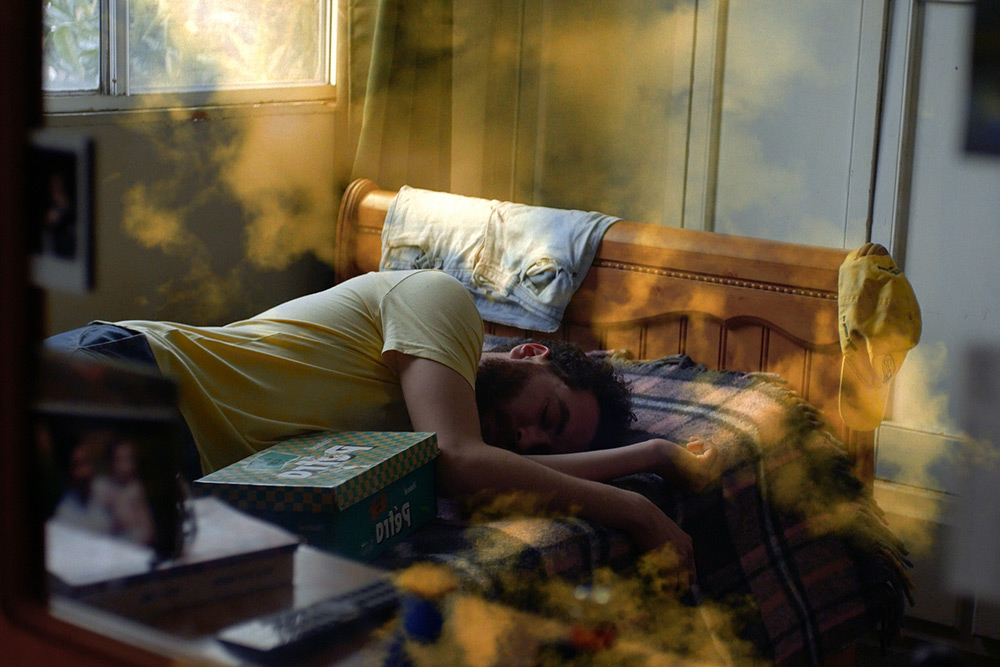
The premise of his newest film involves two friends suffering from opposite maladies. Diego (played by Hernández) is averaging 16 hours of sleep per day; Liz (Lízbeth Félix) hasn’t slept a wink in a week. All of it is quite strange and the film slowly unravels the mysteries behind their strange illnesses. Unlike Hernández’s previous films, which privilege a sort of documentary realism, A Skyless Roof entertains the fantastical and overtly experimental onscreen. Diego and Liz’s search for cures leads them to contact a mystic, and throughout their tale are interwoven clips of clouds and old photographs. The narrative zigzags, combined with the hypnotic stream of archival imagery and cloud footage, produce a strange alchemical effect that results in a viewing experience not too dissimilar from that of the film’s protagonists. On the one hand, the tranquil detours into clouds and timeworn photos inspire sleep; on the other, the story’s multiplying intrigue denies it. A Skyless Roof asks the viewer to be both awake and asleep—the perfect kind of mixed messaging meant to inspire a gentle trance at the cinema.
Because Hernández’s films often address politics in a direct fashion, it goes without saying that there exists a political undercurrent to his latest feature. As a film about sleep and sleeplessness affecting two artists’ creative outputs, A Skyless Roof reifies many of the arguments made in texts like Paul Lafargue's The Right to Be Lazy and Jonathan Crary’s 24/7: Late Capitalism and the Ends of Sleep. It is a film that demands the right to dream, because it is so aware of all that denies artists the ability to do so in this day and age. A Skyless Roof’s final scene, involving a surprising theatrical performance, interrupts its narrative momentum, but in doing so awards a reprieve from all the troubles affecting its two young artists.
A Skyless Roof screens this evening, January 21, at Anthology Film Archives as part of the series “Lost & Found: Cine(ma)s Latinoamericanos Re-Unidos.” Diego Hernández will be in attendance for a Q&A.