In his first short films, Otar Iosseliani’s odes to the rhythms of life make bothering with reality—discerning documentary from fiction, or the prosaic from the fantastical—beside the point. (This is an observation first made by Andrei Tarkovsky, a peer and admirer of Iosseliani, in his book Sculpting with Time). In Metrograph’s “Otar Iosseliani Early Shorts Program,” the prolific Georgian filmmaker winks toward decades of work yet to come (a lot of which would be produced in France); these short films feature wild and creative sonic compositions, inventive sight gags, and a close observation of the various entanglements the drunks, slackers, lovers, and workers of Georgia fall into.
Trained in piano, composition and conducting at the Tbilisi State Conservatoire before decamping to Moscow to study mathematics, Iosseliani explains the polyphonic musical arrangements that structure his work: “I compose my movie according to the laws that I invented for myself and that relate to the musical form,” he said in a 2014 Masterclass at the Screen Arts Department of the St. Petersburg Institute of Cinema and Television. “For example, I try to escape the sonata form, i.e. collision of two opposite forms… And on the contrary, I take as a sample polyphonic composition, fugue with counterpoint, with repeated themes, [and] latent themes coming at the forefront”.
Spend some time with the rich and deeply funny interviews that the idiosyncratic filmmaker gave across the last 30 years and I bet you’ll find it difficult to resist excessively quoting him. This is frustrating, in part, because one of the declarations that most illuminates his work concerns language itself: “What I try to avoid is to give a primary role to words,” he told David Kakabadze of RadioFreeEurope in 2007. Daily patterns of movement, echoing clomps of footsteps, how the camera trails after flirting couples, or the exaggerated shapes an inflating shirt makes in front of a fan—all of these gestures and sights are more important than the things people might happen to utter to one another in Iosseliani’s films.
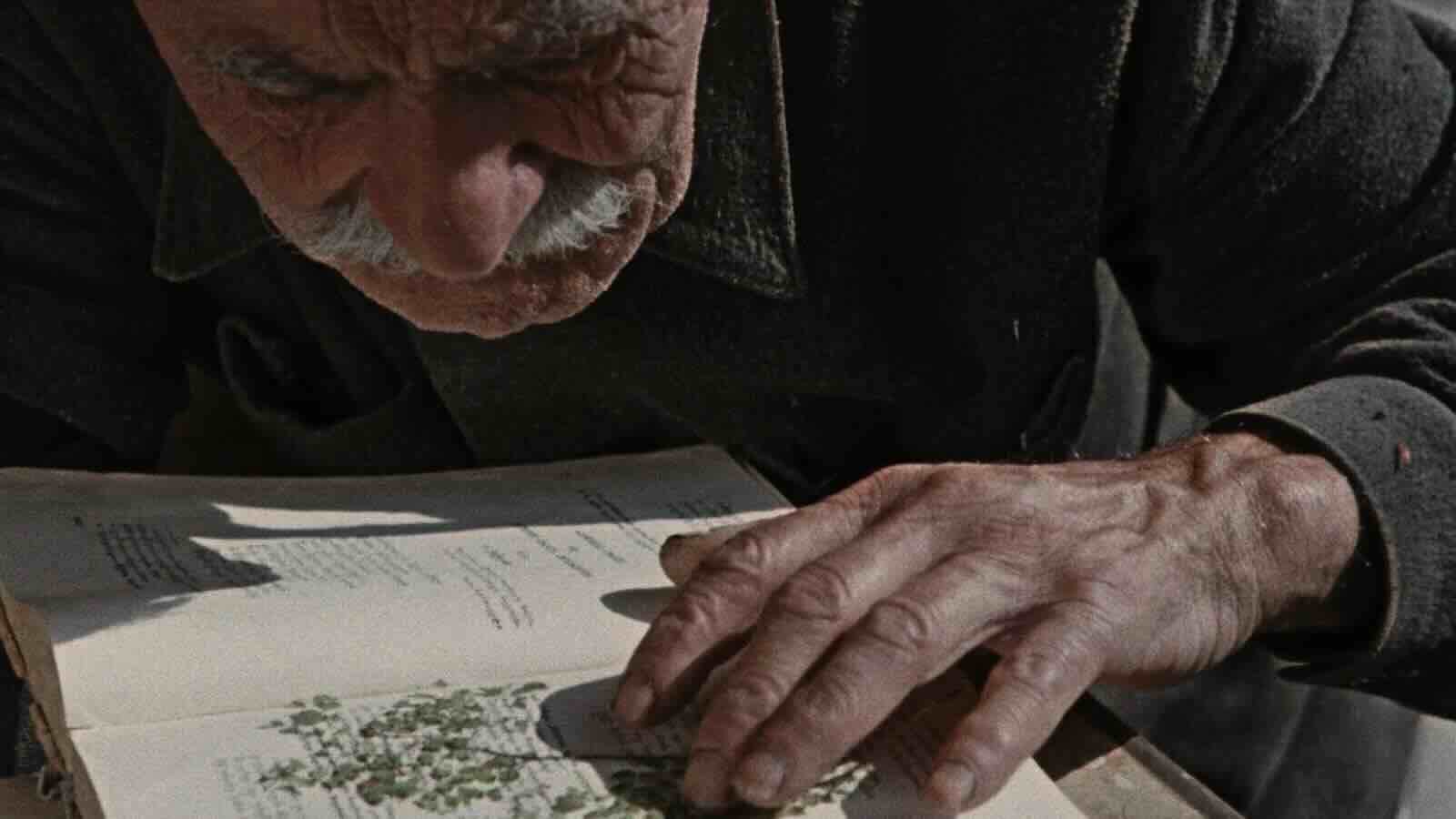
His characters mumble and talk over each other, break into or are distracted by song, and are drowned out by industrial machinery or natural sound. Or, in the Tati-esque parable April (1961), about the perils of obsessive consumerism, foley is used in raucous and plastic ways, screeching and clattering as rags buff a table or water drips from a faucet. Sapovnela (1959), a riot of color and song, scores the work of the late Mikheil Mamulashvili, a gardener whose landscape art in the city of Mtskheta is renowned across Georgia. Tudzhi (1964), shot in remarkable black and white by Shalva Shioshvili, follows the work (and, as importantly, the breaks from work) of four blast furnace operators at the Rustavi Metallurgical Plant, where Iosseliani worked for several years after April was censored from release by Soviet authorities. Here too, sounds drown out language, but co-workers joking with each other on-and-off the clock need no translation.
Much has been made of Iosseliani’s decamping to France in 1982. In combing through reviews and reporting on his films across the years, there’s a consistent focus in the Western Press on the Soviet censorship that led him to leave the USSR for the West. But Iosseliani never considered himself an émigré. “Well, when I'm filming, I live in France. Whenever I'm not filming, I go home,” he said. Moreover, he often spoke of the complications of making films in Europe: “Young people, starting out in film, fall into the clutches of hucksters from the very beginning. That could be worse than falling into the clutches of censorship."
Iosseliani’s first film Akvarel (1958), which he made as his thesis project for the All-Union State Institute of Cinematography in Moscow (now known as the S. A. Gerasimov All-Russian University of Cinematography) after dropping out of his math studies, is a piece of portraiture equal parts slapstick and earthbound. In it, a young couple tussles over money, alcohol, and unequal workloads, as dirty children look on, chasing one another from their cramped home into an art museum where they are stopped in their tracks by a watercolor painting of a house that resembles their own. Multiple docents, using identical language, analyze the painting to visitors: “You feel the warmth radiating from the canvas. Beautiful and kind people live in this house. They labor hand in hand. They are happy.” There’s a pitched ambivalence about cultural production, state-sanctioned or otherwise, to Akvarel. Iosseliani casts himself as one of the museum guides, and the struggling couple and their children, no richer than before, pose before a painter in their front yard. This need to disrupt, recast, and laugh at all versions of reality, so up for grabs then as now, runs through all of Iosseliani’s oeuvre.
“Otar Iosseliani Early Shorts Program” screens this afternoon, August 8, and on August 16, at Metrograph as part of the series “Otar Iosseliani: Fables of Modern Life.”