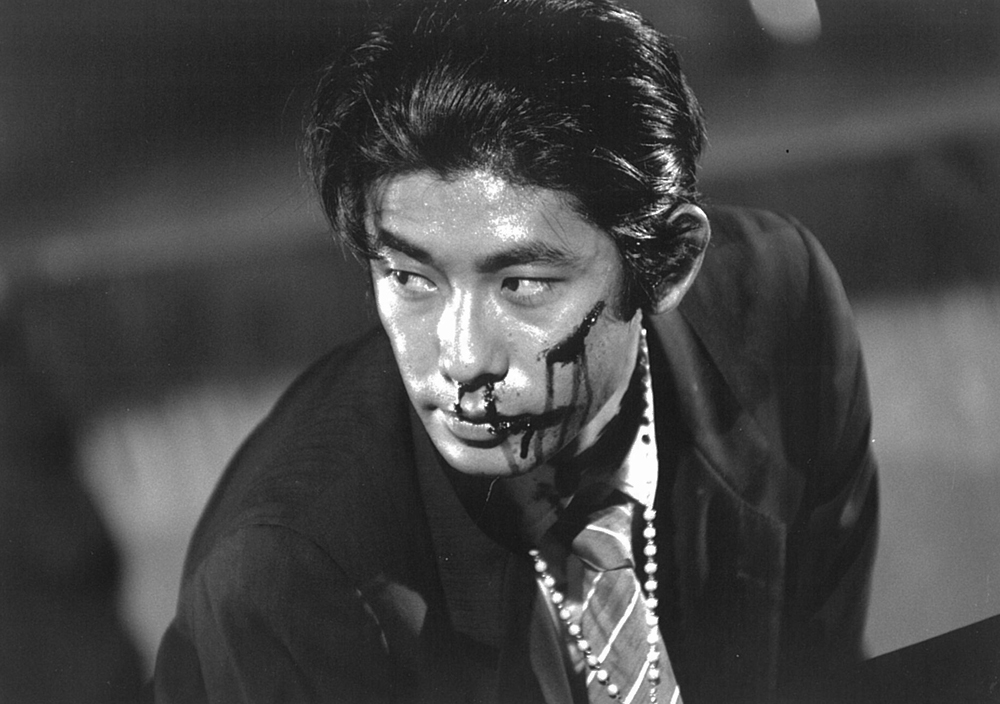
The Most Terrible Time in My Life (1993) is the first film in Kaizo Hayashi’s Maiku Hama trilogy. Starring Masatoshi Nagase as the eponymous private eye, the series pulls viewers along in the slicked-back PI’s vintage subcompact convertible, skidding between scenes of comedic mayhem and ultra-violent action set pieces in the Japanese entrepôt of Yokohama. During a mahjong game with his childhood crew of ex-delinquents, the amateur investigator brashly intervenes on behalf of a Taiwanese waiter (Yang Haitin) being harassed by local gangsters. This foolhardy act of chivalry, which results in Maiku’s pointer finger being sliced clean off by a Yakuza’s blade, lands him in the middle of a brewing mob war and a tragic fraternal rivalry.
With this inaugural entry, as is with the rest of the trilogy, The Most Terrible Time in My Life is constructed from a dense web of stylized pastiches, all of which anachronistically play out over a dreary recession-ridden Yokohama. From the works of American pulp novelist Mickey Spillane, whose own Mike Hammer is the namesake of Hayashi’s titular PI, to the gritty postwar noirs of Akira Kurosawa and Shohei Imamura, the renegade filmmaker draws from a rich, albeit chaotic, aesthetic lineage. Collaborating with veterans of the Nikkatsu Noir, notably Branded to Kill’s (1967) Joe Shishido, who fittingly plays Maiku’s mentor, Hayashi emulates a similar genre-bending approach to filmmaking. By simultaneously channeling both arthouse and commercial sensibilities, the director uses Maiku as a stubbornly romantic proxy to navigate a national moment of financial collapse and political scandal.
Having debuted on screen in Shinji Somai’s P.P. Rider (1983), and more famously starred in Jim Jarmusch’s Mystery Train (1989) as an Elvis-obsessed tourist, Nagase delivers a performance that goes beyond nostalgic mimicry. Instead of playing a believable mid-century detective, it is evident that the reformed juvenile is merely cosplaying the onscreen personas of Toshiro Mifune and Humphrey Bogart. With his fourth-wall narration breaks, numerous outfit changes, and irresistible urge to look cool for the camera, Maiku’s world exists in parallel to that of his contemporary hometown. Working out of the now-defunct Nichigeki Theater’s projection booth, the constant clicking of rotating film reels suffuse the detective’s office with a hauntological quality. In effect, the suited-up sleuth is more like a ghost from a bygone era of cinema than a believable Yokohama native of the ‘90s. Single-mindedly, and rather incompetently, chasing cases, he chooses to naively operate within the sinister political reality of gangster capitalism that permeates every corner of his seaside city.
The Most Terrible Time in My Life screens March 20-29 at Metrograph as part of the series “After the Case.”