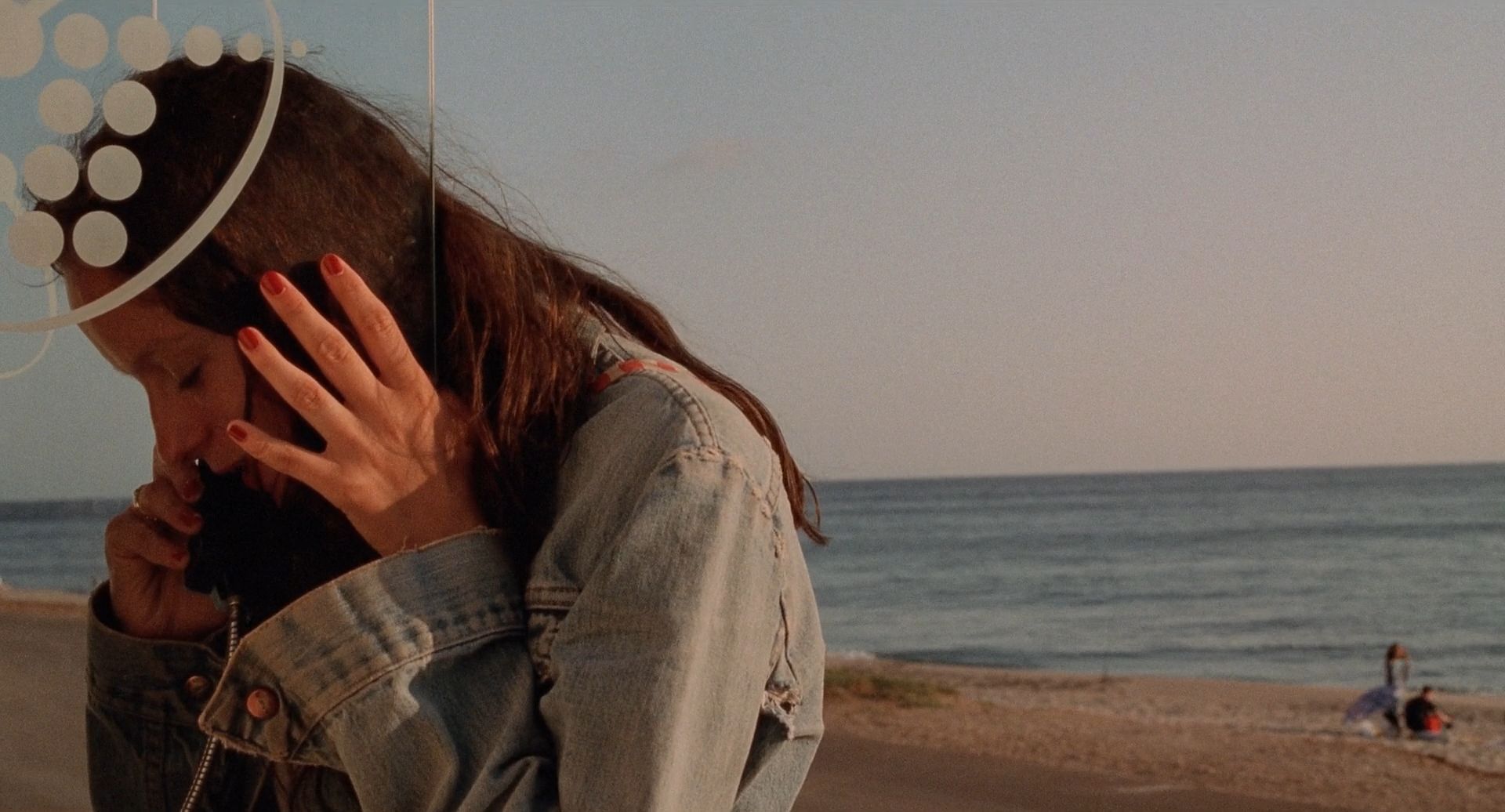
Amongst many memorable, puzzling frames in Lynne Ramsay’s sophomore feature Morvern Callar (2002), one in particular stands out as a post-millenium remix of a 17th century Dutch vanitas (still life paintings symbolizing the ephemerality of life). At a resort in Spain, Morvern (Samantha Morton) looks out from her balcony at an expanse of identical ones. It’s late at night, and half of these verandas are cast in dark shadow: either vacant suites or housing those “trying to fucking sleep up here” as one cranky voice pleads. Outside other units, bedside televisions illuminate garbage and toilet paper thrown into flight by drunk vacationers. Trash floats across the screen. It’s all over the sun-bleached resort, which accumulates the detritus of its partying youth at an unmanageable rate. Whereas vanitas of yore are replete with overturned wine goblets, extinguished candles, skulls, bad fruit, or half-eaten shellfish, plastic is a fitting contemporary evolution: functionally transient, cheap, and disposable but materially capable of outliving humans.
If Morvern Callar carries the spirit of a vanitas, its eerie and austere compositions have more kinship with proto-Surrealist paintings by Giorgio De Chirico. Take the film’s unforgettable opening scene set inside a dark living room where flashing rainbow Christmas lights on an artificial tree illuminate the bloody wrists of a male corpse on the floor as Morvern lies prone next to him. Amidst this macabre tableau, heightened static noise feels like a scream. “READ ME” glares out from an open word-processing document on a desktop computer screen, its massive font size commanding focal attention.
The imperative of the note recalls the “Eat Me” and “Drink Me” tags attached to potions in Alice in Wonderland which radically alter the imbiber’s size and perspective. Though what follows is a similarly strange journey, Morvern—unlike Alice—does not produce an ocean of tears after the fact. She reveals very little emotion as she opens the floppy disc enclosing her boyfriend’s novel, which also includes a note instructing her to seek posthumous publication. Twisting these last wishes, Morvern deletes his name on the manuscript and replaces it with her own before mailing the novel to a publisher.
For Anwen Crawford, author of the recent Decadent Edition from Fireflies Press, Morvern Callar is as substantially immersive as it is impossible to grasp. At every stage, Morvern resists being known or understood. We learn next to nothing about the nature of her relationship, who her boyfriend was, or her own personal history (we do learn she had a foster mother who died). At the same time, the film—which is grimily sensual—places us in intimate proximity with her physical body: “I’m here next to her fingertips yet out of reach of an interior drama, if there is one,” writes Crawford.
The warped pleasure of viewing Morvern Callar is one of being abjectly drawn in by its mystery while simultaneously shut out and frustrated. Morvern’s inscrutability places the audience in a position of forced acceptance that we’ll never figure her out. Her baffling behavior begins with a refusal to confront or tell anyone about the dead body on her floor, which she leaves there for days, jumping over the corpse to make a frozen pizza in the kitchen, evading it to leave for the pub, or ignoring it to take a bath. In this same tub, she eventually cuts up the cadaver and disposes of it in the wilderness. Funeral money set aside by the boyfriend is repurposed for the resort vacation on which Morvern invites her chatty grocery store co-worker Lanna (Kathleen McDermott). When the publisher contacts Morvern, eager to buy the manuscript, she accepts a life-changing advance of 100,000 pounds.
Like a lump in the throat that can’t be swallowed, the film stokes a sense of dread without providing release. Crawford refers to this spectatorial limbo as an overall atmosphere of “suspended (un)feeling”. The bad thing–death by suicide–has already happened, and though the possibility of another calamity looms, time simply passes. Ramsay is not interested in dramatizing accountability for Morvern’s oddities and transgressions. Morvern gets away with it, but the implied wrongness of what she is ‘getting away with’ remains murky. Crawford draws compelling comparisons between Morvern and Jane Campion’s eponymous Sweetie (1989) as well as Mark Renton in Trainspotting (1996)—the latter being more immediately relevant as Scottish cinema’s center of gravity in the late 1990s—but her character also contains shades of Patricia Highsmith’s shapeshifter Tom Ripley given their shared unsettled moral compass and fragile vulnerability.
There are many ideological and historical frameworks that Crawford uses to contextualize the film’s temporal setting, including globalization, Cool Britannia, New Labour, ‘90s rave culture in deindustrialized Scotland, as well as its pre-social media and post-9/11 theatrical release. This academic rigor is helpful in working through the sociopolitical implications of the film, but what Crawford’s text most profoundly reveals is that the truest way in to Morvern Callar begins and ends with a personal, haptic relationship to its contents. Charlotte Wells’s autofictional riff Aftersun (2022) also underscores this notion.
An established music critic, Crawford pays homage to the role songs play within Morvern’s inner world (she is frequently shown listening to a Walkman playing a mixtape gifted to her by her boyfriend). Crawford’s book is structured in two parts: an A-side and a B-side. Although her final section shares The Mamas and the Papas “Dedicated to the One I Love” with the film’s iconic coda, each chapter is otherwise named after a song that doesn’t appear on its soundtrack. Taking notes from Morvern and the hard parts of life confronted in writing the book, it's a choice Crawford doesn’t have to explain, befitting of a film enriched by the secret selves of its protagonist.
Morvern Callar screens tonight, September 27, at Metrograph on 35mm as part of the series “Fireflies Press Presents.” Fireflies Press co-publisher Annabel Brady-Brown will introduce the film.