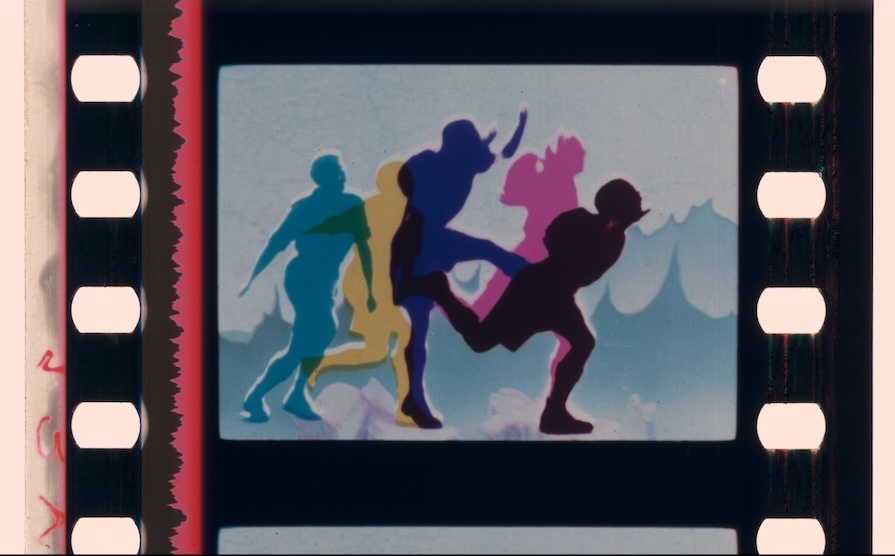
In the 1930s, at the same time Walt Disney was fine-tuning the spotless craftsmanship of film animation that still dominates the market nearly a century later, Len Lye unveiled his first revolutionary contributions to the medium. Monomaniacally seeking perfection, Uncle Walt Taylorized the process, employing hundreds of artists to create the aqueous gestures of Mickey and Snow White, not to mention the painterly backgrounds and prairie sentimentality of the narratives. The sublime perfection of movement in those early Disney shorts defies their origins in human hands. Lye, however, was a one-man band who used his own hands to apply paint directly to blank celluloid. The saccadic effect of misaligned or miscalculated frames in an animated sequence was and is anathema to the Disney-descendant looking to imbue their creation with the familiar physics governing life outside the theater. But Lye saw tremendous energy in the small variations across frames that create an excitable, unruly image. His work is as playful and joyous as any mainstream animated spectacle, but is far more invigorating in its instability.
Six new digital preservations of essential Lye films will appear throughout San Francisco Film Preserve’s Re:Vision festival of restored and rediscovered films this week. Like cloudwatching, taking in a Lye film presents viewers with the chance to float through their visual inventory in search of figural associations. According to the biographer Roger Horrocks, Color Box (1935) was partially inspired by designs adorning Polynesian tapa cloth that the New Zealand-born Lye encountered during several extended sea voyages as a young man. Lye took inspiration from indigenous artists who used geometric stencils that produced slightly inconsistent markings with continued use. He used stencils to apply painted shapes onto film, and manipulated the wet paint with a fine-tooth comb to create dancing striations. In three minutes, a parade of richly textured circles and lines careen in all directions across the screen to musical accompaniment by Don Baretto and his Cuban Orchestra. Newsmedia at the time heralded Colour Box, commissioned by the UK’s General Post Office, as the “first film made without a camera.” Though not quite true—Man Ray’s Return to Reason (1923) was created by placing objects directly onto unexposed celluloid over a decade earlier—the sentiment captures the excitement over the apparent novelty of Lye’s films, and testifies to how widely his experimental animations were screened compared to his avant garde predecessors.
He took a similar approach in making Kaleidoscope (1935), Rainbow Dance (1936), Colour Flight (1937), and Swinging the Lambeth Walk (1940), each of which contributed an advancement of the technique, whether by deepening his rich color palette or establishing fresh relations between his graphic elements. The oddball of the bunch is The Birth of the Robot (1936), an origin story of Shell Oil’s mascot from the 1930s told using stop-motion puppets. It lacks the inventiveness of Lye’s other works, but its unintentionally dystopian storyline of a corpse in the desert reanimated as the Shell Robot Oil Man who proceeds to cover the world in motorways works beautifully as a snapshot of Big Petrol’s hubris.
Watching clouds drift across the sky as an art student inspired Lye to seek methods for capturing movement itself rather than simply objects in motion. When his attempts to do so in painting failed, he discovered motion pictures as a natural vehicle for his ambitions. Contemporary critics had a field day comparing his work to spaghetti, explosions, and fruit salad. Pareidolia is hard-wired in the human mind, and in the case of Lye’s films, searching for familiar forms produces a great deal of engagement. But deeper in the work we find pure elemental movement. Lye’s cha-chaing forms stop resembling the depiction of electrons or muscle fibers in textbooks and alchemically assume the vitality underpinning them. It’s perhaps blasphemous to suggest taking off one’s glasses or forcing one’s self cross-eyed during a film screening, but for a Lye film, it might help audiences tap into the pure movement he was chasing. It’s a testament to Lye’s playful spirit and profundity of vision that his work demands multiple viewings utilizing multiple sensory regimes.
Len Lye's animated short films will open six of the screenings during SF Film Preserve's Re:Vision film festival, running Thursday through Sunday at the Roxie.