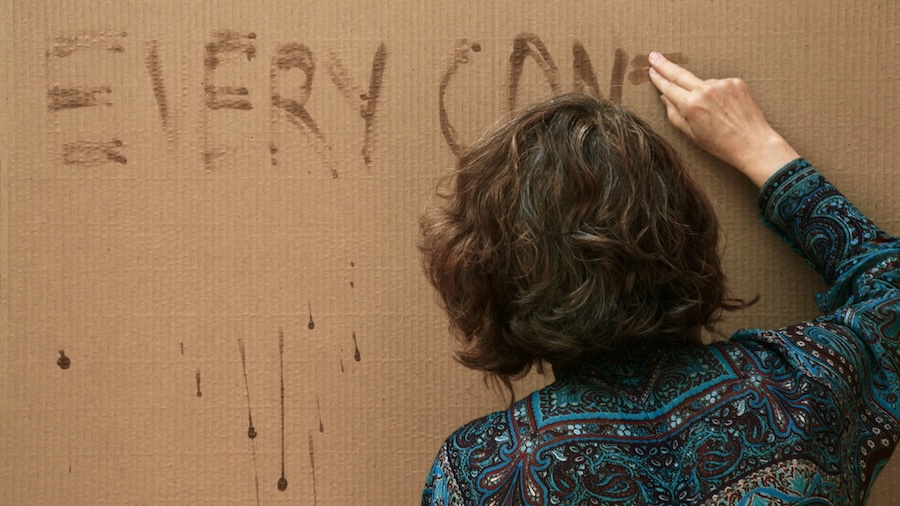
Lynne Sachs’s new film Every Contact Leaves a Trace (2025) begins from a pun on Locard’s Exchange Principle: the forensic axiom that each encounter between people or objects deposits a material residue. Sachs turns the principle inward, toward the sedimented matter of a life lived among others: some 600 business cards accumulated over four decades, a paper archive indexing the chance encounters and professional exchanges of an illustrious career. The film appropriately screens on the occasion of Sachs’s Persistence of Vision Award from SFFILM, which recognizes her career in experimental documentary filmmaking.
As Sachs sifts through the stacks, narrating associations or confronting blank spots in her recollection, the cards’ standardized form gives way to the unruliness of relation. Sachs layers a restless flow of images, animations, and superimpositions over a diaristic voiceover, while frequent collaborator Stephen Vitiello’s omnipresent score hums beneath. She stages new encounters with select figures represented in her collection: a textile artist, a therapist, a refugee and mother who once cooked for her. Conversations always seem to turn toward days gone by, though the governing insight is less about recovering evidence of what “really” happened than observing how the past is continually remediated through its recounting and the subtle gravity people exert upon one another’s lives across space and time. At intervals, Sachs extends the interpersonal scale of her inquiry into a more expansive awareness.
While speaking to the woman who cuts her hair or searching for someone to make her maqluba, she holds Ukraine and Gaza on her mind. As she thinks of previous mistakes, of her ambivalent German-Jewish heritage, or her complicity in historical and current violence while living within the imperial core, her on-screen interlocutors serve as mirrors into her own wandering mind, a gesture toward entanglement reminiscent of Chris Marker’s reflexive Sans Soleil (1983). The “trace,” the film suggests, marks both the fact of contact and the asymmetries that shape it. At the same time, these traces may falter in their own ways, as they fail to hold the fullness of what passes between people. What constitutes intimacy? What does it mean to know someone? Closeness doesn’t necessarily produce understanding or solidarity. It can generate hostility or leave damage. With Sachs, we learn that to be in relation is to come to terms with one’s capacity to do harm and to accept that we might leave imprints that elude our awareness entirely. If Sachs begins from the business cards as her archive of traces, then, by the end she relinquishes the thinness of their description to the irreducible complexity of the people and relationships they represent.
Every Contact Leaves a Trace screens Saturday, May 9, presented by Other Cinema at Artists's Television Access, with Lynne Sachs in person.
Previously:
Every Contact Leaves a Trace screens Wednesday, April 29, at BAMPFA, with Lynne Sachs in person to receive SFFILM's Persistence of Vision award.