There is a purpose to recording, even if we are ignorantly burdened by our modern ability to store everything, delete nothing, and never have to look back at anything. Recordings are meant to preserve what we don't want to leave solely to our mortal, intangible, and fallible memories, but what we capture in images are only traces of light and red-green-blue values; sound is an unembodied frequency. The mementos we create only contain so much observational information, and so little truth. In the Hungarian-Canadian feature Blue Heron (2025), memory is probed through 35mm photographs, handycam tapes, digital devices, and the painfully gap-filled nature of recall inspired by writer-director Sophy Romvari's personal family history. Set in the safety of a fictionalized script, the film leaves a deeply moving impression of the frustrations in trying to make sense of the past from a finite body of evidence.
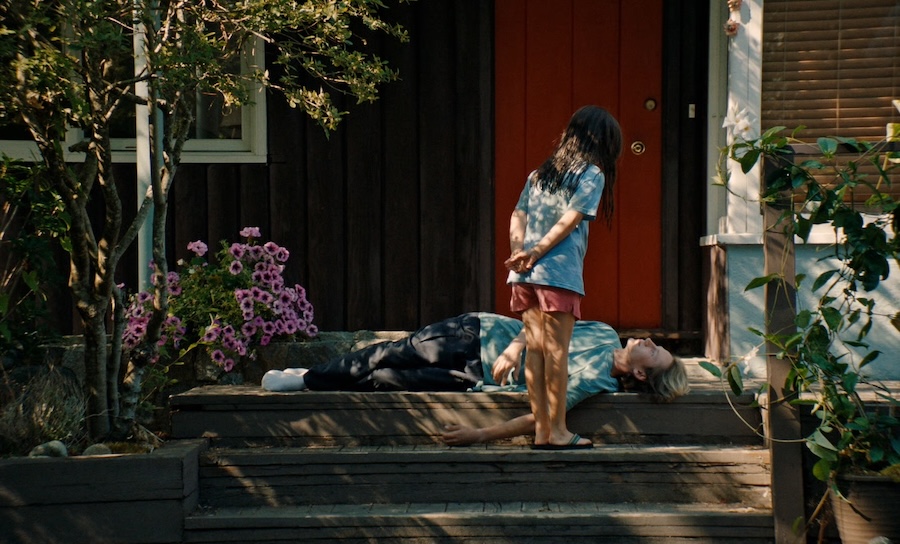
Moving to Vancouver Island in the late 1990s, Blue Heron's child protagonist, Sasha (Eylul Guven), adapts to her new home while surviving adolescent boredom in the summertime with her three brothers. But her eldest sibling, high schooler Jeremy (Edik Beddoes), has long dealt with troubling behavior that now seems to get worse every day, spanning the spectrum of exhaustion and stress and fear that has challenged their parents for years since he was a child. Despite the various professionals who have consulted Jeremy and his parents, nobody understands what he is going through, nor does he offer any clues about what he needs. Even when at wits' end, his parents offer him their love, but their desperate hopes for Jeremy create what a social worker will later recall as a crisis for the entire family.
Twenty years after the first half of the film, a grown Sasha (Amy Zimmer) sifts through the home videos and photographs her father (Ádám Tompa) had constantly been shooting during her childhood. Like Romvari, she's making a film—one that reckons, and maybe even reconciles—with a major family story: the story of her oldest brother. Romvari weaves in nonfiction interviews with contemporary social workers while Sasha shares new information from Jeremy's various psychological reports. Blending these clinical appraisals of his past with Sasha's meta-visits to her memories from the same time period drives home a jarringly heartbreaking truth: we can never go back to the past and we will never be able to know what we don't already.
Blue Heron is a multimedia portrait of a family that truly loves each other, but also shows the frayed edges of patience and the self-deprecation of feeling like a failure. Notably, there's a great effort to care about the parents, who are just as lost as anyone else in the mystery of Jeremy. Their mother (Iringó Réti) questions and blames herself, but there is no answer about what's "wrong." As Jeremy says, "I think there's a lot you don't remember." No amount of photos or home videos would reveal it all.
Blue Heron screens Saturday, April 25, at BAMPFA, and Wednesday, April 29, at the Marina Theatre, as part of the 2026 SFFILM Festival.