Have you heard that line about how every hotel room has a cuck chair? It's pretty much true, which makes the statement both amusing to acknowledge and the chairs’ existence highly conspicuous. The cuckolded husband is not only a longstanding trope of relationship power dynamics, somewhat adjacent to the so-called whipped guy who submits to his partner, but also a kink of its own. Some people just really like to watch, and who better to watch their partner, or object of desire, than a filmmaker?
Perhaps we can best trace directors working repeatedly with onscreen muses (often beautiful young women) back to the 1930s, with the seven films Josef von Sternberg directed with Marlene Dietrich as his star, a collaboration that culminated in the self-explanatory The Devil Is a Woman (1935). Unlike painting, which saw artists try to capture someone’s allure, film actually made it possible to do so in 360 degrees and four dimensions, plus sound. For Roger Vadim, notorious director of sexy femme-focused films and husband to always-much-younger women, his marriage to rising star Jane Fonda began ending shortly after the now-cult classic film Barbarella (1968) was released. A sci-fi flick that indulges as much in its medieval astronaut costumes as it does in sexuality, Barbarella was their last of four movie collaborations.
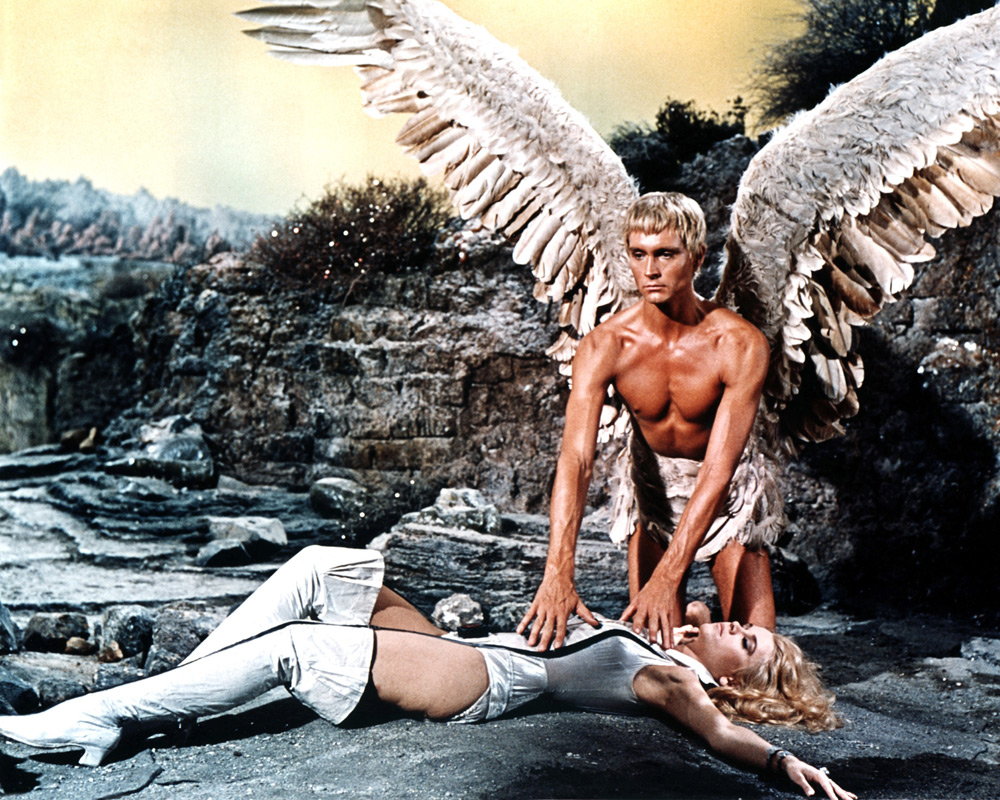
Filming his then-wife as the frequently semi-nude "astronavigatrix" from Earth conducting a mission to uncharted space territory was not about putting Vadim in the proverbial cuck chair. Fonda, in the title role, seduces and is seduced off-screen by various men, including the blind angel Pygar (played immaculately by the Adonis-like John Phillip Law), who repeatedly leave her in states of post-coital sedation. (The film was released with a shockingly low PG rating in the US.) Barbarella, then, was Vadim's last gloat to show himself off as Fonda's husband. Look at Barbarella writhing and moaning in satisfaction: is that not what we might assume Fonda is like after a romp with her own husband? Is the playboy Vadim, by portraying the stereotypically beautiful heroine in her sexual hunger, stroking his own ego because she belongs to him in the institution of marriage, in the world outside the film set at Cinecittà?
It's as possible as those chairs in hotel rooms being there for the purpose of cuck shows, which is to say it’s possible. Barbarella, based on the popular comic book series by Jean-Claude Forest, follows Fonda in the 41st century as she carries out a mission assigned to her by the President of Earth (Claude Dauphin). She must find the scientist Durand-Durand (Milo O'Shea), who has gone missing on the mysterious planet Tau Ceti. To make matters worse, it's crucial she locate him because of the danger his latest invention poses: a weapon of mass destruction known as the positronic ray. To find him, Barbarella must face flesh-eating robotic dolls, men who prefer physical intercourse over pill-based, hand-holding sex (as future Earthlings do), and a liquid energy monster called the Mathmos, which feeds on pure evil and puts her in contact with the ultimate sci-fi boss, The Great Tyrant (Anita Pallenberg), who rules over Tau Ceti's land of lost souls and has more than just an innocent interest in the "pretty-pretty" Barbarella.
Vadim directed a fantastical action film (originally scripted by Terry Southern) with vast-seeming futuristic sets, a plethora of avant-garde costumes, fiery explosions, flying characters, and other special effects rendered beyond campy amateur attempts by the uncredited Carlo Rambaldi, who won Academy Awards for his effects in King Kong (1976), Alien (1979), and E.T. (1982). But Fonda's sex appeal has often overshadowed the science fiction elements of the story, and her feminism, if Barbarella has any, has been frequently attacked.
Barbarella passes the Bechdel test—it has at least two named women who talk to each other about something other than men—despite having countless topless women in various states of servitude or decoration in the background. It also features two women in the most powerful roles, as Good and Evil. Barbarella's strength as a heroine (or, dare I say, role model) is her lack of self-consciousness or shame, especially regarding her appearance or its effects on others. Her naïveté about her power to attract (and command) others is admirable here. She never tries to take advantage of it, and hardly takes notice of it herself. It's us, the audience (at Vadim's mercy), who must beg for her to put aside her humility to flirt with us—if only for one second. But no: Barbarella has a mission, and like any good girl with a goal, she's undeterred by such undeserving distractions as shallow vanity, purposeless sex appeal, or partnership—temporary or matrimonial.
Barbarella screens tonight, December 15, and on December 20, at the Museum of Modern Art on 35mm as part of the series "MoMA and Cinecittà Present: Carlo Rambaldi."