At one unfortunate, or perhaps fortunate, film festival screening of his child-centered drama Where Is the Friend’s House? (1987), Abbas Kiarostami informed the audience that the friend’s house and many houses all around it had just been destroyed by an earthquake days earlier. Although he’d gone back to see if the children in the film were among the estimated 50,000 dead, he still didn’t know. That going back and not knowing might itself make for a film, someone in the audience suggested, with an offer to finance it, and what kept this from being a supremely tactless suggestion was the understanding that it would not just be a film but an ethical film, of the self-aware sort that only Kiarostami could make.
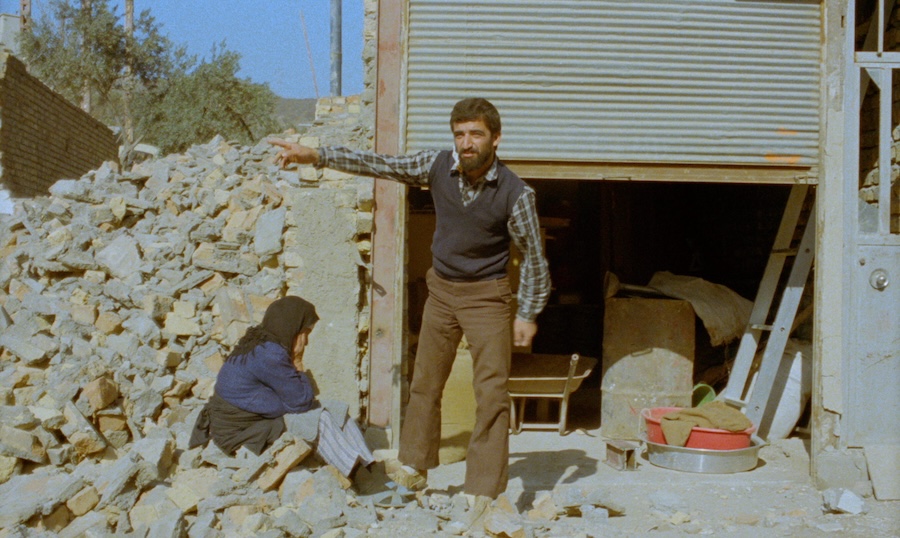
He thought it over and indeed later restaged the experience: a reconstruction of a destruction, with non-actors portraying himself and his son making their way by car through the earthquake’s rubble, and several of the surviving villagers portraying themselves abiding, again, complete devastation. In English the film is called And Life Goes On (1992), which sounds about right for how it is gently distancing and affirming at once—an improbable, staggeringly humane synthesis of documentary and daydream.
As this fictive father and son zigzag through dusty hills in search of the earlier movie’s kids, Kiarostami presents the occasional painterly tableau and expressive offscreen sound, but certainly no insult-to-injury platitudes about community coming together or the triumph of the human spirit, nor any overcooked catharsis or closure. Instead, the prevailing tone is delicately matter-of-fact. This lets us notice, after a while, that unlike its buildings, spirits in the village appear unbroken. One woman calmly declares her husband is buried in the debris, but asks for help unearthing her kettle because, as she states, “I haven’t had any tea in three days.”A man setting up a hillside TV antenna explains that yes, he’s in mourning too, but the World Cup only happens every four years. Two newlyweds say they lost 65 relatives in the disaster, but went ahead with their wedding anyway because, as the groom explains while polishing his shoes, “Those who died didn’t know what was coming. We decided to enjoy life while we could. The next earthquake might kill us too.”
Between Where is the Friend’s House? and this not-quite-sequel, Kiarostami also directed Close-Up (1990), his still-standing monument to cinema as an instrument of mediated (and falsified) personae. And Life Goes On extends that film’s probe of the relationship between experience and artifice, in this case as something like a poem people pass around in remembrance to process the otherwise incomprehensible: necessarily a reduction, extra real instead of strictly true. With Through the Olive Trees (1994) a couple years later, that newlyweds scene got a film of its own in the form of a fictional making-of, or a recreation of the recreation And Life Goes On already was, or the not-quite-sequel it was understood to deserve.
And Life Goes On plays Saturday, August 22, as part of the series Through an Open Window at Yerba Buena Center for the Arts.