The risk a period piece runs is that any immaculate reconstruction of the past, however distant, will always feel like a different reality than the present one. History is only recoverable insofar as we can learn about what happened and what life was like for people before us. To actually try and reinhabit the past is a folly of nostalgia favored by fools and fascists.
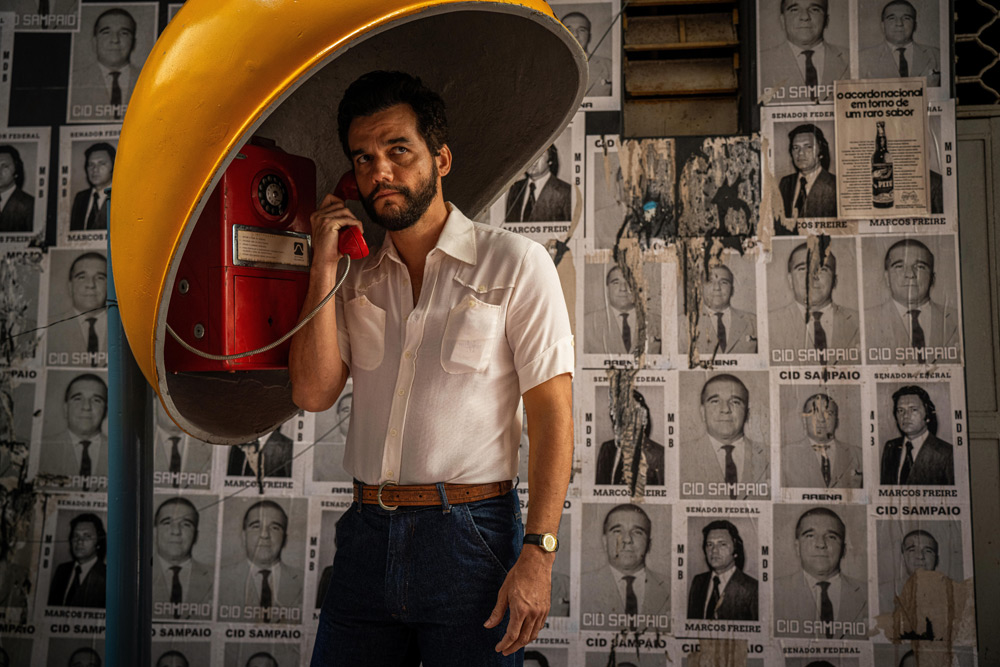
Kleber Mendonça Filho is neither a fool nor a fascist. The Brazilian critic-turned-filmmaker is one of the premier directors in the world today, mining the legacy of his hometown, Recife, in ways that illustrate how yesterday can rule today. His latest and fourth feature film, The Secret Agent, is a slow-burn political thriller set in 1977. It is his first feature film set almost entirely before the present day. Inspired partly by recollections of his own childhood, Mendonça recreates this time period and place by weaving in fashion, cultural references, political events, and Volkswagen Beetles. But, not for the purpose of mere marination in memory.
Instead, Mendonça provokes his audience, tweaking Brazilian and global cinemagoers alike to consider just what exactly it is that connects people to their past, be it glorious, tragic or unknown. Not content with demonstrations of simple cause-and-effect, Mendonça goes further in The Secret Agent. What really distinguishes our time from theirs? What does it mean for history to resemble recency? How does the past shape us and our world, even if we ourselves do not know what happened?
I spoke about such echoes with Mendonça in a recent interview over Zoom. Our conversation has been edited for length and clarity.
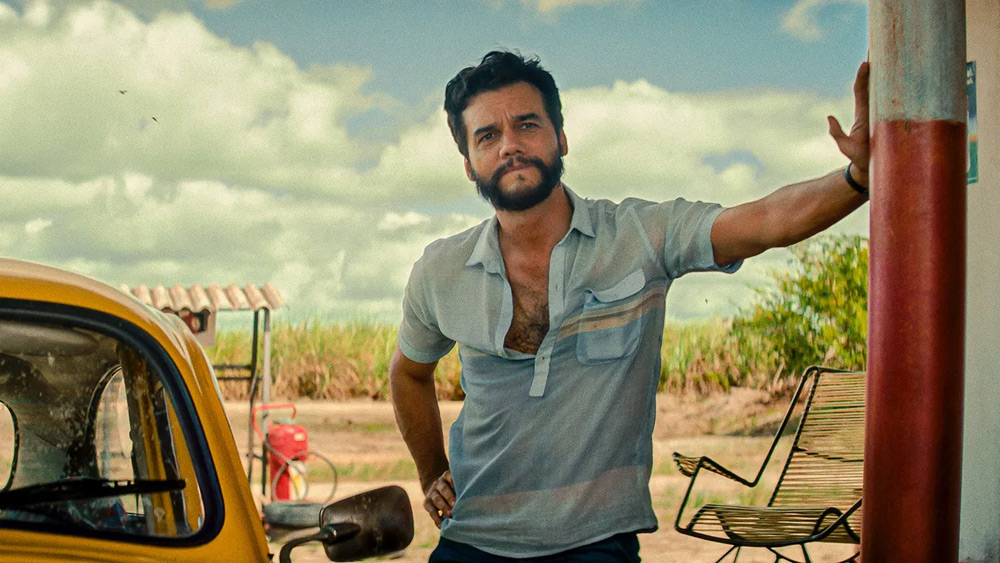
NK: The first thing that the audience encounters in The Secret Agent is a dead body, the decaying corpse of an alleged thief that is neglected for days. Then, the audience sees a cop coming by, not dealing with the corpse, but instead going through this elaborate effort to shake down the protagonist for what amounts to a pretty pathetic bribe. That struck me as a pretty intentional decision, considering the kind of commonplace nature of petty corruption in Brazil. What made you want to use that as a starting point for your film?
KMF: I like the whole gas station situation. I like the fact that it's isolated on a back road. I like the fact that it's in carnaval. Coming from Brazil, particularly from the northeast, means you're in a heightened state of realism, because during carnaval you can get lost in the music, in the costumes, in the drugs. It’s like normal rules don't really apply…. So, the whole situation, I think, is very credible from the point of view of the police being overworked or just too busy with other things and feeling like shit because they probably get very bad pay. It’s an opportunity to get more money out of corruption.
The thing with the cigarettes towards the end actually happened to me on Ash Wednesday in the early ‘90s. It wasn't out of town, it was in the city. I was a young driver and I was stopped by the cops, who went through a full checklist of things that could have been wrong with my car. Nothing was wrong with my car. I had the documents. I had the driver's license. I had the spare tire. Everything was perfect. In the end, he kind of just gave up and said, “Just give me something and I'll let you go,” which is completely absurd. You’re supposed to be a good citizen doing everything right and this guy was actually looking for something wrong, so that it could be an opportunity to make some money. I think that the normalization of corruption is both comical and very frightening, which translates into great drama.
NK: When I sat down for your movie, I was thrust into the year 1977. You have Jaws (1975), but what really struck me was the presence of Angolan refugees. If it's 1977 and, as they say in the movie, “first we were on the one wrong side, and then we're on the other wrong side,” it’s suggested that they were on the losing side of the MPLA purge from that year. I found, in this deliberate detail, that there's something about 1977 that’s worth emphasizing, or that is worth sitting with. Why 1977?
KMF: Well, it's probably the first year I remember. I have said this a number of times: it's not about my childhood, but as a child, you're incredibly sensitive. I'm not talking about Angola. I'm talking about cars, for example. I couldn't tell you what a Kia looks like, or a BMW, because we don't even own a car [nowadays]. But in 1977, I could be a car expert. I could tell you the difference between the ‘77 model, or the ‘76 Volkswagen Beetle, or the Brasília. These are things that I paid attention to.
The other thing is that one of the defining characters in my life is a friend of my mother's, Thereza Vitória. She was actually from Mozambique and she was a historian. She was an incredible person, a Black woman, of course, and I loved her accent. I loved when she came to have lunch and I never forgot her. Then, I write this character, Thereza Vitória. I really love her because she's like a memory from the past. But I thought, Mozambique or Angola? Well, I think she could be Angolan. And, I really like the idea that you would never be popular with one side, because you would be on the right side, right? I find it fascinating when you also have a falling out with the right side, because that's how politics is. Sometimes all it takes is that in a meeting, you go, “What about so and so?” And you’re dead. Because, the spirits are running high and it's all very passionate. You're finished, just because you raised a question which actually makes sense. I always thought that she would be that person, and I also thought she would be the one character. Her husband, you know, nice, good man, but he would be this. He wouldn't be the stronger political link. She would be the stronger political link, as Thereza Vitória was in real-life.
I wanted to bring Angola into the mix knowing what I know of Angola—from friends, from a couple of books, and from observing Portugal and Angola and their tumultuous relationship. But, I think there are many interesting things about ‘77-’78. For example, the photograph at the end of the film with Wagner dead. I thought a lot about the kidnapping of Aldo Moro in Italy. Manchete, Brazil’s version of Life magazine, had a four- or five-page spread on the kidnapping, which was very violent and very bloody. As a little kid, I saw those black-and-white pictures, and they were very shocking; men shot on the ground, in the street. That is a memory from childhood. Orca: The Killer Whale (1977), the Dino De Laurentiis movie. It has very strong images of cinema and Morricone’s score is wonderful. It is a film that I saw at the São Luiz cinema, which is in the film. All of these things—the cars, Thereza Vitória, Mozambique, Angola, and Jim Jones in Guyana—are part of my childhood memories.
NK: My dad is a rabbi, and when he finished rabbinical school in the United States, he became a rabbi of a Reform Jewish synagogue in Rio de Janeiro, staying a few years before coming back to the U.S. He still speaks fluent Portuguese. In 2019, for Yom Kippur, we went to Recife as the local Jewish community there had hired him to lead the services. We stayed in Boa Viagem for a week and that happened before I'd ever seen any of your movies. So, it was a very weird, textural experience watching your movies and going, “Oh, wait. I know that place!”
The thing that has struck me since seeing three of your four movies—I still have not seen Pictures of Ghosts [2023]—is your specific attachment to Recife and, in Bacurau [2019], the state of Pernambuco as a whole. I was apprised of this when I went to Recife. There is a sense of cultural distinctness and an identity particular to the city and to Pernambuco. In Bacurau, it comes out straightforwardly. There's this town with a communitarian ethos, and Udo Kier and a bunch of rich people are coming to kill them. Aquarius [2016] is both about this one woman resisting developers, but also development more generally. Through it all, you clearly have got in your head a very fixed idea of what it means to be either from Recife or from Pernambuco. What do you think of as those sort of essential or special qualities, that are also clearly your definition?
KMF: I agree with everything you said, but sometimes it's a little uncomfortable to say it, because it feels like you're saying that the region you come from is kind of special—which it is.
There is something—which might turn up in my next film, which will be set in the ‘30s—in that Recife is far from the financial, media, and cinema capitals of Brazil. That, in a way, makes Recife provincial. But Recife is also a port city, and it's the northeasternmost point of Brazil in the Atlantic Ocean, which means it was the first touching point of the underwater cable coming from Europe, the zeppelins coming from Europe, and the ships. It has always been very cosmopolitan. We had the first university law school in Brazil, the first newspaper in Latin America. It's a weird mix that you get and history keeps repeating itself. Lightning keeps striking the same place over and over again. I'm not sure you know, but Recife has the first synagogue of the Americas.
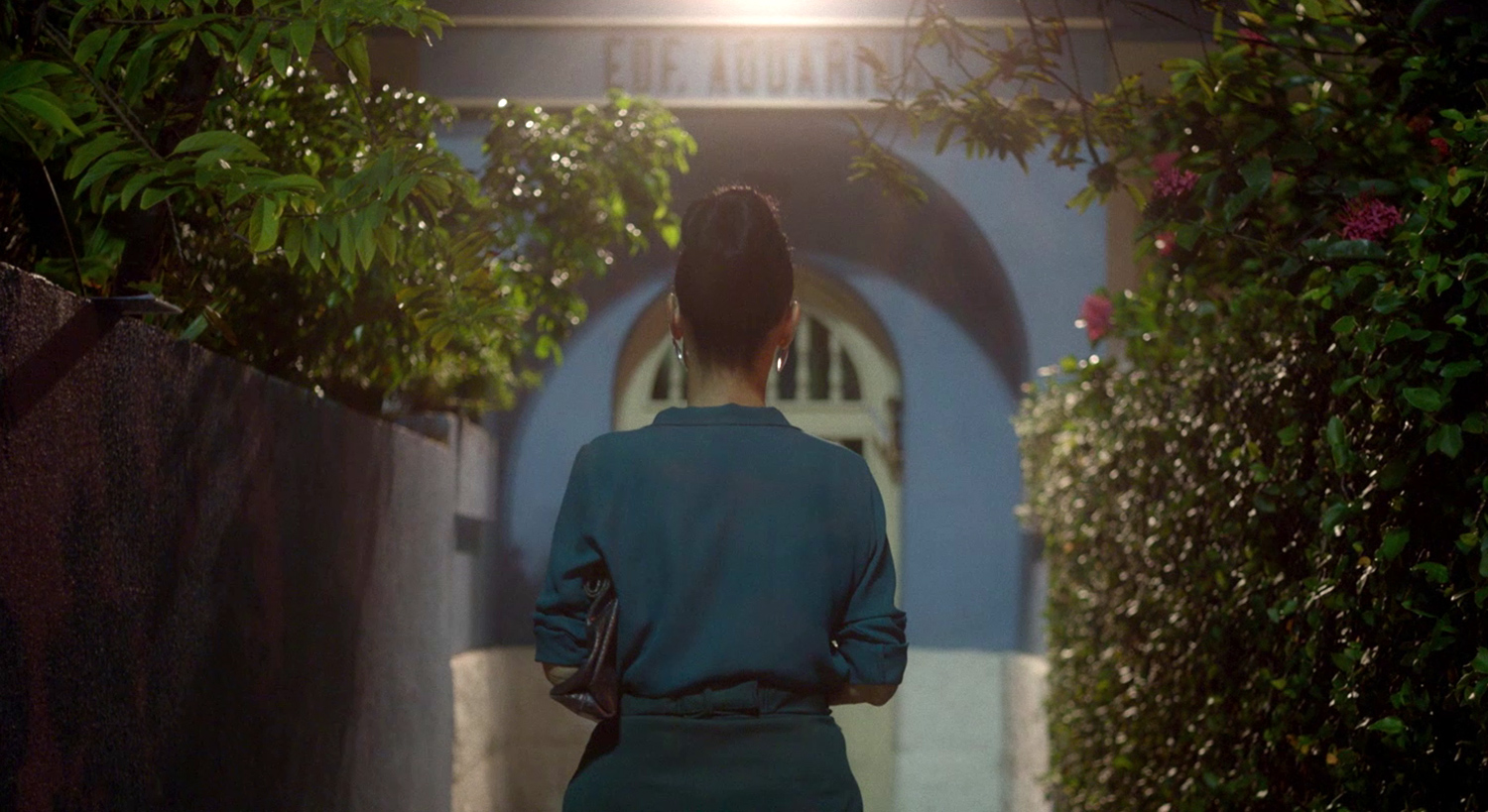
NK: I visited it. You show old Recife in the movie so beautifully: how it's astonishingly well-preserved and how it blends into the city a bit. It doesn't feel as apart. Old and new sit next to one another there in very dramatic ways.
This is a more minor point, but another part of life in Recife is all the shark stuff. It seems to me that you have some very particular ideas about what the sharks mean for Recife and what they suggest as an idea.
KMF: Well, the shark is a predator. It’s a fascinating animal because it lurks in our subconscious, not only because of Spielberg's film, but because of what a shark means. It's an eating machine with three or four rows of razor sharp teeth.
I come from a city which actually has a problem with sharks. If it’s 34 celsius in Recife, a Sunday on the beach in Boa Viagem—this is probably the biggest expression of pleasure and denying pleasure—it’s almost like two people who really want to have sex but don't have a condom. I'm on the beach. It's really hot. It looks amazing. But, I can't go in the water because there is the fear that I might lose a leg or an arm, like so many people have. It's like a curse. It's the irony of ironies, and it has become who we are. In the ‘90s, when only surfers were being attacked, even myself, I would say, “Well, I'm not a surfer, so I'll be alright.” And then other people began to get attacked.
NK: I suppose that Martin Niemöller poem about Nazis also applies to sharks. “First they came for the surfers, and I did not complain because I wasn't a surfer…”
KMF: Exactly. You go, “I'm not a surfer.” Then, the second wave was people who would swim very far. I don't swim far. Then, the conversation ended when this trucker from Santa Catarina was attacked at about one or two feet of water. He had half his leg taken. So, you know, we started behaving.
NK: I don't know many directors working today who are as skilled as you are at finding people who are so distinctive looking, but who also have real presence on the screen. In The Secret Agent, Alexandre exudes this incredible comfort and kindness, and you just believe that this man has nothing but purity. Dona Sebastiana is another character like this. Are these whom you know and whom you've remembered?
KMF: I think the strongest part of making a film is casting. I just get to know [people]. They come for a coffee, we have lunch, and we have long conversations about life. I like people both as characters in the film and outside the film. Brazil and the United States are very diverse societies of many different faces. If you're going to make a film about life on the planet, you should be very open to the kinds of faces that you're going to put up on the screen. The work that we did with Gabriel Dominguez, the casting director, was just such a happy moment. First you get pictures, then you get videos, then you get to meet people, and then the indecision sets in because you have three amazing people for one role. I've been very lucky, because I like all of these people. I love them. They have become part of what the film has become and there's a lot of recognition for the cast.
Also, Wagner is a star. He’s a celebrity and he had a really important role in making everybody feel great. He could’ve been the star who doesn't give a fuck about other actors or actresses, but he really made everybody feel great. He was holding everything together. Me too, of course, as the director. But if the star is aggressive or treats people with contempt, I don't think it would’ve worked the way it did. He really wanted everybody to shine.
NK: There's only one question we didn't get to yet. For this question imagine I'm wearing a cowboy hat, because I'm asking this question as an American. I think that Americans, having never lived under an open dictatorship, have a cultural image of a dictator as someone like Hitler—somebody who wants to exert total control over society.
But, one thing about your movie is that the villain is revealed to be a capitalist working within the system of the dictatorship. They’re an agent of the state, insofar as they are able to operate levers of power in the state to their own benefit. But he's not the president. He's not wearing a uniform. He looks just like another Brazilian guy, except that he has an air of menace about him. It doesn't matter if there's a real dictator, or if there's a wannabe dictator like Bolsonaro in charge, these practices exist across time. I had to sit with this a bit after seeing the movie and I wanted to know if you agreed. Is some of what's in this movie about illustrating these continuities?
KMF: The most striking aspect about contemporary issues we all face in different countries with, let's say the far-right and authoritarian streak in Brazil, the United States, and Europe, is what strikes me most as a father now. How these people, of a certain ideology today, are always fighting reality. That is something that I never cease to be horrified by. Bolsonaro, for example. I'm telling you this because on Saturday [December 27], one of his henchmen was arrested trying to escape Brazil. The idiot escaped into Paraguay. He broke his electronic bracelet. This guy was the head of the National Highway Patrol police back in 2022 when the presidential election took place, the one Bolsonaro lost. On that day, he sent out an order, particularly to the Northeast of Brazil [where Pernambuco and Recife are located], because they knew that Bolsonaro would lose in a landslide there. He told his men on the highways basically to stop car traffic.
This is the first time I'm telling anybody this and now I'm making a crazy connection, because in the opening of the film, the same police, the highway police patrol, comes into the gas station. These people, in 2022, were told by their head office in Brasília, the capital, to actually stop cars and buses which were taking voters to the voting stations all over the Northeast to prevent people from going to the polling stations. But with the internet and cell phones with cameras, from the very early morning, we began to see reports coming up and videos coming up of a pattern of harassment taking place all over the northeastern region. The Supreme Court was very quick to act, saying that this had to stop. So, this head of the highway patrol was serving a jail sentence, was allowed to go home for Christmas with an electronic bracelet, and then he found a way of escaping Brazil. He was arrested and now he's back in a state prison.
These people are fighting reality. To make my point clear to you: they were fighting reality because if the people don't want Bolsonaro anymore, and that's reality, then they find a way of using power to cheat and manipulate an election by basically impounding thousands of vehicles across the region. That’s what I found writing this film and going through the recent dark years of Brazil, the U.S., and Europe. Fighting reality. I find it comical and tragic at the same time.
The Secret Agent screens this evening, January 7, and tomorrow, January 8, at Film at Lincoln Center. Director Kleber Mendonça Filho will be in attendance for Q&As. It is also screening at other cinemas in New York and nationwide.